This is one of the most important tangos, well-known and performed by many artists. As a DJ, I feel this is one of the golden songs, frequently played and requested. So let’s delve a little deeper. (By the way, if you’re not familiar with the song, you’ll find some videos featuring the music below.)
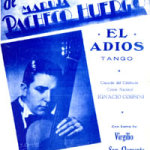
The first source we should always look at is TodoTango. Searching for ‘El Adios’ yields a whole range of interesting sources [1]. First of all, the song was written in 1937 by Maruja Pacheco Huergo, with lyrics by Virgilio San Clemente. Maruja is short for Maria Esther, so the composer is a woman (!), which is rather unusual in tango. San Clemente is known as the author of the waltz ‘Viejo Jardin,’ performed by Carlos Gardel.
The lyrics to ‘El Adios’ can be found on TodoTango[1]. Here is the Spanish version:
En la tarde que en sombras se moría,
buenamente nos dimos el adiós;
mi tristeza profunda no veías
y al marcharte sonreíamos los dos.
Y la desolación, mirándote partir,
quebraba de emoción mi pobre voz…
El sueño más feliz, moría en el adiós
y el cielo para mí se obscureció.
En vano el alma
con voz velada
volcó en la noche la pena…
Sólo un silencio
profundo y grave
lloraba en mi corazón.
Sobre el tiempo transcurrido
vives siempre en mí,
y estos campos que nos vieron
juntos sonreír
me preguntan si el olvido
me curó de ti.
Y entre los vientos
se van mis quejas
muriendo en ecos,
buscándote…
mientras que lejos
otros brazos y otros besos
te aprisionan y me dicen
que ya nunca has de volver.
Cuando vuelva a lucir la primavera,
y los campos se pinten de color,
otra vez el dolor y los recuerdos
de nostalgias llenarán mi corazón.
Las aves poblarán de trinos el lugar
y el cielo volcará su claridad…
Pero mi corazón en sombras vivirá
y el ala del dolor te llamará.
En vano el alma
dirá a la luna
con voz velada la pena…
Y habrá un silencio
profundo y grave
llorando en mi corazón.
The song consists of three verses and is therefore quite long. The three verses can be divided into a first part (8 lines) and a second part (6 lines). Here is the English translation.[2]:
In the afternoon dying in shadows,
very nicely we said farewell;
You didn’t notice my deep sadness
and as you left we both smiled.
And desolation, from watching you go,
broke with emotion my poor voice …
The happiest dream, died in the goodbye
for me, the sky became dark.
In vain the soul
with veiled voice
poured in the night the sorrow …
Only a silence
deep and serious
cried in my heart.
As time has passed
you always live in me,
and these fields that saw us
together, smiling
wonder if oblivion
has cured me of you.
And among the winds
my complaints go
dying in echoes,
looking for you …
while far away
other arms and other kisses
imprison you and tell me
you will never return.
When spring return,
and the fields show their colors,
again the pain and memories
will fill with nostalgia my heart.
Trilling birds will populate the place
and sky will cast its clarity…
But my heart will live in shadows
and the wing of pain will call you.
In vain the soul
will tell the moon,
with veiled voice, the sorrow…
And there will be a silence,
deep and serious
crying in my heart.
Oops, another very sad song that doesn’t quite fit the music at first. That’s just how tango is…
TodoTango refers to YouTube as the video source for the song in a version by Rodrigo y Nacho, which has since been removed from YouTube.
Interestingly, I couldn’t recall ever hearing such a long song during my tango ‘training.’ So I watched Edgardo Donato’s version, and suddenly it clicked. Donato recorded the song in 1938 with Horacio Lagos as the estribillista. An estribillista is a singer who is only allowed to sing part of the lyrics, so the orchestra carries the majority of the song. This resulted in music for dancers with a strong, driving rhythm. You can find more information about the different roles of tango singers here.[3].
This is the version by Edgardo Donato:
Another version of the song was recorded that same year by Francisco Canaro with Roberto Maida as Estribillista (are there any songs Canaro hasn’t recorded?). This song is also frequently played at milongas (according to the DJ). Interestingly, the singer begins with the second part of the first verse (‘En vano…..’) and then jumps to the first part of the verse (‘En la tarde…..’).
http://www.youtube.com/watch?v=CRWyFewC5bo
From there, I began searching for other versions of the song with the complete lyrics. My collection yielded a version by Ignacio Corsini (‘El caballero cantor’). This version was also recorded in 1938, and it featured the entire song.
Another version, in a more modern style, was performed in 1954 by Angel Vargas with the Angel Vargas/Armando Lacava Orchestra. In this version, verses 1 and 2 are sung by the singer, while verse 3 is omitted. The fresh style of the arrangement clearly demonstrates the evolution of tango towards a more sophisticated style.
Another stylistic development comes from one of the great masters of modern tango music himself. Osvaldo Pugliese recorded ‘El Adios’ in 1965 with Jorge Maciel as the singer, in his own distinctive style. The lyrics are also shortened. Maciel now only sings verses 1.1, 2.1, 2.2, and repeats 2.2.
My collection includes two more recordings. One is a beautiful one by Julian Plaza (sung by a female vocalist), and the other is purely instrumental by the Hugo Diaz Trio. This one is simply spectacular, because Diaz’s harmonica playing is truly unique.
Another one comes from Color Tango (Pugliese 2.0) by Roberto Alvarez, sung by Roberto Decarre.
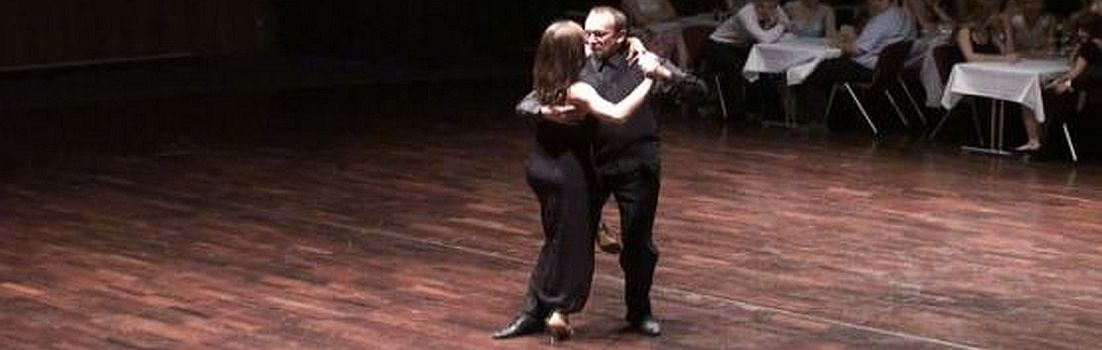
The song is also very popular in tango shows. I find the show by Gustavo Naveira and Giselle Anne, performed in San Francisco in 2008, to be the most spectacular. They dance the Donato version.
This is another example from Sebastian Arce and Mariana Montes, who are dancing the version by Pugliese.
Abrazos,
-Richard
Sources
1 http://www.todotango.com/musica/tema/650/el-adios/
2 https://letrasdetango.wordpress.com/2013/03/29/el-adios/
3 http://www.tangology101.com/main.cfm/title/The-Role-of-the-Tango-Orchestra-Singer/id/946