Normally, when I’m having lectures with other teachers, I ask them about their naming conventions for the steps. I can’t help it—I’m a German academic, and I believe it’s crucial to speak the same precise and descriptive language. The language of tango, of course, is leading and following, good balance and projection, and caring for our valued partners. Without this language, there is no real tango. Tango is all about communication and finding a nonverbal way to communicate and connect. That’s what we love and what we constantly strive for. I usually divide my time between private lessons and my own practice, which I use to perfect my skills and overcome my frustration when progress is slow.
When practicing and teaching tango, it’s important to talk about it, and this is where the problems arise. It seems there aren’t many common terms used in tango discussions. Asking Argentinian teachers about naming conventions is particularly frustrating, as they usually either don’t know the traditional Argentinian teaching method, which simply involves copying examples from other teachers, or they refer you to it.
So what are the basics of this business? First of all, there’s the basic step (‘el básico’), which seemingly no one loves—but everyone uses it in lessons (for foreign tourists). The numbers of the 8-count basic steps are unique and frequently used in regular lessons. ‘Dance 1–5, lead lady forward in ocho and…’ is one such commonly used instruction that employs the step number of the basic step. Naming parts of the basic step (often also classified as follows: 1–2 introducion, 3–5 salida, 6–8 resolucion) is, in turn, not very common, and the term salida can be used in many logical contexts.
Even this uniqueness can be compromised by many teachers who start with the second step. I must admit, there are good reasons for this, and I usually start with the side step (apertura) as well, but starting with step number 2 isn’t really pleasant to teach…
Of course, we learn techniques in class and how to apply them in social dancing. Tango websites usually offer a list of tango techniques. This blog’s list, or two other very comprehensive lists from other websites (which I consider highly reliable), can help with this:
http://tango.rstoll.com/tango-terminologie/
http://www.tejastango.com/terminology.html
http://www.verytangostore.com/tango-terms.html
These lists typically describe the terminology we need for the technical elements and basic Spanish words in tango and Spanish lessons. Generally, they are quite good, but the definitions of individual terms can be vague. They are helpful for everyday tango practice, but only of limited use when writing out a choreography.
It’s important to talk about choreography because sometimes you need to write down the steps. I know we live in the age of video cameras, but what if the teacher at the next workshop doesn’t allow video recording (this happened, for example, at a very popular tango school in Buenos Aires)? Or what if you want to write a choreography that has to fit a specific piece of music perfectly (this is the typical situation when preparing for a show dance).
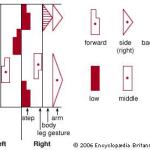
Tango choreography is typically very personal and usually not intended for public consumption (I couldn’t find a good example of written choreography online). Choreography is generally imperfect, as it doesn’t reflect actual body movements. Professional systems for this are difficult to master and not very practical. A good example is Laban notation (correctly: Labanotation) [1], which is typically used in modern dance. In partner dances, the steps are directly choreographed, along with additional information on the degree and direction of the turn, dance posture, and rhythm.
Choreography is always difficult. With highly standardized dances like international ballroom dances, where steps and degrees of turn are very well standardized, it’s somewhat easier. It becomes more difficult with Latin American dances, and with dances that have a low degree of standardization, like salsa, it can be a real challenge. With tango, it’s a real problem because there aren’t many clear definitions we can refer to. This makes it difficult to write choreography for yourself, and even more difficult when you have to write it for someone else. I have no idea how you could solve this problem (without a video camera). To illustrate the challenge, here’s an example of a piece of choreography I wrote:
1-2 Basico                                    SS
3 Basico, LF forw. Sacada                     SS    Back/Side/Ocho for Lady   QQS
Close (forw. enrosque) / Bw Sacada            QQ    Lady side step            S
Calesita turning left with small bw. steps    QQQQ  Lady off axis (no step)
RF to side                                    S|    Lady recover
LF fw.                                        S     Lady LF bw.  (cross system !)
RF Sacada to side/back into open step of Lady S     Lady RF bw.
Stay on RF                                    S     Voleo (Lady) with LF       S+
LF close, RF to Salida Americana (PP)         +S    Lady LF forw. into Sal.Americ.
wait and uncross (receive Gancho w. left leg) SSS   Giro left to Gancho
Change weight to RF, LF close                 +S|   Lady RF forw Ocho          S+
Have fun dancing along!
-Richard
Literature
1 http://en.wikipedia.org/wiki/Labanotation