I’ve been accused of placing too much emphasis on modern and neo-tango music on this blog. I agree, I admit it, and I regret it. I would actually like to start a new series of articles with a more traditional focus, but I want to concentrate again on musical topics and some basic knowledge for experienced tango dancers.
There are some typical tangos that everyone knows and that most of us can identify and name by their original Spanish title. These (let’s call them ‘great tangos’) were usually played by different orchestras and have a firm place in international tango folklore.
Some of them have a story to tell. Some have a very special text, some none at all. Some are difficult, some are easy.
Today we begin with the tango ‘Nueve de Julio’ or ‘9 de Julio’. This tango is purely instrumental, not particularly demanding in its original form, but it is famous and everyone knows it.
Here is the interpretation by Jorge Mosso (bandoneon solo), who plays the song (almost) in the original style:
Okay, first off, it’s not exactly a musical gem, but interestingly, that’s precisely what made the song a ‘big’ song. Let’s take a closer look at the song first. Tototango[1] provides us with a free image of the sheet music.
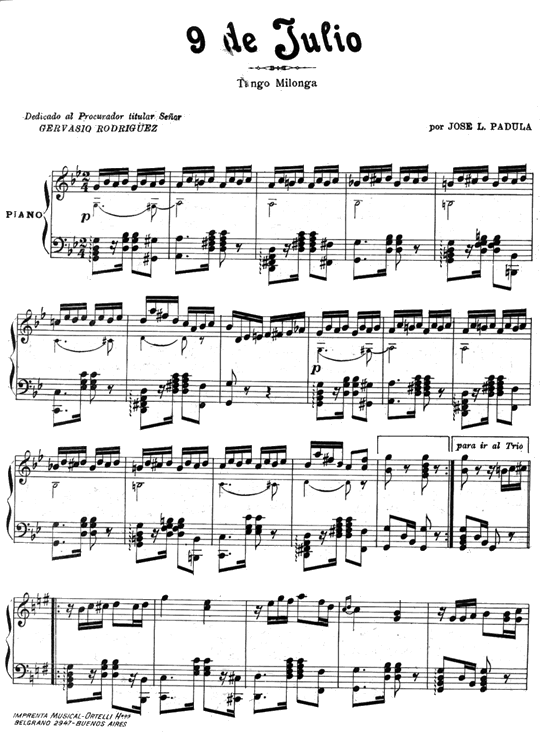
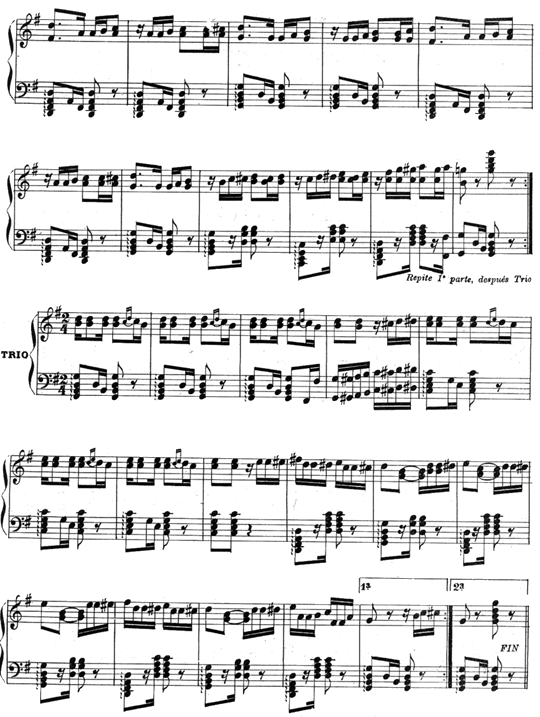
In the piano version, the song is written in 2/4 time and begins in G minor. The left hand plays a habanera rhythm, the right hand the melody. The song actually consists of three parts. Part A is the main theme, which comprises two sets of eight bars and is repeated once, so this part looks like Part AA.
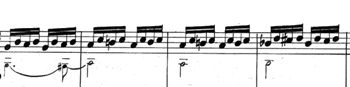
Then a B section is played, which in turn consists of 2×8 bars and is repeated again and can be written as BB.

Part A is repeated (‘repite primera parte, despues trio’), and then a third part follows, called the Trio, which again consists of 2 x 8 bars that are repeated. I write it as CC.
![Part C (trio), only the first 4 bars, taken from [1]](http://tango.5toll.com/wp-content/uploads/2014/01/Part-C.jpg)
The overall structure is therefore: AABBAACC. The piece of music can thus be described as a ternary song structure (ABA) [2]. It can be classified with an additional Part C. The name ‘Trio’ comes from the old minuet form, in which a purely instrumental section stood between two minuet dances [3]. This part was usually played with three instruments, hence the name ‘trio’ (musical piece with three instruments). In fact, here the additional part is referred to as the trio.
The song was composed in 1918 by Jose Luis Padula in Rosario, without vocals. Jose Luis, who lived there as a poor bohemian, sold it for only 5 diners to a Mr. Trebino [4]. Orchestras adapted the song, adding their own contrecantos and even additional parts. Here is a 1930 version by the Orquesta Luis Petrucelli, which plays the typical contrecantos that became popular in later orchestral versions:
So what happened on July 9th (July 9th)? On July 9, 1816, the Congress of Tucumán declared Argentina’s independence from Spain and established it as a state. In Argentina, this day is celebrated as a national holiday. The Avenida de 9 de Julio (with the obelisk at its intersection with Avenida Corrientes) is the widest street in the world [5].
Back to the music. Many orchestras have played ‘9 de Julio.’ The most famous of these is the orchestra of Juan D’ Arienzo, the master of rhythm. It’s very likely you’ll hear one of his versions at a milonga. With his distinctive staccato rhythms, he remains to this day a paragon of rhythmic power. Juan D’ Arienzo usually plays his songs in the standard style, but adds a final section to each one, in which he demonstrates his rhythmic prowess in a very special way. This final section is called the ‘Variacion.’ Please listen carefully to his typical interpretation (the Variacion begins here at approximately 2:40):
Numerous versions by other artists can be found online. These artists have mostly performed the piece in their own interpretive style or applied the typical musical style that was fashionable for the respective season. Here are just a few examples:
The first version is a gentler version played by H. Salgan, the second by O. Pugliese (my favorite), and the third is a more contemporary interpretation by Collectif Roulotte Tango, which adheres very strongly to the traditional sound and even to the variation of the great master himself – a true homage to Juan D Arienzo.
Finally, let’s turn to the dance aspect of tango. Couples performing to ‘9 de Julio’ are easy to find.
Here are two examples: Pasi & Maria Lauren performing in Finland and Julio Paloma & Maximiliano Alvarado from Chile at a stage tango competition.
Finally: Why is this tango such a ‘great’ tango? In my opinion, it began as a simple piece of music, and the conductors had to add the contrecantos, which became an integral part of the song. The simplicity of this song allowed it to be refined by various orchestras into a beautiful and well-known tango piece.
Abrazos,
-Richard
Literature
1 http://www.todotango.com/spanish/las_obras/partitura.aspx?id=2173
2 http://en.wikipedia.org/wiki/Ternary_form
3 http://en.wikipedia.org/wiki/Minuet
4 http://www.todotango.com/spanish/creadores/jlpadula.asp
5 https://en.wikipedia.org/wiki/9_de_Julio_Avenue