During the second tango craze, Berlin was one of the capitals of tango[1]. Original Argentine orchestras played here, and German orchestras also tried to copy the popular tango music. People were crazy about it and demanded more. In 1928, a tango was even incorporated into Kurt Weill’s ‘Threepenny Opera.” [2].
http://www.youtube.com/watch?v=ARfumOj5GLw
Especially in Berlin, large ballrooms opened, including the ‘Femina’, with four floors, 400 tables for 2000 guests and four dance floors [3, 4]. The tables were even connected to telephones [5]. In European capitals, authentic Argentine orchestras performed, including one conducted by Francisco Canaro’s brother, who played in ‘gaucho’ attire. The situation was captured in a tango by Friedrich Holländer: ‘Don’t always look at the tango violinist’. The song was performed by several singers, including Curt Bois, Leo Monosson, and Weintraub’s Syncopators.
http://www.youtube.com/watch?v=wAQZO3cGURQ
https://www.youtube.com/watch?v=OvbkFd8YJZ8#t=12
http://www.youtube.com/watch?v=UhZ98wnPcUg
Interestingly, the composer Friedrich Hollaender sings the refrain in the last example himself.
The song describes a man complaining that his wife/girlfriend is always looking at the tango violinist, who is wearing a uniform jacket (like a monkey…). Here are the German lyrics and the English translation:
Gugg doch nicht immer nach dem Tangogeiger hin, was ist schon dran an Argentinien ?
Du siehst ja garnicht dass ich auch noch bei dir bin, ich hab doch auch ganz schöne Linien.
Der Junge wirkt auf Dich wohl „spanisch“, jedoch aus Dir macht er sich gar nichts,
Also bitte: Gugg doch nicht immer nach dem Tangogeiger hin, was ist schon dran an Argentinien !
Sicher ist es bloß die olle Uniform, die wirkt wie Chloroform auf jede Frau,
zöge ich mir so ne Affenjacke an, fängt sie mit mir was an, ich weiß genau.
Doch ich verschmähe gottseidank solche Tricks, mich muss man lieben wie ich bin, oder nix,
Wenn sie sich verknallt, bitteschön – mich lässt es kalt.
Don´t always look at the Tango fiddler, what is all about Argentina ?
You don´t notice that I am with you, I am also looking quite handsome.
This guy looks for you really Spanish, but he doesn´t notice you at all.
So please: Don´t always look at the Tango fiddler, what is all about Argentina ?
Surely it is only the old uniform, it works like chloroform for all the women.
If I would wear such a monkey jacket, she would fall in love with me, I am sure.
But I dislike such tricks, I want to be loved like I am – or not at all.
If she falls in love – well I don´t care.
Apparently, the composer saw some Argentinians in distinctive outfits (perhaps the Canaro Orchestra). Furthermore, the Germans were somewhat envious, but certainly knew that tango originated in Argentina. In the first video, you’ll see pictures of Curt Bois, and perhaps you’ll recognize one of them. Curt Bois had a small role in the 1942 film Casablanca, so you may have seen him before.
German orchestras attempted to copy the Argentine style of tango playing, but were mostly unsuccessful. There are two reasons for this. Even in the country that invented the bandoneon, these instruments were not present in dance orchestras and, if they appeared at all, were usually replaced by the accordion. Another problem is the way rhythm is generated within the orchestra. One of the most important characteristics of Latin American music is the fact that all instruments create rhythm together. For a European orchestra, the roles of rhythm and lead instruments are fixed and not variable. Thus, in later stages, the rhythm is created by drums, and the essential characteristic of the original tango is neutered into a militaristic quagmire.
There were good musicians who truly studied tango. One of them was Juan Llossas, a native Spaniard who began his career in Latin America and studied music in Germany (Darmstadt and Berlin). There he founded his Spanish-Argentine Tango Orchestra. This orchestra played when the Femina opened in Berlin in 1929[6]. He was called the German ‘Tango King’. Here are three of his pieces, the second sung by Leo Monosson:
http://www.youtube.com/watch?v=-Bqau5DcieI
http://www.youtube.com/watch?v=2lS_JpLWS58
http://www.youtube.com/watch?v=PI-sJwAaTQc
Other orchestras played European compositions, here an example of Donna Clara (originally a Polish composition by Petersburski), here the orchestra of Marek Weber:
http://www.youtube.com/watch?v=qrazWuIyty8
Here is another example from L. Bernauer, from 1929:
http://www.youtube.com/watch?v=hjjzKVGibcE
and another song by L. Monosson:
http://www.youtube.com/watch?v=6CR1x9TqYRk
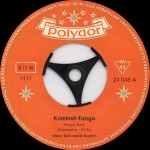
After World War II, the era of German tango hits came to an end. One of the last was Hazy Osterwald’s ‘Kriminal Tango’ from 1959 [7]:
http://www.youtube.com/watch?v=N7Rg2qCHyuQ
Today, modern orchestras play nostalgic tangos in the original style of the 1920s. One final example is Max Raabe’s Palast Orchester:
http://www.youtube.com/watch?v=Fj7QM4KzfwE
Have fun,
-Richard
literature
1 http://de.wikipedia.org/wiki/Deutscher_Tango
2 http://en.wikipedia.org/wiki/The_Threepenny_Opera
3 Birkenstock A, Rüegg H: Tango – History and Stories. DTV, 2001.
4 http://de.wikipedia.org/wiki/Femina-Palast
5 https://anthropologist.wordpress.com/2008/10/29/the-cultural-life-of-berlin-circa-1933/
6 http://de.wikipedia.org/wiki/Juan_Llossas
7 http://en.wikipedia.org/wiki/Kriminaltango