
A DJ’s job is to compile music. Interestingly, this also requires good documentation of the tracks in their collection. Knowing the title and orchestra is particularly important, which is usually not a problem. It becomes more complicated when an orchestra has recorded a track multiple times. This is especially difficult with artists like Carlos Di Sarli, who re-recorded many tracks with each change of orchestra or singer. Therefore, information about the recording session, matrix number, source (vinyl), and so on is crucial. My colleagues place great emphasis on accuracy here; I admit I take a simpler approach. I think that the year of recording is both important and sufficient. For my tandas, I always include the year of the track.
Where can one actually obtain this information, especially if the CD in question is only available in digital form or stored in some box in the attic?
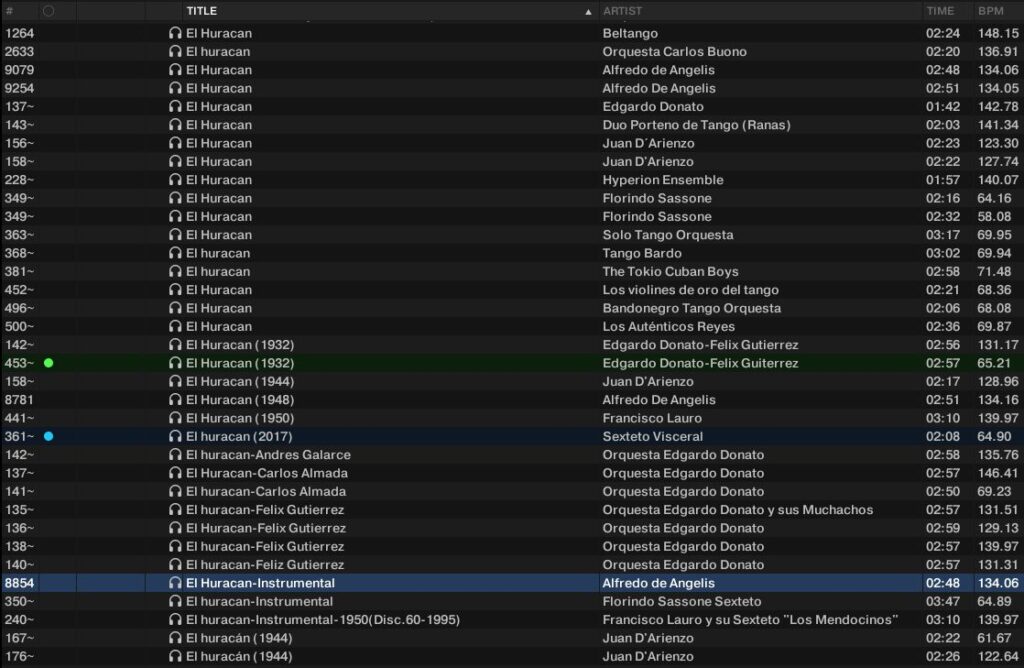
First of all, an internet search is helpful. Most tangos can be seen and heard on YouTube, so let’s do a search. I had planned a tanda a few weeks ago and I’m looking for the piece ‘El Huracan’—no, not D’Arienzo’s version, but Edgardo Donato’s. My search in my DJ software’s database immediately yields many results (Fig. 1).
A search using the keywords ‘Donato & Huracan’ reduces the results somewhat (Fig. 2)..
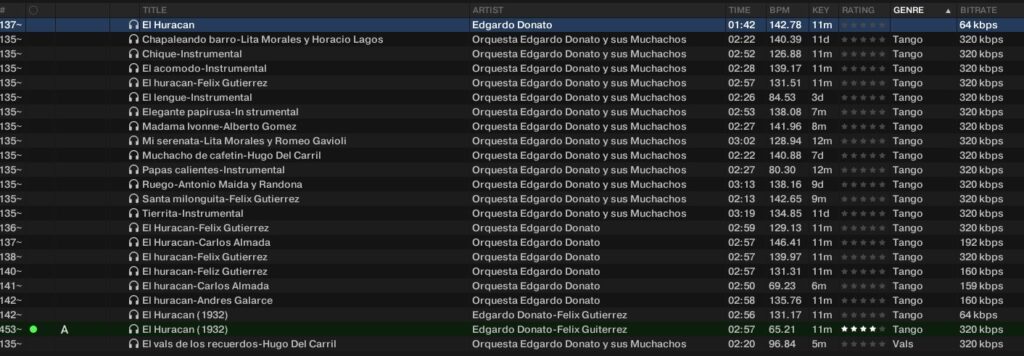
About half of the results are correct; why the top half refer to completely different pieces is a mystery known only to the gods of bits and bytes. I’m happy here because I’ve already played this piece with the singer Felix Guiterrez (marked here with the green dot), so the year 1932 is already entered.
Had I not already possessed this information, my next step would have been to search the internet. However, the search itself isn’t very helpful and only creates confusion, especially since other dates also appear. Using a tango database is helpful here. So, we go to Tango.info and search for El Huracan (Fig. 3).
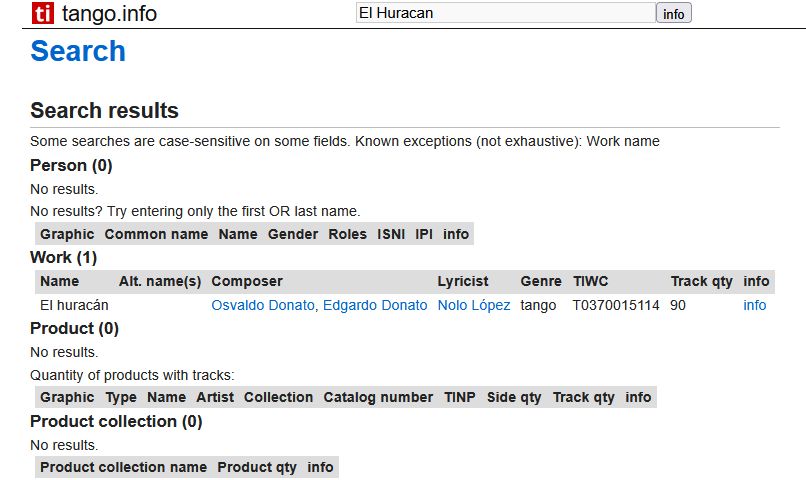
The title is found under ‘Work,’ and we note the composers Osvaldo and Edgardo Donato, as well as the lyricist Nolo Lopez. The database contains 90 entries for this title, which we can view by clicking on ‘info’ (Fig. 4).
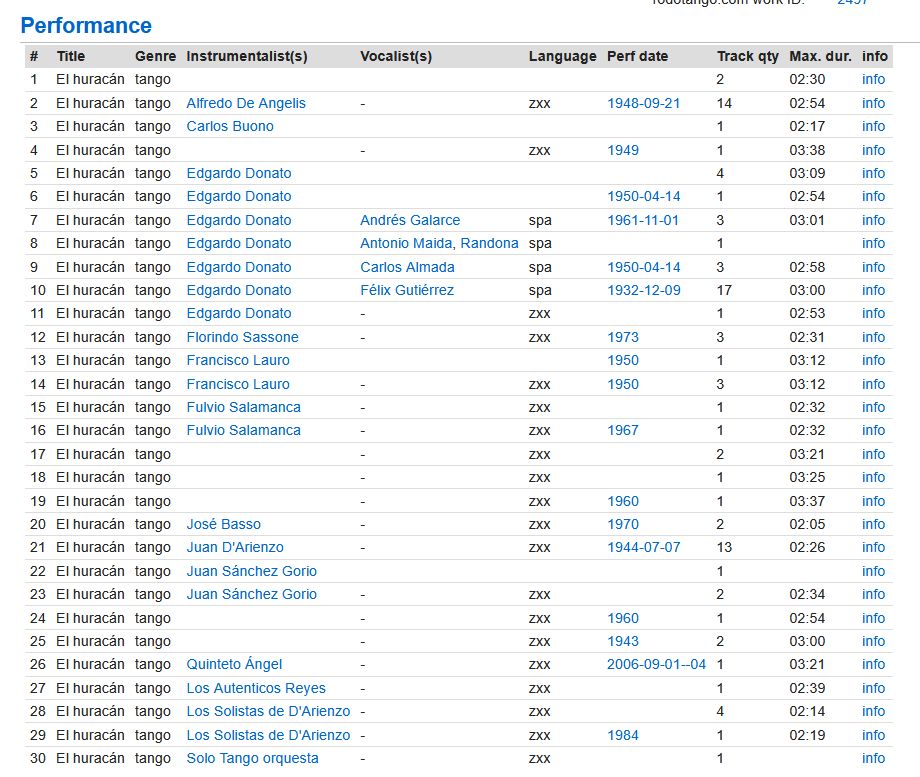
Here we see 30 results, some of which are familiar to me. The version I’m looking for is No. 10 from 1932, with a total of 17 releases (tracks). The D’Arienzo recording is No. 21 from 1944. The information for the Donato version I’m looking for provides not only the title but also the publication information, i.e., on which records the title can be found (Fig. 5), and also gives the precise recording date, 1932-12-09, if needed.
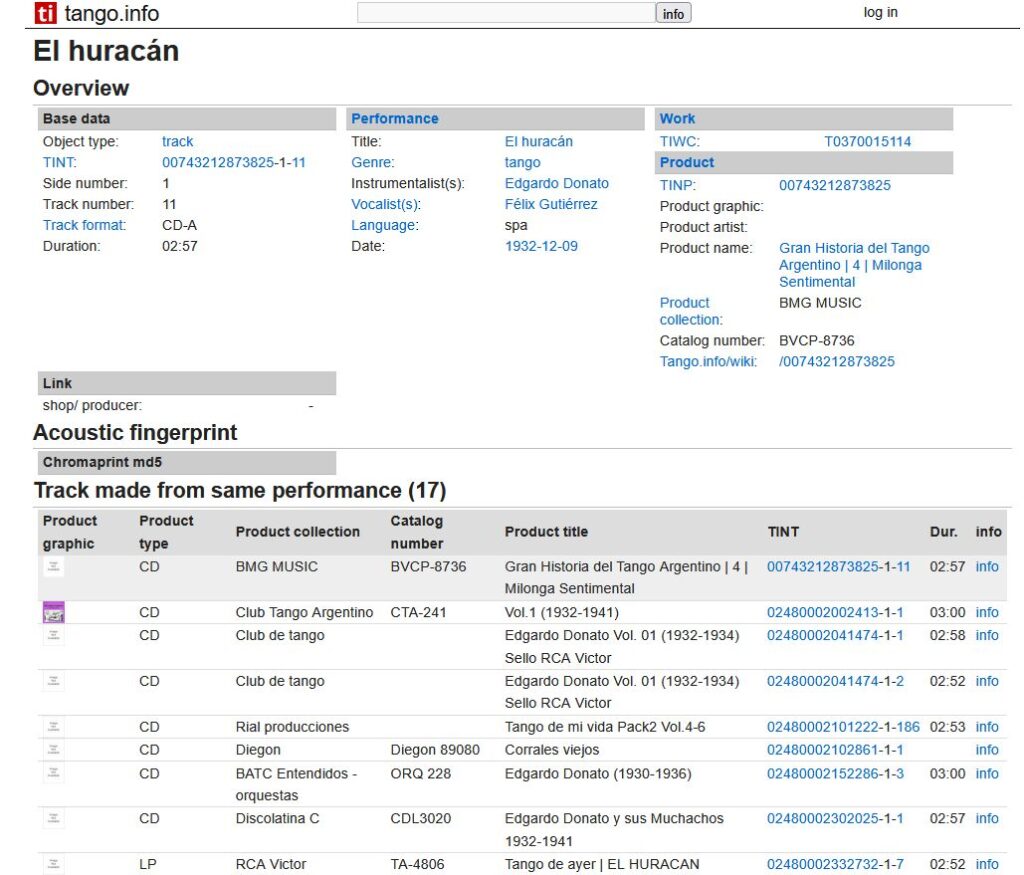
Fig. 5: Information in the database about the recording of Donato with Guitierrez as singer that we were looking for (excerpt).
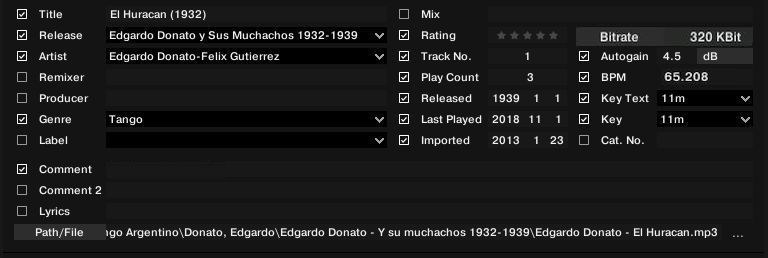
Since my database also generates the record titles (ordered as a directory), I can easily check which album my version comes from. In this case, it’s the CD ‘Edgardo Donato y su muchachos 1932-1939’ from the collection ‘El Bandoneon’ (Fig. 6).
All this information can be stored locally, but the year is enough for me. Just to conclude, my Donato Guitierrez Tanda:
Que Haces, que haces (1933) Edgardo Donato-Felix Guitierrez
La Novena (1933) Edgardo Donato-Felix Guitierrez
El Huracan (1932) Edgardo Donato-Felix Guitierrez
However, at the Milonga I spontaneously swapped La Novena for another song; I think it was a song with Horacio Lagos as the singer.
-Richard