What is a perfect tango? For me, it’s a song that is musically interesting both harmonically and rhythmically, features a melodic contrecanto, has a good dose of polyphony, is well-instrumented, and comes with lyrics that have the potential for the vocal expression of emotion and drama. “Quiero verte una vez mas” is by no means the perfect tango, but it has many of the qualities from the list above.
A popular piece at milongas, performed by many different orchestras, it’s probably familiar to most milongueros. Less well-known, however, are some of its background details. It was composed in 1939 (?) by Mario Canaro. Mario is the youngest brother of Francisco Canaro, born in Buenos Aires in 1903 (as a reminder: Francisco was born in Uruguay in 1888) [1]. Mario was therefore 15 years younger than Francisco [2]. In 1927, Mario traveled to Paris with Francisco, where he received musical training at the Bruselas Conservatoire [2]. Of his relatively numerous compositions, “Quiero verte una vez mas” is one of the best known, along with “Corazon de Artista” and “Oigo tu voz.” He played violin, bandoneon, and double bass in various family orchestra formations. After the death of Francisco Canaro, he continued to lead the Quinteto Pirincho for some time. He died in 1974.
Also of interest is the text written by Jose Maria Contursi (born 1911 in the Barrio Lanus, died 1972). To get straight to the point, Jose Maria, nicknamed “Katunga,” was the son of Pascual Contursi, one of the most famous lyricists in tango (born 1888, died 1932). Pascual’s lyrics tended to depict rather depressive stories of loneliness and unrequited love. Among other things, he was also responsible for the revised lyrics of “La Cumparsita.” It is said that his depression and early death were likely due to the long-term effects of a syphilis infection [3]. Jose Maria followed in his father’s footsteps and became a tango poet, writing the lyrics to many famous tangos. He also worked on the 1952 tango film about his father’s life, “Una Noche Triste.” In addition, he was an announcer for the radio station Stentor, a civil servant in the Ministry of Agriculture, and secretary for SADAIC (the musicians’ advocacy group founded by Canaro) [4].
First, here is the version by Canaro with Enrique Rondo as the singer from 1939:
Here is the text in Spanish [5] and English:
| Tarde que me invita a conversar con los recuerdos, pena de esperarte y de llorar en este encierro… Tanto en mi amargura te busqué sin encontrarte… ¿Cuándo, cuándo, vida, moriré para olvidarte?Quiero verte una vez más, amada mía, y extasiarme en el mirar de tus pupilas; quiero verte una vez más aunque me digas que ya todo terminó y es inútil remover las cenizas de un amor…Quiero verte una vez más ¡Estoy tan triste y no puedo recordar por qué te fuiste! Quiero verte una vez más y en mi agonía un alivio sentiré y olvidado en mi rincón más tranquilo moriré. Noche que consigues envolver |
The evening invites me to conversation. with my memories, the sorrow of waiting for you and crying in this prison……. I searched for you so much in my sorrow. without finding you… When, when oh life, shall I die? To forget you? I want to see you one more time. my beloved, and intoxicate me with the sight into your eyes. I want to see you again, even if you tell me that it’s all over and that it is useless To remove the ashes of a love.I want to see you again, I’m so sad and I can’t remember Why did you leave? I want to see you again, and I will be in my agony Feeling redemption and left in my corner die in peace. night that succeeds |
The protagonist of this text has been abandoned; let’s assume for the moment that we’re dealing with a man who, depressed and defiant, hides away in a corner and would rather die, yet still longs to see his lover one last time. This is the perfect story for a tango: not the glamour, but the misery of machismo.
Comparing the lyrics with Canaro’s recording, one notices that Canaro omits the second verse, “Noche me consigues…”. This is common practice in most recordings, likely due to recording time constraints.
The song has subsequently been recorded by many other orchestras. Here is the 1964 version by Juan D’Arienzo with Jorge Valdez, also without the second verse:
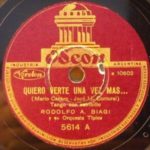
Rhythmically somewhat more demanding is the version by Rodolfo Biagi with Jorge Ortiz (1940):
A slightly calmer version is Francisco Lomuto’s 1940 version with Fernando Diaz. Please ignore the advertisement shown in the video.
https://www.youtube.com/watch?v=V0CY3M1xaWE
Here’s a rare little gem: a film recording of Libertad Lamarque singing this song. The clip is from the 1950 film “Otra Primavera.” Here, exceptionally, the second verse is sung.
The recording by Osvaldo Pugliese, also from 1950, with Alberto Moran, should not be omitted here.
Here’s a slightly more dramatic version from Jorge Falcon:
https://www.youtube.com/watch?v=vxWczUD_zYo
Just out of interest, here is the song sung as a ranchera by Chayito Valdez:
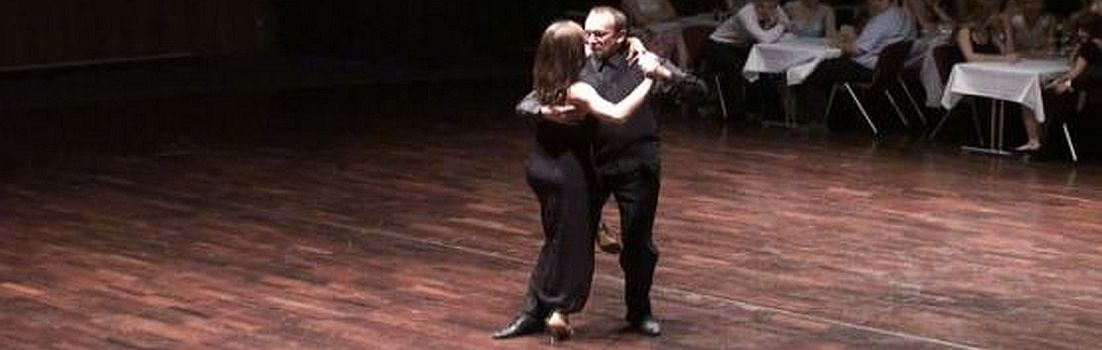
And finally, a guitar version of Adolfo Beron danced by Mariano “Chicho” Frumboli and Juana Sepulveda:
Literature
1 https://en.wikipedia.org/wiki/Francisco_Canaro
2 Ludwig E, Tango Lexikon, Lexikon Imprint Verlag, Berlin 2002. S. 107
3 https://todayintango.wordpress.com/2011/05/11/1972-may-11-j-m-contursi-dies-in-arms-of-oscar-iacobelli/
4 http://www.todotango.com/creadores/biografia/60/Jose-Maria-Contursi/
5 http://www.todotango.com/musica/tema/180/Quiero-verte-una-vez-mas/