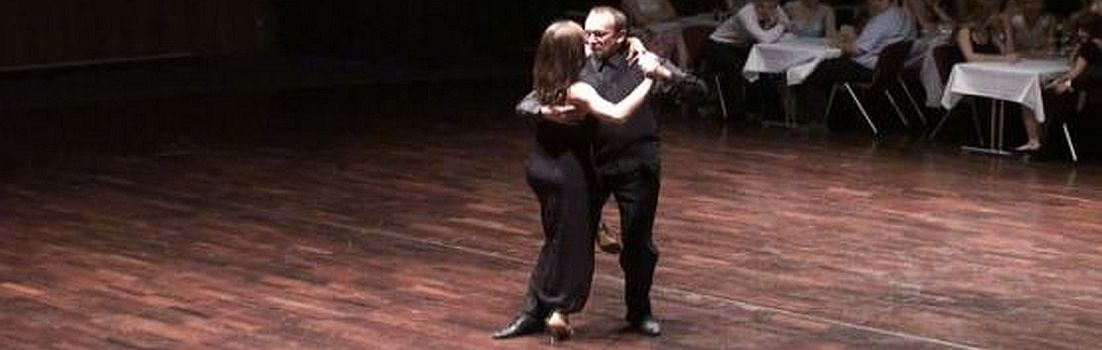
Many dancers enjoy showing off their skills on the dance floor. Good dancers do this at competitions, in exhibition dances, or at dance events; less skilled dancers sometimes do too, and yet…
I’m bringing this up because yesterday I wanted to show a friend—not a dancer—that tango is different from what the average person outside of Latin America imagines. So I watched a random YouTube video with her (well, it was from one of the better couples) and immediately got the question: “Is that scripted?” I replied with a resounding, “Of course!” A few glasses of Malbec later, I unintentionally started brooding over the situation.
Couples performing in shows have the opportunity to determine the style of their dance through their choice of music and to tailor their choreography to the music and the audience. I already learned how to develop choreography to music from one of my tango teachers.
Even a typical tango at a milonga is, in a sense, choreographed. I’m thinking of the final bar of the music, which leads into a simple closed final position or a more or less expansive pose (pose final) in the tango escalation. When I mentioned this to another teacher, he told me that one simply had to understand the structure of the tangos. I then spent over ten years searching for a common structure, only to be told by a truly excellent international teacher that there isn’t one. Instead, good milongueros have simply heard the pieces (100-200 times) so often that they know the ending by heart and can therefore plan the last two or three bars in advance.
Back to show dancing. Even in ballroom dancing, I learned from good coaches that choreography is built around the music. Since the pieces aren’t known in advance at competitions, one takes advantage of what is certain: that pieces are usually played in phrases of 2, 4, 8, or 16 bars. Choreography is therefore tailored to these phrases. Among dancers, there’s always been a debate about whether this is worth the effort, because you’re often interrupted on a competition floor and can lose synchronization. This does happen (especially since competition is a competitive arena), but if it does, you’re no worse off than other couples. However, if you can present your dance phrase-synchronized, you have a clear advantage in the judging because you’ve simply danced the music better.
Back to tango. If a couple performs a show, which is quite common in Argentina both in milongas and at tourist events, they have the choice of dancing a choreographed routine or improvising. In my experience, only the truly skilled dancers improvise; the vast majority of couples choose a piece of music and choreograph a show to it, which should be more or less well-suited to the music. With this approach, the music is first analyzed by counting the bars per phrase, which isn’t as simple as in European ballroom dancing because the phrases and interludes can vary in length. Then the phrases are classified and choreographed and rehearsed with appropriate movement elements. The real art lies in coordinating dance and musical accents (e.g., a gancho on a single piano note).
Today’s example is the tango “El Puntazo” (The Puntock/Horn Blow), composed by Alejandro Junnissi and first recorded by Juan D’Arienzo in 1952. “El Puntazo” is, to my ears, a fascinating piece of music. The theme is banally simple, the countertento pleasing, the cadenzas rather straightforward—but the rhythm! It seems that the simple main theme has no inherent meaning, existing only to allow the composer to revel in rhythmic variations and syncopation. It’s difficult to discern whether the tango was intentionally composed this way or whether D’Arienzo forced it into his unmistakable style. I suspect that both are somewhat true. Individual elements can also be heard in other compositions by Junnissi, who, incidentally, was a bandoneon player for Pedro Maffia. In any case, all modern recordings are based on D’Arienzo’s version. For the musicians, the high tempo and rhythmic complexity are definitely hard work.
So here is Juan D’Arienzo:
Here’s a video showing what it looks like when a modern orchestra plays this piece in the style of D’Arienzo:
I would like to compare some show performances on “El Puntazo” here. Let’s start with the heavyweights: Sebastian Achaval (World Champion in Tango Salon in 2005) and Roxana Suarez, his partner since 2007, are dancing “El Puntazo” here in 2010:
What we see is a technically perfect tango of a high caliber. The speed of the execution is truly impressive. However, it’s difficult to say whether this performance is choreographed; the dynamics remain almost consistently at the highest level, and aside from the excellent dancing in time with the music, a connection to the music itself isn’t really apparent.
Quite different is the show by “Chicho” Frumboli and Juana Sepulveda, with a distinctly different dance style. As in the previous example, the dancing is extremely fast, but with much more pronounced tempo changes in different phrases. The show is presumably choreographed. The music is live, performed by Solo Tango.
A bit calmer here are Maja Petrovic and Marko Miljevic at the “Tango Mi Amore” festival 2015 in Pisa:
Here’s Paola Sanz and Facundo de la Cruz in 2014, dancing in Los Angeles.
My absolute favorite is the show by Esref Tekinalp and Vanessa Gauch Arabacioglu. This performance was filmed in Istanbul in 2014. Their approach to choreography is to emphasize show elements at the appropriate moments in the music, incorporating simple rhythms and show elements such as alternating high kicks and jumps (e.g., at 2:16). Compared to other shows, the focus here was clearly on the music, which was presented with a touch of humor to appeal to the audience.
Finally, a rare opportunity to see several tango teachers dancing in a group show, “El Puntazo” (Taipei, 2013). I think it’s safe to assume that this was improvised.
Conclusion: For me, it’s clear that in show performances, the advantage (familiar music, choreography) cannot and should not be relinquished. Especially with such a fascinating yet difficult tango as “El Puntazo”.
Greetings,
-Richard