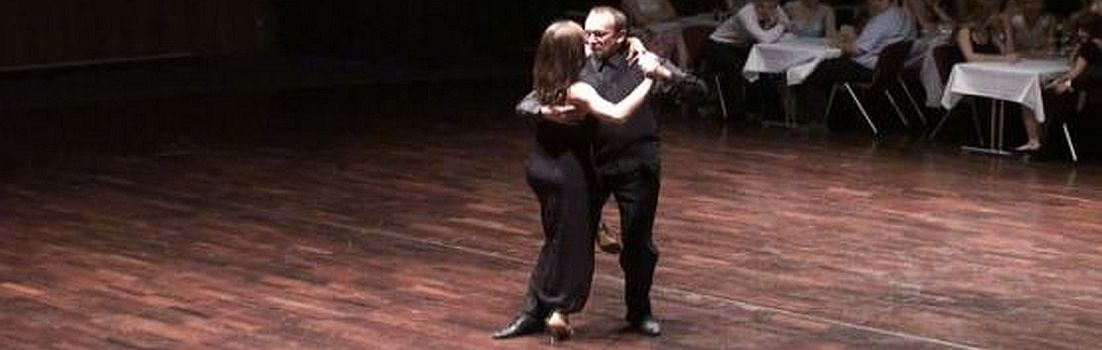
Let’s go to a milonga together. I’m a bit particular about this, because I often choose my dance partners (with their consent, of course) based on the character of the music (and the character of the woman in question). Accordingly, I get annoyed when a tanda starts romantically but then develops into something completely different. Like many other milongueros, I want my music to be predictable. That’s why the tanda/cortina system was invented a long time ago. As a DJ, I’m expected to use it, and I adhere to it, regardless of the milonga’s format, even for practicas. A tanda is a set of 3-5 pieces of music that lasts about 10-15 minutes and is musically and character-wise homogeneous. Cortinas are simply signals to the dancers that the tanda is over and a new one is about to begin. Let’s take a closer look at this system:
- Cortina
In a very traditional milonga, after the tanda, couples are expected to leave the dance floor and prepare for the next tanda, engaging in the popular cabeceo game. In old Buenos Aires (and not only then), cabeceo were exchanged across the dance floor. People on the dance floor disrupted this visual, wireless communication. Therefore, the cortina, more or less non-danceable music, was played between the tandas. Cortinas in Buenos Aires, and especially on larger dance floors, can be quite long (1-1.5 minutes) to ensure the entire dance floor is clear. Interestingly, there are now efforts in Europe to return to this system. A DJ generally acts as the master of ceremonies and should adapt to the customs and traditions of the (local) milonga. If you assume approximately six tanda cycles (36 tandas and 35 cortinas) at a longer milonga, guests will spend almost half an hour listening to cortinas. The DJ should therefore make the cortina short enough to clear the dance floor noticeably. I have cortinas between 20 and 60 seconds to adapt to this situation. According to the codigo (milonga etiquette), dancing the cortina is considered bad manners, but there are always some who don’t know this. It’s the DJ’s job to play truly undanceable music. There are no other rules. It’s up to the DJ’s taste whether they want to play jazzy swing or the theme song from “Game of Thrones” as their cortina. I cut my cortinas to the appropriate length at home and make sure I choose a reasonably complete musical phrase for it. The cortina is something you get used to (a kind of training exercise?), and the audience usually has to adapt to it for three or four tandas. Personally, I play one good cortina per evening. Some DJs use one per tanda cycle, while others change it after each tanda. I don’t want to judge too much here, but as a milonga guest, I feel irritated by the latter approach with >30 new Cortinas.
Should a cortina be played at all? Some tango DJs don’t play one, and they give good reasons for doing so. I always play a cortina for official milongas, but not for practicas and neolongas. However, I always stick to the tanda system.
- Tandas
A tanda is a homogeneous group of 3-5 musical pieces. Generally, one should construct groups of 4 tangos, 3-4 waltzes, and 3 milongas. Only for very short milongas do I prefer groups of three tangos to present a greater variety of characters within the milonga. For very long neotangos, two musical pieces may be sufficient to adhere to the general time guideline of 10-15 minutes per tanda.
Apart from the homogeneity of the Tanda, there are no other rules, and these can be broken at any time without reason.
A DJ should always remember that their job is to get couples onto the dance floor. The usual strategy for this is to start a tanda with a strong and energetic track that gets people onto the dance floor, regardless of how tired they are.
Another powerful piece should leave people with a good and satisfying feeling at the end of a tanda. The remaining pieces (numbers 2 and 3) can therefore be weaker. This is generally accepted knowledge, but the principle can be modified, especially if a tanda is meant to transition between two characters. I personally adapt my tandas according to my strategy and the demands of the dance floor. For example, if I want to reduce the energy, I start with a strong piece and develop the tanda towards less energetic pieces, but always within the established character.
When constructing a tanda, I always strive for a consistent character. The simplest way to achieve this is to use only one orchestra with the same singer from the same period. Some DJs go so far as to aim for tracks from the same recording session, which I find difficult to maintain. Let’s look at an example. I love early DiSarli tangos from the Sextetos period (1928-1932). These have wonderfully simple rhythms and charming contrecantos. So, I want to construct a tanda with Ernesto Fama as the singer and first select two strong pieces: Chau Pinela and Flora, followed by two weaker pieces, in this case: La Baguala and La Estancia. Even though these pieces meet all the criteria for a consistent character, the strong pieces begin with a catchy rhythm, while the weaker ones have a more romantic feel. Therefore, in a rhythmically driven phase of the milonga, I tend to choose the stronger pieces for positions 1 and 4. Looking at the tempo, it’s noticeable that La Baguala is the slowest piece, which is why I’ve placed it in third position to emphasize the contrast with Flora. This contrast is also reflected in the tonality, which I won’t discuss in detail here. So my tanda would be:
Chau Pinela (1930) Carlos Di Sarli(Sexteto)-Ernesto Fama 124 BpM Gbm
La Estancia (1930) Carlos Di Sarli(Sexteto)-Ernesto Fama 128 BpM Bb
La Baguala (1931) Carlos Di Sarli(Sexteto)-Ernesto Fama 117 BpM D
Flora (1930) Carlos Di Sarli(Sexteto)-Ernesto Fama 127 BpM Ab
This tanda is homogeneous, which was easy to achieve here. It becomes more difficult with mixed tandas. Tandas with multiple singers are extremely difficult to construct. In case of doubt, it’s easier to add instrumental tracks. As an example, we want to enhance the tanda above more in the style of the “strong pieces.” For this, we combine two instrumental pieces that, in my opinion, complement this character well: “No Cantes Victoria” and “Anorandote,” both evergreens from the album (Carlos Di Sarli – Las primeras grabaciones). At the last milonga, I found that “Chau Pinela” works well as an opening track, so I’m keeping that and combining it with “Flora” as the second track. “Anorandote” will be the fourth strong song, and “No Cantes Victoria” remains in third place.
Chau Pinela (1930) Carlos Di Sarli(Sexteto)-Ernesto Fama 124 BpM Gbm
Flora (1930) Carlos Di Sarli(Sexteto)-Ernesto Fama 127 BpM Ab
No cantes Victoria (1930) Carlos Di Sarli(Sexteto) 128 BpM Ab
Anorandote (1930) Carlos Di Sarli(Sexteto) 130 BpM Em
This example is meant to show that a mixed tanda can sometimes keep the character stable. However, problems requiring a mixed tanda are often much simpler. For example, a vals tanda that should include my favorite vals, Loca de Amor by Biagi and Ibanez. A search in my database reveals only three valses with Biagi and Ibanez:
Lejos de ti (1938), Viejo Porton (1938) and Loca de Amor (1938)
So I need a waltz, preferably from the same era, that fits. My choice here is Dichas que vivi by Biagi with Falgas, which can also be identified as a strong track. Therefore, I’ll keep the Ibanez tracks together, starting with Loca de Amor and ending with Falgas.
Loca de Amor (1938) Rodolfo Biagi/Teofilo Ibanez 110 BpM Db
Lejos de ti (1939) Rodolfo Biagi/Teofilo Ibanez 113 BpM G
Viejo porton (1938) Rodolfo Biagi/Teofilo Ibanez 109 BpM Ab
Dichas que vivi (1939) Rodolfo Biagi/Andres Falgas 108 BpM Bm
However, in the Vals it is generally easier to construct mixed tandas.
- Where can you get ideas for tandas?
Nowadays, there are many resources for tandas online. For beginners and advanced players alike, Stephen Brown’s list of tandas is a rich source of inspiration [1]. Especially since Stephen has organized his list by character and it spans almost the entire history of tango, from the Guardia Vieja to Neotango. Another source of wisdom is DJ Antti Suniala’s blog [2], who publishes the “Tanda of the Week.” Here you can find tandas from him and other DJs, often with explanations and background information. One article also deals with tanda construction [3]. Other tandas of the week can be found on YouTube, especially from DJ Yüksel [4].
All these experienced DJs share their tandas with the tango community as a resource for better tango music at milongas. For a novice DJ, it would be very easy to simply add all these examples to their own playlists. I admit that I also have some successful tandas in my database, but I always have mixed feelings when I play other people’s tandas. Firstly, every tanda is subject to something like intellectual property rights, even if they are explicitly released. Secondly, these tandas were always created for a specific situation and target audience, so they won’t necessarily work in a different milonga. I therefore believe it’s a better approach to learn from these tandas, understand them, and then use this knowledge to sift through your own collection and construct similar tandas. This way, you learn to create tandas and also to quickly put them together “on the fly” during a milonga. Incidentally, I’ve often compared my tandas with DJ friends and noticed that they are often very similar and frequently consist of the same songs.
- Evergreens and hidden treasures
On some blogs, it’s fashionable to criticize Poema because it’s the most requested track, even though I don’t know any DJs who still want to hear it. I still enjoy playing Poema at my milongas, though.
Besides Poema, there are other songs that are frequently played or requested. I call these evergreens. According to a survey by TangoTecnia [5]. These are the 10 most played tangos worldwide:
1 Poema
2 Bahia Blanca
3 Desde el Alma
4 Paciencia
5 Sonar y nada mas
6 Recuerdo
7 Milonga de mis amores
8 Remembranzas
9 Nada
10 La Mariposa
I’m quite sure you, dear reader, you are familiar with all these pieces. For a DJ, it’s always good to play evergreens because they provide dancers with both technical and emotional security. However, we DJs are often on the lookout for new and rare tracks and artists. I call these “hidden gems,” especially if they fit a milonga and are also danceable. This isn’t a problem as long as a DJ finds a good balance between evergreens and “hidden gems.” As beautiful as a tango by Rafael Canaro or a vals by Pepe Aguirre might be, not everyone in the milonga might share that opinion. For me, a good balance is 60% evergreens, 30% well-known orchestras, and 10% “hidden gems.” According to an estimate by DJ Atti Suniala, most tracks in milongas worldwide are selected from a pool of approximately 200-300 songs.[3].
The next blog post will be about musical strategy in a milonga.
Sincerely,
-Richard (DJ Ricardo)
1 http://www.tejastango.com/tandas.html
2 http://tandaoftheweek.net
3 http://tandaoftheweek.blogspot.com.au/p/tips-for-djs
4 http://tangoroute.com
5 http://tangoclay.us/pdf-tc/Report%202014.pdf