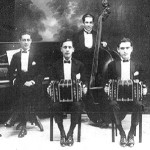
As previously noted, the large EDO orchestras are the most reliable in terms of danceability. According to an analysis by Steve Morell [1]. The core period of the EDO (European Orchestra of Germany) lies roughly from 1935 to 1955, during which most of these orchestras were simultaneously performing and recording. The orchestras were usually named after their conductor, who frequently wrote the arrangements. The 15 best-known orchestras are listed in this (alphabetically sorted) table, which gives the conductors’ names, dates of birth and death, and instruments played:
Rodolfo Biagi (1906-1969) Piano
Miguel Calo (1907-1972) Bandoneon
Francisco Canaro (1888-1964) Violin
July De Caro (1899-1980) Violin
Alfredo de Angelis (1912-1992) Bandoneon, Piano
Lucio Demare (1906-1974) Piano
Carlos Di Sarli (1903-1960) Piano
Angel D´Agostino (1900-1991) Piano
Juan D´Arienzo (1900-1976) Violin
Osvaldo Fresedo (1897-1984) Bandoneon
Pedro Laurenz (1902-1972) Bandoneon
Osvaldo Pugliese (1905-1995) Piano
Enrique Rodriguez (1901-1971) Bandoneon
Hannibal Troilo (1914-1975) Bandoneon
Ricardo Tanturi (1905-1973) Piano, Violin
For the tango DJ, however, such a historically oriented chart is of limited value. DJs want music that is easy to dance to and adapts well to the situation on the dance floor. At the same time, the music tracks should be classifiable by their character in order to use this as a creative tool.
Character is therefore a significant selection criterion, which can be measured in qualities such as rhythm, emotional mood, musical and dance difficulty, energy level, and overall style. I call this the character (or flavor). A good method for classification is provided by Stephen Brown in his “Annotated List of Tandas.” [2]. For daily use, I have reduced his system to four characters:
Soft rhythm
Hard rhythm
Melodic, lyrical (=Romantic)
Dramatic
I understand that it’s difficult to fit a tango orchestra into such a scheme; individual orchestras would actually have to appear in several categories, which I’ve avoided here for the sake of clarity. So here is a (admittedly very rough) list of the 15 orchestras mentioned, along with their typical characteristics:
- Soft rhythm
Typical rhythm without harsh staccato notes, but with varying degrees of syncopation and musical complexity:
De Caro, Tanturi, D’Agostino, Calo, Laurenz
- Hard rhythm
Hard beats with extreme staccato passages, sometimes very fast:
Rodriguez, Biagi, D’Arienzo
- Melodic, lyrical
Music rich in harmony, gentle legato phrases, emphasized contrecantos and romantic emotional appeal:
Demare, Troilo, Fresedo, Canaro, Di Sarli
- Dramatic
High energy content, high dynamics:
De Angelis, Pugliese
For the DJ, it’s important to maintain a consistent character within each tanda and to create a progression within the tandas as part of a general musical strategy, in line with the conditions on the dance floor. If a more nuanced differentiation of character is needed, a singer (if present) can be added as another dimension. Most orchestras in the EDO (Epoca de Oro) have featured singers, usually as estribillistas, meaning they only sang a small part of the piece, sometimes just the chorus or individual verses, to give the orchestra more prominence. Nevertheless, they still influenced the character of the pieces. Some of them shaped this so significantly that an entirely new category emerged (e.g., Di Sarli with Roberto Rufino versus Di Sarli with Alberto Podesta). Therefore, the general rule is that the singer should not change within a single tanda.
Here is a list of the (main) singers for some of the major orchestras (without claiming to be exhaustive):
Rodolfo Biagi: Andres Falgas, Jorge Ortiz, Alberto Amor, Hugo Duval
Miguel Calo: Raul Beron, Alberto Podesta, Raul Iriarte
Francisco Canaro: Ernesto Fama, Francisco Amor, Roberto Maida
Juan D´Arienzo: Alberto Echagüe, Hector Maure, Mario Bustos, Alberto Reynal, Jorge Valdez
Alfredo De Angelis: Carlos Dante, Julio Martel, Floreal Ruiz, Oscar Larroca
Lucio Demare: Raul Beron, Horacio Quintana, Juan Carlos Miranda
Carlos Di Sarli: Roberto Rufino, Jorge Duran, Alberto Podesta, Oscar Serpa, Mario Pomar
Osvaldo Fresedo: Roberto Ray, Floreal Ruiz, Oscar Serpa
Osvaldo Pugliese: Alberto Moran, Roberto Chanel, Jorge Maciel
Enrique Rodriguez: Armando Moreno, Roberto Flores
Ricardo Tanturi: Alberto Castillo, Enrique Campos
Anibal Troilo: Francisco Fiorentino, Alberto Marino, Floreal Ruiz, Roberto Goyeneche
All these combinations result in a vast array of individual musical characters for the milonga. If you consider only the 15 orchestras mentioned above, each with an average of 3 different singers, and also purely instrumental pieces, you arrive at almost 60 characters, which are virtually impossible to play all of, even in a large milonga. The DJ therefore has considerable creative freedom, even if they intend to limit themselves to the core era of EDO (Electronic Dance Orchestra).
Abrazos,
-Richard (DJ Ricardo)
1 http://www.tango.uk.com/orchestras.htm
2 http://www.tejastango.com/tandas.html