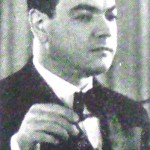
Francisco Canaro wasn’t just the King of Tango; with his second nickname, ‘El Kayser,’ he was called the Emperor of Tango. Why? Let’s listen to his great tangos and take a look at his biography..
Canaro was born in 1888 in San Jose de Mayo (Uruguay) as the child of Italian immigrants and was named “Canarozzo” [3]. He got his nickname “Pirincho” when his midwife saw his hair during birth and was reminded of the crest of a crested bird, “Pirincho” [1, 8].
Canaro began his musical career immediately after emigrating to Buenos Aires at the age of 10, where he and his family lived in abject poverty in a conventillo (tenement building). Francisco worked as a newspaper deliveryman and house painter [8, 9]. Interestingly, it wasn’t until 1944 that he acquired Argentinian citizenship. The story that he fashioned his first violin from an old oil can is debatable. Equally debatable is the claim that he taught himself to play the violin. What is certain is that he received no formal musical training, but was always more of an organizer, business leader, and orchestra conductor. By 1900, he was already playing in an instrumental trio [2]. According to his memoirs, the first tango he played was El Llorón [8]. There he also tells the story of how he was almost shot when he performed with two friends in a small town in the province of Buenos Aires in 1906 [9].
He eventually learned the tango business together with his neighbor, the bandoneon player Vincente Greco [3], with which he began his professional tango career [8]. In 1912 he composed his first tangos “Pinta brava” and “Matasanos”, and these were followed by (depending on the count) approximately 700 compositions and approximately 3800 recorded tangos [5] until he died of Paget’s disease in 1964 [1, 2]. He published his memoirs in 1956 (‘Mis 50 anos con el Tango’) [8].
Because Canaro started his career very early, he is often classified as belonging to the ‘Guardia Vieja’ (old guard) era, which is only half the story. Canaro’s musical output spans all periods up to and including the Golden Age (Epoca de Oro). Throughout this development, Canaro has always adapted to the fashions and spirit of the times like a chameleon. Even classifying him as the conductor of the EDO orchestra is probably not entirely accurate.
Canaro was always incredibly successful (apart from his brief foray into the film industry), and as a result, he became incredibly wealthy by expanding his family business with his brothers. This earned him his second nickname (‘El Kayser’) and cemented the phrase ‘rich as Canaro’ in the Argentinian language. He founded his first orchestra in 1916 with pianist José Martínez (Orquesta Canaro-Martinez), which merged in 1917 with the orchestra of Roberto Firpo, a consummate musician whom he greatly admired (because he always admired Firpo’s musical expertise). By 1918, he and his brothers already had four orchestras, which regularly performed in the cabarets of Buenos Aires [9].
His first large orchestra (bearing his name exclusively) was founded in 1925 [3]. In 1932, he also founded a quintet (Quinteto Don Pancho, his nickname in Spain) and later (1940) the Quinteto Pirincho, under his first nickname. Like the house orchestras of the major record labels, the quintets never performed in public, but only for recordings [7], and they coexisted with the larger orchestras conducted by him and his brothers.
Since he earned money with music, he had been fighting for copyright since 1918 and finally founded the Argentine Association of Authors and Composers (SADAIC = Sociedad Argentina de Autores y Compositores de Musica) in 1935 [3].
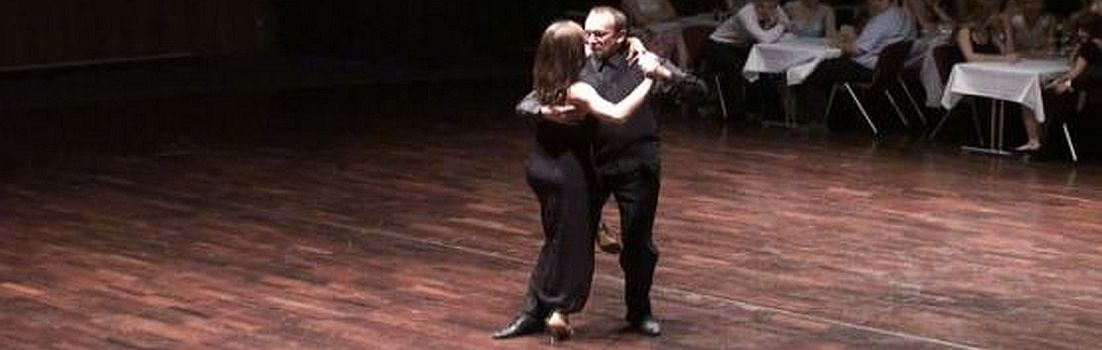
As tango dancers, our first question is always about the sound of his orchestra. Canaro always played primarily for the dancers. His tangos have a soft and easily audible rhythm, but his repertoire also includes romantic and melodic tangos, dominated above all by his singers.
Canaro changed many performance practices. He is credited with the switch from 2/4 to 4/4 time, which emphasized the tango more and made it independent of the habanera rhythm. Furthermore, the format of the sexteto tipico is his innovation. Canaro invented it when he assembled an orchestra for the Rosario Carnival in 1916 [4]. This was when the piano had already been integrated into Firpo’s tango orchestra. Canaro used two bandoneons and two violins to balance these sections with the piano’s volume. Later, he added the bass to complete the Sexteto Tipico. For this, he called upon Leopoldo Thompson (originally a jazz musician), who had already played tango music in other ensembles.
In 1925, he visited Paris (in the midst of the second tango wave, ‘Tangomania’) with a trio consisting of himself and his brothers, where he once again demonstrated his knack for commercial success. Back in Argentina, he conquered the burgeoning radio and ensured his rise to become one of the biggest music stars [8].
https://www.youtube.com/watch?v=7jUmU9pyApM
After some success with musicals, he had some severe financial drawbacks, when entering the film business with a company ‘Rio de la Plata’, he founded in 1934 [9]. Canaro had integrated tango singers into his orchestra since 1924, mostly as estribillistas (i.e., the singers only sang the refrain). His first singer was Roberto Diaz; some of the more well-known singers are cited below as examples:
-Roberto Diaz
-Ernesto Fama
-Roberto Maida
-Enrique Rondo
-Francisco Amor
-Carlos Roldan
Canaro also collaborated with female singers. The most famous was Azucena Maizani, whom he also discovered [3]:
and Ada Falcon, with whom he had an affair from about 1929 to 1938 [6]:
https://www.youtube.com/watch?v=qt0tJS_Gt5g
Another very well-known waltz is also a composition by Canaro (here with Libertad Lamarque):
One of the most famous songs for female singers (‘Se dice de mi’) was also a Canaro composition, sung here by Tita Merello:
https://www.youtube.com/watch?v=-sEUiCMLc0o
Canaro’s most frequently played tango is probably the hit ‘Poema,’ sung by Roberto Maida. It’s generally assumed that it’s played far too often in milongas, but it’s also very frequently requested. It’s special because it belongs to the romantic and melodic category, and Maida’s voice makes it difficult to construct suitable pieces for a tanda.
Canaro will always be remembered as the conductor who played for the dancers, always responsive to their needs and current trends. One could argue that the rhythmic and musical simplicity of his pieces is a product of his musical mediocrity. But it could just as easily be that this was a calculated style aimed at the dancers and ordinary people who were always his target audience.
Even in today’s milongas, his music is mostly played for beginners and less frequently (with the melodically more complex pieces) for advanced dancers..
Abrazos,
-Richard
Sources
1. http://es.wikipedia.org/wiki/Francisco_Canaro
2. http://en.wikipedia.org/wiki/Francisco_Canaro
3. http://de.wikipedia.org/wiki/Francisco_Canaro
4. Birkenstock, A and Rüegg, H.: Tango. DTV, 2001.
5. https://sites.google.com/site/franciscocanarodiscography/
6. http://en.wikipedia.org/wiki/Ada_Falc%C3%B3n
7. http://humilitan.blogspot.com.au/2014_05_01_archive.html
8. http://www.todotango.com/english/creadores/fcanaro.html
9. Reichardt, D: Tango. Suhrkamp, 1984.