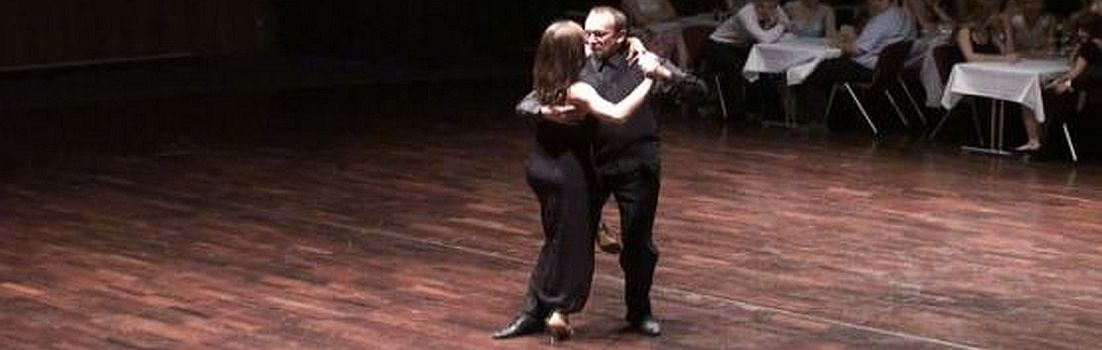
After writing my blog post about Francisco Canaro, I must confess that I was particularly inspired by his affair with Ada Falcon. It’s not often that such a story begins with a piece of music, but it’s more common for these stories to end dramatically. So now I’m (almost compulsively) writing a blog post about this story..
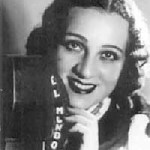
Ada Falcon came from a middle-class family in Buenos Aires, and several romantic and fascinating anecdotes surround her family and the circumstances of her birth in 1905. As early as age 11, she performed in the theater under the stage name ‘La Joyita Argentina’ (‘the little Argentine jewel’) [1]. Her two sisters, Amanda and Adhelma, were also singers, but never achieved overwhelming success. By the age of four, it was clear that Ada (her real name was Aida Elsa Ada Falcon) would become a singer, a goal she realized under the notorious influence of her mother, who even followed her into self-imposed seclusion in 1942 [2].
In her biography on TodoTango, author Nestor Pinson points out that Ada belonged to the small pioneering group of female tango singers who launched their careers between 1923 and 1930 (including Azucena Maizani, Rosita Quiroga, Mercedes Simone, Tita Merello, and Tania Discepolo). Ada was somewhat different, possessing a unique vocal quality that gave her a distinctive position. In 1925, she recorded with Osvaldo Fresedo for Victor, then switched to recording with Enrique Delfino and Manuel Parada for Odeon [2]. Her voice was not a classical soprano, but somewhat darker, somewhere between mezzo-soprano and soprano in the higher registers [3].
On July 24, 1929, she recorded her first tango with Canaro: ‘La morocha’. At that time, Ada was 24 years old, blonde, and had almost hypnotically intense green eyes [2]. Canaro fell in love with her instantly and, alluding to her eyes, wrote the tango vals ‘Yo no se que me han hecho tus ojos’ for her, including its intensely romantic lyrics. This vals remains one of the most romantic and beautiful pieces of music (though rarely played in milongas), likely because the feelings it depicts were genuine. The song has become an integral part of Argentine folklore, and we will discuss it in more detail below.
Canaro was successful, Ada was deeply in love, and Canaro (despite being married to his wife Martha Gessaume) began an affair that lasted over 10 years. During this time, they made 200 recordings together, which not only increased Canaro’s proverbial wealth but also made Ada Falcon a rich woman. She lived in a three-story house in a prime location, drove a red sports car, and flaunted her jewels and furs. Because she had by then developed the attitudes of a diva, her nickname was ‘La Empreza del Tango’ (one could now speculate about Canaro’s second nickname, ‘El Kaiser’).
The affair was common knowledge throughout the city. Canaro considered divorce, but after speaking with his lawyer, he dismissed the idea. A divorce would have financially ruined him. An anecdote also recounts that Canaro’s wife, Martha (nicknamed ‘La Francesa’), caught the two in a compromising position during a rehearsal. She then pulled a pistol from her handbag and pointed it at Ada, who immediately fled the room. The couple separated, and Ada declared to Francisco, ‘I will no longer sing for you.’ Ada withdrew from public life, became even more eccentric, and neglected her career. In 1942, she released her last two recordings, ‘Encadenado Corazon’ and ‘Vivre con tu recuerdo,’ ironically both compositions by Canaro. Afterward, she retreated to a house near Cordoba and became a Franciscan nun along with her mother. It is likely a coincidence that her order bears the name of the great love of her life. She never explained why she withdrew so radically from public life.
Her last interview and probably her last recordings were given shortly before her death in 2002 (in a retirement home near Cordoba) to documentary filmmakers Lorena Muñoz and Sergio Wolf for their film “Yo no se que me han hecho tus ojos”, which was released in 2003.[5]Here she was asked the reason for her escape and she replied, ‘Because I have to atone for a sin.’ A link to the film is below.
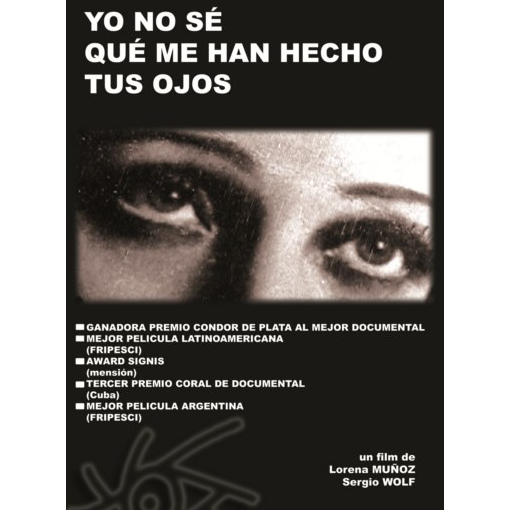
Ada Falcon was buried in the Cementerio de la Chacarita in Buenos Aires in a mausoleum for famous artists, right near Francisco Canaro. Their affair was well-known in Buenos Aires, and many still remember it today. In 2010, the story was adapted into a television film and part of a miniseries (Lo que el tiempo nos dejó: Te quiero) [6]. Links to this episode are located below.
Finally, I’d like to turn to the song that ultimately changed Ada Falcon’s life. It is undoubtedly one of the most beautiful waltzes, and many artists have recorded it, including Carlos Gardel. The song has become so deeply ingrained in the Argentinian musical heritage that many no longer know it was written by Canaro. Some think it’s a Gardel piece, while others trace its origins back to modern folk singers..
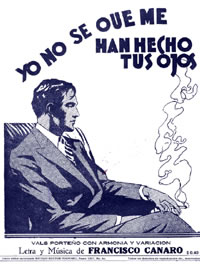
This is the original version by Canaro and Falcon with lyrics:
In the TV drama (Lo que el tiempo nos dejó: Te quiero) Julieta Diaz plays Ada Falcon and sings the song playback with the original version:
This is a recording by Carlos Gardel:
Here is the text in Spanish [7]:
Yo no se si es cariño el que siento,
yo no se si será una pasión,
sólo se que al no verte, una pena
va rondando por mi corazón…
Yo no se que me han hecho tus ojos
que al mirarme me matan de amor,
yo no se que me han hecho tus labios
que al besar mis labios, se olvida el dolor.
Tus ojos para mi
son luces de ilusión,
que alumbra la pasión
que albergo para ti.
Tus ojos son destellos
que van reflejando
ternura y amor.
Tus ojos son divinos
y me tienen preso
en su alrededor.
Tus ojos para mí
son el reflejo fiel
de un alma que al querer
querrá con frenesí.
Tus ojos para mí serán
la luz de mi camino
que con fe me guiarán
por un sendero
de esperanzas y esplendor
porque sus ojos son, mi amor!
Yo no se cuántas noches de insomnio
en tus ojos pensando pasé;
pero se que al dormirme una noche
con tus ojos pensando soñé…
Yo no se que me han hecho tus ojos
que me embrujan con su resplandor,
sólo se que yo llevo en el alma
tu imagen marcada con el fuego de amor.
Here’s the translation (with some help from Google Translate): guitar accompaniment at [9] and piano reduction here [10] :
I don’t know if it’s love I feel,
I don’t know if it will become a passion.
I only know that if I don’t see you,
A pain creeps around my heart.
I don’t know what your eyes have done to me,
When they look at me, I die of love.
I don’t know what your lips did to me,
When they kiss me, they make me forget the pain.
Your eyes are for me
the lights of the illusion,
that illuminate passion
which I feel for you.
Your eyes are sparks
as a reflection
of tenderness and love.
Your eyes are divine.
and hold me captive
in their vicinity.
Your eyes are for me
true reflection
a soul that, when it loves,
does this only with obsession.
Your eyes will be for me
be the light on my path,
that has faithfully guided me
on a path of hope and glory
Because they are your eyes, my love!
I don’t know how many sleepless nights.
I stayed awake, thinking of your eyes;
But I know that one day I will be asleep
Thinking of your eyes, I dreamed…
I don’t know what your eyes have done to me,
to pursue me with their light;
I only know that in my soul
May I carry your image, bound with the fire of love.
Here is an alternative recording of Canaro with Alberto Arenas and Mario Alonso as a duet. The song is ideally suited as a duet because the second singer can sing the contrecanto:
Here is the version by Juan D’Arienzo and Osvaldo Ramos (1965), along with the musical analysis [11]:
A slightly older version from 1931 by Ignacio Corsini, accompanied by three guitars:
Here is a version by the Argentinian folk singer Luciano Pereyra (live and unplugged in front of a fanatical audience):
Finally, the documentary by Lorena Muñoz and Sergio Wolf. Even if your Spanish isn’t perfect, the images are highly interesting:
If you prefer fictional entertainment, here is the television play ‘Lo que el tiempo nos dejó: Te quiero’ in 4 parts:
Enjoy one of the greatest love stories of tango.
Abrazos,
-Richard
Sources
1 http://en.wikipedia.org/wiki/Ada_Falc%C3%B3n
2 http://www.todotango.com/english/artists/biography/148/Ada-Falcon/
3 http://de.wikipedia.org/wiki/Ada_Falc%C3%B3n
4 http://www.verytangostore.com/legends/francisco-canaro.html
5 http://www.imdb.com/title/tt0324625/
6 https://es.wikipedia.org/wiki/Lo_que_el_tiempo_nos_dej%C3%B3
7 http://www.todotango.com/musica/tema/817/Yo-no-se-que-me-han-hecho-tus-ojos/
9 http://www.tusacordes.com/secciones/ver_tema.php?id=49338
10 http://www.todotango.com/musica/tema/817/Yo-no-se-que-me-han-hecho-tus-ojos/
11 http://www.tangomusicology.com/wordpres/yo-no-se-que-darienzo-1965/