
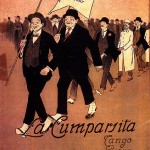
No other tango in history has caused so much confusion and controversy. Everyone loves it, almost every tango orchestra has played a version, and it’s played at nearly all milongas that adhere to the traditional Argentine codices. Even this little song didn’t begin as a tango.


The song was composed in 1916 by Uruguayan musician Gerardo Hernan “Becho” Matos Rodriguez (a 17-year-old architecture student) in Montevideo as a carnival march for the brass band of the Uruguayan student association [1, 2]. Gerardo showed the music to the orchestra conductor Roberto Firpo, who was playing at the ‘La Giralda’ café in Montevideo, and Firpo agreed to play it as a tango [1]. He added a third part from one of his own tangos (“La gaucha Manuela”) as well as a small part of Verdi’s song Miserere from Il Trovatore [1]. He performed the song that evening with great success, together with ‘Bachicha’ Deambroggio and ‘Tito’ Roccataggliatta. That same year, he recorded the song for Odeon Records as the B-side of a 78 rpm record, but without success, and the song fell into obscurity until Pascual Contursi wrote the lyrics in 1924 [1]. The song became a huge hit, was recorded by Contursi and given the title ‘Si supieras’ [1]. This ultimately led to a legal dispute with Gerardo Rodriguez, which was only resolved in 1948 through an agreement negotiated by Francisco Canaro. This reinstated the title ‘La Cumparsita’ and established Contursi’s lyrics (as well as a 20:80 revenue split) [1,2,4]. In 1924, Gardel recorded the song with great success in Buenos Aires, and in 1928 in Barcelona [2]. Other famous recordings are by Juan D’Arienzo (6 interpretations), Piazzolla (4 interpretations) and Alberto Mancione, whose 1952 recording was awarded the title of best version of the song.
I would like to mention that ‘La Cumparsita’ was not Gerardo Rodriguez’s only tango. He composed other well-known tangos such as ‘Che papusa, oi!’, ‘Adios Argentina’, and ‘Mocosita’, to name just a few. Interestingly, he also worked for a time as the Uruguayan consul in Germany [3].
The original text can be found here [4]. This is the text of ‘La Cumparsita’ in the version by P. Contursi:
Si supieras,
que aún dentro de mi alma,
conservo aquel cariño
que tuve para ti…
Quién sabe si supieras
que nunca te he olvidado,
volviendo a tu pasado
te acordarás de mí…
Los amigos ya no vienen
ni siquiera a visitarme,
nadie quiere consolarme
en mi aflicción…
Desde el día que te fuiste
siento angustias en mi pecho,
decí, percanta, ¿qué has hecho
de mi pobre corazón?
Sin embargo,
yo siempre te recuerdo
con el cariño santo
que tuve para ti.
Y estás en todas partes,
pedazo de mi vida,
y aquellos ojos que fueron mi alegría
los busco por todas partes
y no los puedo hallar.
Al cotorro abandonado
ya ni el sol de la mañana
asoma por la ventana
como cuando estabas vos,
y aquel perrito compañero,
que por tu ausencia no comía,
al verme solo el otro día
también me dejó…
Here is the English translation [5]:
If you realised,
that still inside my soul,
I uphold that affection
I had for you…
Who knows if you realised
that I haven’t forgotten you ever,
when turning back to your past
if you think of me…
Friends no longer come
not even for a visit,
nobody wants to console me
in my affliction…
From the day you left
I feel anguish in my chest,
tell me, darling, “what have you done
to my poor heart?”
However,
I always remember you
with the divine affection
I had for you.
And you are everywhere,
part of my life,
and those eyes that were my joy
I look for them everywhere
and I can’t find them.
In the abandoned flatlet
not even the morning sun
peeks through the window
as it did when you were here,
and that companion puppy,
that didn’t eat in your absence,
upon seeing me alone the other day
it also left me.
Whoops, a really sad song, a true Contursi experience!
I mentioned that many different orchestras have played ‘La Cumparsita’. EMI released a CD with 20 different versions (CD ‘La Cumparsita, veinte veces inmortal’). My collection contains over 100 different versions (I can’t count them exactly because there are many duplicates).
Besides the legal dispute between Rodriguez and Contursi, there were other scandals. For example, the Argentinian team marched into the 2000 Sydney Olympics to ‘La Cumparsita,’ which led to protests and official demands from the Uruguayan government. In fact, ‘La Cumparsita’ was officially declared Uruguay’s cultural and popular anthem by law in 1997 [1].
I mentioned that the song is played at many milongas. In very traditional milongas, it’s always the last piece; often, an entire tanda of ‘La Cumparsita’ is played..
Here are some videos, starting with the Gardel song, the orchestral version by Juan D’Arienzo, Piazzolla’s 1957 record, and finally Mancione’s 1952 version:
http://www.youtube.com/watch?v=xg_HycXA-a0
http://www.youtube.com/watch?v=VUiH_HpWYSc
Now for some dances. Starting with Gustavo Naveira and Giselle Anne, one of my favorite tango couples, and of course Chicho and Juana, and finally Sebastian Arce and Mariana Montes:
http://www.youtube.com/watch?v=CPbEaZYUVtA
And finally, as a tribute to a very talented child: the guitar version by Julio Silpitucla (11 years old):
Abrazos,
-Richard
Sources
1 https://en.wikipedia.org/wiki/La_cumparsita
2 http://www.todotango.com/english/biblioteca/cronicas/la_cumparsita.asp
3 http://www.todotango.com/english/creadores/gmrodriguez.asp
4 http://www.totango.net/cumpar.html
5 http://lyricstranslate.com/en/la-cumparsita-lil-marchin-band.html#ixzz2vL0wzqYF
6 http://www.totango.net/cumpar.html