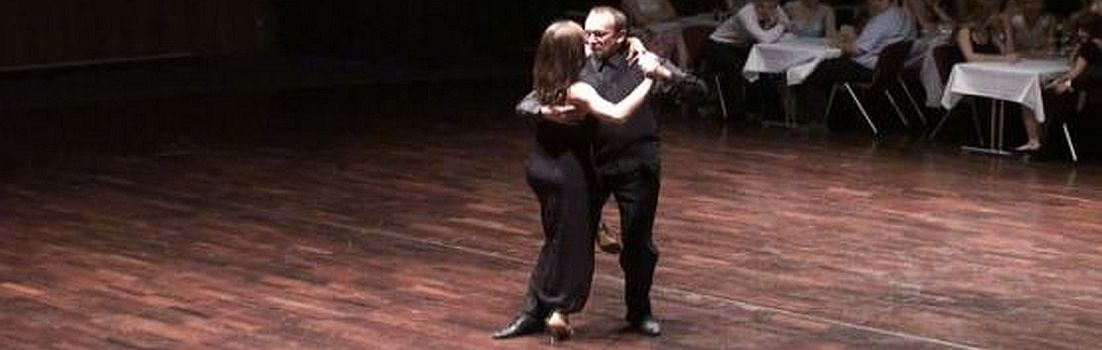
I’ve been dancing tango since the late 80s, first as a student of Fabiana, then under Nicole y Ricardo, and I’ve seen a lot of the milonga scene worldwide, including milongas in Germany, Luxembourg, France, the Netherlands, Spain, Poland, Singapore, Thailand, Dubai, Australia, New Zealand, the USA, and of course, Buenos Aires. In all these milongas, two things were essential for me: the people and the music. Without these two ingredients, there would be no milonga. What makes me happy in a milonga is the closeness to my dance partner in the embrace, the depth of personal communication in the dance, the deep immersion in the music, the rhythm of the piano, the intimate embrace of the double bass, and the musical diversity of violins, bandoneons, and the singer’s voice, the lament of the contrecantos and the whipping of the syncopations, the variety of musical personalities, styles, and emotions. Words can hardly describe it. All of this is presented by the best orchestras of the EDO and controlled by a single person – the DJ!
A standard book for DJs is called “Last Night a DJ Saved My Life” (published in 1999 by Bill Brewster and Frank Broughton) [1], which alludes to an old Indeep title from 1982. This book actually deals with the history of DJing in the 20th century, but the title represents what a DJ can achieve at a milonga (even though the book has nothing to do with tango). A DJ can transform and liven up an otherwise dull milonga, or they can completely ruin a top-notch, packed milonga. This is what makes DJs so popular and awakens in all of us the desire to stand (or sit) behind the decks. Other people recognize the responsibility involved and prefer to stay out of it. I sometimes make wicked jokes about the fact that some people feel qualified for this task after buying their second tango CD (usually the soundtrack to “The Tango Lesson”). On the one hand, there’s certainly some truth to it, but on the other hand, it’s really mean (and I apologize for that). There are many milongas in this world, and not all of them are milongas with more than 500 guests and a professional DJ. Actually, the vast majority of milongas are smaller events with fewer than 20-40 guests. These milongas are hosted by small clubs, usually lovingly decorated with the very essence of tango. The people there are friendly, open, and always welcoming to occasional visitors (I have often experienced this hospitality and always feel a deep sense of sympathy and friendship for this tango community). Most of these small milongas don’t have the money to hire a DJ, so someone from the club is asked, or rather, gently persuaded, to fill this role. It actually takes a long time to find one’s footing in this role, to acquire knowledge of the background and the music. Good DJs need to mature like a fine wine. I began my DJ career in a dance club and later as an instructor and trainer for ballroom dancing, Latin American dancing, and tango, continuing it at dance events and parties at a German university. I had plenty of time to grow into the role of a tango DJ, and that was back when internet access wasn’t yet ubiquitous and tango knowledge still had to be acquired from books. I would have given a lot for a tutorial like this back then.
Now I have plenty of time to share my (not always conventional and often uncomfortable) opinions on this blog, and because my job as a university lecturer has made teaching a part of me, here’s my two cents on tango DJing. Tango DJing has little to do with regular club DJing. There’s no scratching, beat matching, blending, sampling, or anything else that’s common practice these days. A tango DJ needs to have internalized more than 80 years of tango music and cultural history, they need to be knowledgeable about music (words like syncopation, rubato, etc., must be familiar), and a grasp of tango’s cultural background, ideally including basic Spanish language skills, would be a great asset.
This little tutorial is about the basics and is not aimed at the international superstars of the scene, but at the heroes in small tango clubs who are asked, begged, forced or left to prepare the music for us so that we can dance into heaven.
This tutorial is based on earlier blog posts, which I revised as part of the redesign of this site to be bilingual, subjecting them to a more logical and coherent concept. Here, then, is the second revision of my tutorial, which I dedicate to the tango community.
So, onward from “bedroom DJ” to accomplished milonga DJ. Next time I come to your milonga, please save my life, or at least the evening, or simply treat me to a glass of red wine or a dance…
Abrazos,
-Richard (DJ Ricardo)
PS: A small, grateful greeting to my former mentor: DJ Didi from Giessen.
1 https://en.wikipedia.org/wiki/Last_Night_a_DJ_Saved_My_Life_%28book%29