The milonga and the DJ – A well-ordered affair
Okay. You’ve spent years learning tango, bought tango music, know all the big and small orchestras, and maybe you’ve even been to a milonga somewhere else (perhaps even in Buenos Aires?). Now your club is asking if you’d like to DJ at their next event. What an honor! Who could be better suited, apart from the (few to many) professional DJs?
Unfortunately, there are a few things you need to know and consider before you even get behind the mixing console. Some of these things are purely technical, others are basic tango knowledge, and some you’ll only learn by immersing yourself in them. This is the first part of a short series about DJing that I started three years ago. Why? I’ve been DJing since 2004 and have made just about every mistake imaginable. I want to offer aspiring DJs some guidance so they can make fewer mistakes, learn by example, and develop their own style. As a DJ, I’m just a small fry and can’t compete with the big names in the business, but as one of my tango teachers so aptly put it: “We’re all on a wonderful journey…” Just so you know: This blog is based on my series that began in 2013, which I’m currently updating to version 2. The first version was only available in English; now I’m translating the new revision into German.
For a good milonga (the formal tango dance event), playing good music is extremely important. For dancers to enjoy the event, the music must be good, as it’s the foundation that binds everything together. Therefore, the DJ is (apart from our esteemed dance partner) the second most important person of the evening. A DJ should understand the structure of the milonga and see music as a means of drawing people onto the dance floor, while still playing it in a structured way, adapted to the actual situation on the floor. Milonga and music are very structured in classical tango, which leads us directly to the structure of the milonga itself.
The Milonga
A milonga is a very traditional dance event. Most organizers worldwide adhere more or less to the traditions still practiced in Buenos Aires today.
For this, the music will be in Toilet structured, usually containing 3-4 musical pieces. Tandas are separated by means of a CurtainsA short piece of non-tango music signals the beginning and end of a tanda. This makes sense because dancers typically want to dance one tanda with a partner and then separate to dance another tanda with a different partner. In this system, the DJ is responsible for selecting suitable songs for the tanda and the cortina. Pieces for a tanda should belong together and harmonize in terms of style, tempo, and energy. Dancers don’t want the style to change within a tanda, for example, from an atmospheric di sarli to a neo-tango. This is because dancers sometimes choose their partners based on the music. As a DJ, you should therefore make the music predictable. The tanda should be the right length and have a clear start and end. Tandas typically consist of 3-4 tangos and 2-3 milongas and valses. This can change for alternative styles; for example, many neo-tangos are very long, and a tanda with only two pieces might be justified. A cortina is typically not danceable (if it is, it will be danced). During the cortina, the dance floor should be completely cleared so that the mirada/cabeceo system can work later. However, it’s up to the DJ whether they prefer the traditional cortina system or whether they don’t play any cortinas at all. Personally, I play one cortina per evening with a non-danceable rhythm.
Putting together the right pieces for a tanda is an art and a matter of taste. Ideally, you shouldn’t change the orchestra (that would be a mixed tanda) and you should stay within the same musical style (and era). Unfortunately, some traditional orchestras (e.g., DiSarli) have changed their styles several times, so a good DJ should be aware of this. It’s also unusual to create tandas with multiple different singers. Some DJs go so far as to only combine pieces from the same orchestra with the same singer from the same recording session. More on putting together tandas later in this series.
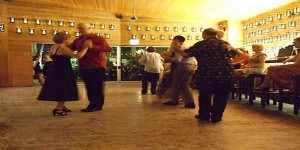
- Picture 1: Local Milonga in Cairns

Milongas have established traditions. The last song should always be “La Cumparsita,” which otherwise shouldn’t be played. Sometimes the entire final tanda consists of different recordings of “La Cumparsita.” This way, every dancer knows immediately, without any announcement, that it’s the last tanda (because sometimes dancers reserve it for special partners). In my milongas, the last piece is always the recording by Carlos Gardel, not to be danced, but to commemorate him. This also lets everyone know that the milonga is now over. Depending on the mood, the last tanda can be very long if the audience requests encores (also all versions of “La Cumparsita”).
There are other rules (codes) as well. For example, playing “Adios Muchachos” is said to bring bad luck because it’s supposedly Gardel’s last song (not true). With the exception mentioned, Gardel’s pieces are generally not played. Similarly, Piazzolla’s music is rarely played because he always emphasized that his music was for listening, not dancing. This may have changed in the meantime, but I still don’t usually play Piazzolla pieces. There are also rumors that female singers aren’t played in Buenos Aires. I can’t confirm this from personal experience. It wouldn’t reflect the special significance of these artists. However, in Buenos Aires, it’s common for tandas to be played occasionally with other dance music (salsa, rock and roll).
The general music style at a milonga depends on the dancers’ preferences and the organizers’ requirements. Many dancers enjoy the music of the EDO (Epoca de Oro), while others love Neotango or modern tango orchestras (Color Tango or OT Fernandez Fierro). It’s the DJ’s job to prepare a mix for everyone. However, they’ll never be able to please every single dancer. Personally, I agree on a mix with the organizer and communicate this to the audience beforehand (e.g., 50% EDO, 20% modern, 20% Neotango, 10% non-tango). Playing Neotango or non-tango music can be a resounding success or a complete disaster. It’s always tricky whether non-tangos qualify as tango; sometimes a single tanda salsa or bachata can be a great way to liven things up.
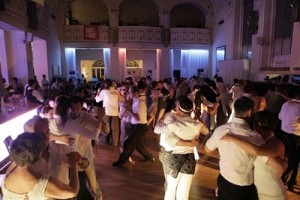
- Picture 2: Milonga in Buenos Aires

The dancers want to have fun. It’s important for a DJ to also play well-known and popular tracks. So, if a DJ plays tracks like “El Flete” or “Poema” (which they themselves might not want to hear anymore), it’s because they’re frequently requested. The DJ therefore needs to find a balance between these evergreens and the ten new CDs from BsA featuring rare collector’s items. The DJ’s work is geared towards the audience, not their own (current) personal taste.
The DJ
The DJ’s job is to fill the dance floor. This means the DJ has to observe and control what’s happening. There’s something called “tension” here. If the dance floor is empty, the tension is low; if it’s packed, the tension is high. A good DJ can play with and control this tension. Tension can’t be increased indefinitely, so the DJ creates arcs of tension through their music selection. This will also be discussed further.
There are many different styles of DJing here. Some DJs always play according to the situation and even switch orchestras abruptly. Other DJs structure the milonga like a story, changing styles slowly and in waves.
I personally like to structure my milongas as a narrative and only change my plan when absolutely necessary. So, if I’m DJing a milonga that’s scheduled for three hours, I’ve already prepared a playlist of exactly three hours. The average preparation time here roughly corresponds to the planned duration.
To summarize: The DJ doesn’t just randomly put CDs in the player; he curates and controls the music. He is the master of the milonga and therefore has influence and responsibility. A milonga can be completely ruined if bad music is played. A DJ must be a specialist in tango music with good taste. But he must also be able to impart the necessary musical knowledge to the group.
So what exactly is a DJ? Just someone who plays music. It could be a club member spinning a few CDs at a practice session, or a professional DJ playing for over 100 people and earning money doing so. Speaking of money, I’ve never earned a single cent as a DJ in my life, apart from a few drinks and the occasional bit of food, or a small amount that barely covers my travel expenses. Professionals might earn some money for large events, but that’s usually not enough to live on. DJs serve the community. But if you’re being paid as a DJ, you should behave professionally. In my opinion, it’s not right to just play a playlist and dance along enthusiastically in between sets.
In the next articles, I will talk about the hardware needed for DJing at events of any size.
Abrazos,
-Richard (DJ Ricardo)
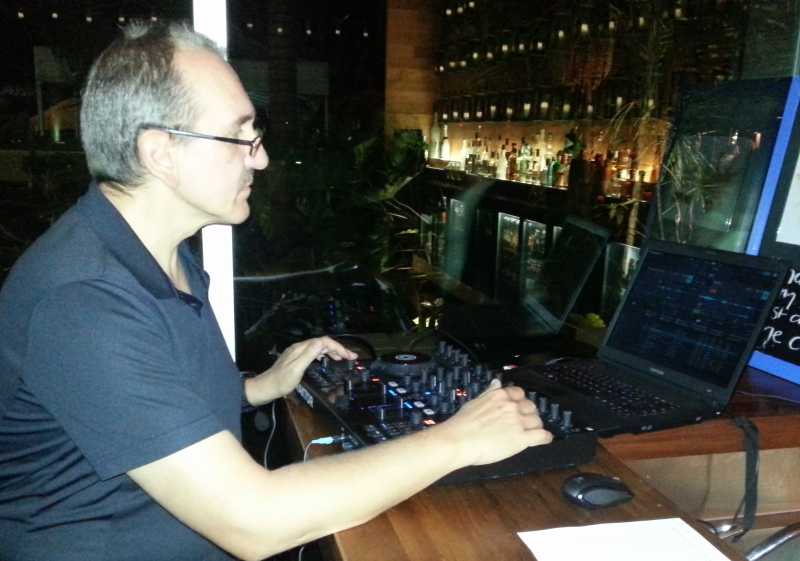
PS: I use the terms DJ and dance partner in a gender-neutral way in my texts. I really dislike the term DJane. Anyone who finds typos is expressly welcome to keep them.