

Last week I was a guest at a milonga, where I also occasionally DJ, and I listened to the music of the DJ there (who, by the way, did an excellent job). What I found interesting was that he was DJing with his mobile phone, obviously playing a Spotify playlist. The connection to his two portable speakers was also clearly via simple Bluetooth. I don’t mean to criticize my colleagues’ work at all, but it got me wondering if this is a viable technical option for my own work. I’ve prepared two posts on this topic.
In times of ubiquitous internet access and virtually unlimited data, the concept of streaming has become quite popular. Streaming providers like Netflix for movies and Spotify for music deliver content directly from their own databases to mobile devices, eliminating the need to deal with music sources like records or DVDs. This is convenient for the end user, who pays a relatively small fee for this service. With a music provider, users search for a track by artist or title and can then add it to one or more personal lists, creating a personalized playlist.
Spotify is a streaming music provider founded in Sweden in 2006 with approximately 777 million users [1]. Their database contains over 100 million music tracks (as of 2024; some sources suggest significantly more).
Several years ago, I explored the concept of streaming, but found that niche music like tango was barely, if at all, represented in the database of the provider at the time. So, let’s move on to the first experiment. The question here is: Is tango music suitable for a typical milonga represented in the database of a current provider?
For this, I selected one of my recent milonga playlists, a rather traditional one with some nuevo and a few tandas featuring modern orchestras. It contained 95 tracks, with three pieces per tanda and the usual mix of tango, vals, and milonga. I then searched for these tracks on Spotify.
Result: Of the 95 tracks on my playlist, only four were not listed on Spotify.
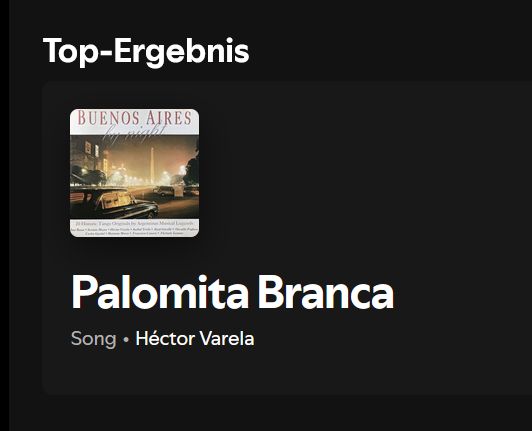
This result is significantly better than I expected. It shows that the database contains more than just the typical tango evergreens. Therefore, it’s no problem to put together a high-quality milonga using Spotify’s material. The descriptions of the tracks on Spotify correctly list the orchestra and singers; only the recording time is missing, which makes planning a milonga more difficult. One track was listed with a typo (see image).
Even in its simplest format, Spotify delivers music compressed in .ogg format at 160 kbps, which in my opinion is sufficient quality for a milonga. Spotify also offers uncompressed playback for some of its music. However, I couldn’t determine whether this option is available for typical tango pieces, and whether this lossless format makes sense for shellac recordings is another question entirely.
The music is usually played in the provider’s app and transmitted directly to the speakers or headphones via Bluetooth. Whether or not wireless transmission makes sense in this case will be discussed in the next post. The provider’s app is important here because you can create your own playlists within it. Spotify also allows you to physically download music tracks, but they are then stored within the app and cannot be exported from there.
The licensing of the music is explicitly restricted to private use. Commercial use (e.g., for public events) is prohibited on Spotify.
The ability to record Spotify streams using third-party software and save them as a file contradicts the terms of service and is therefore illegal, or at least exists in a very dark gray area.
Professional DJ software offers access to the Spotify database, currently available with a Spotify Premium subscription in programs like Serato, Rekordbox, and Algoriddim DJ-Pro. However, this access is only available online; downloading tracks for a performance is not possible. Use for commercial events is also prohibited. This feature would, however, allow the music to be played on professional hardware (more on this in the next post).
In summary, the pros include Spotify’s extensive database, which is sufficient even for tango DJs, and eliminates the tedious management of a music collection. On the downside, there’s the limitation to the providers’ software, as well as the fact that this software has significant limitations, such as the lack of a preview function or BPM tracking feature. Another disadvantage is the limitation to non-commercial events. A milonga larger than a living room would already violate the providers’ terms of service. In this setup, using streaming music wouldn’t currently suit my needs, but I don’t rule out the possibility that this could change in the coming years.
Undoubtedly, however, its use for privately listening to and enjoying tango music, and perhaps exchanging playlists to get inspiration for the next milonga, is undeniable. In this sense, using Spotify is simple and pleasant.
Literature
1 https://en.wikipedia.org/wiki/Spotify