
Everyone in the tango world talks about the Golden Age (‘Golden Age,’ ‘Epoca de Oro’). This is defined as the period when tango reached the peak of its development, roughly speaking, in the 1940s (‘Cuarentas’). For many tango dancers, this is a well-established term, but unfortunately, it’s very vague. The typical milongueros usually have no idea when even the classic tango songs were recorded; only the few true aficionados and the more serious DJs, who typically note down and compare the recording dates of their tracks, do (it’s a bad idea to play a track from 1932 together with one from 1952 in the same tanda). As consumers of tango music, we can certainly agree that somewhere around 1940, the music suddenly sounded very different, and that many well-known tracks were recorded around this time. Something special must have happened. It is such moments that music historians often examine and try to get to the bottom of this mystery.
Anyone visiting Buenos Aires should definitely visit the museum at the ‘Academia Nacional del Tango,’ located at Avenida de Mayo 833 in the city center, right next to the famous Café Tortoni. There, the current historical classification of tango’s development, compiled by the academy’s director, Horacio Ferrer, is displayed on the wall.
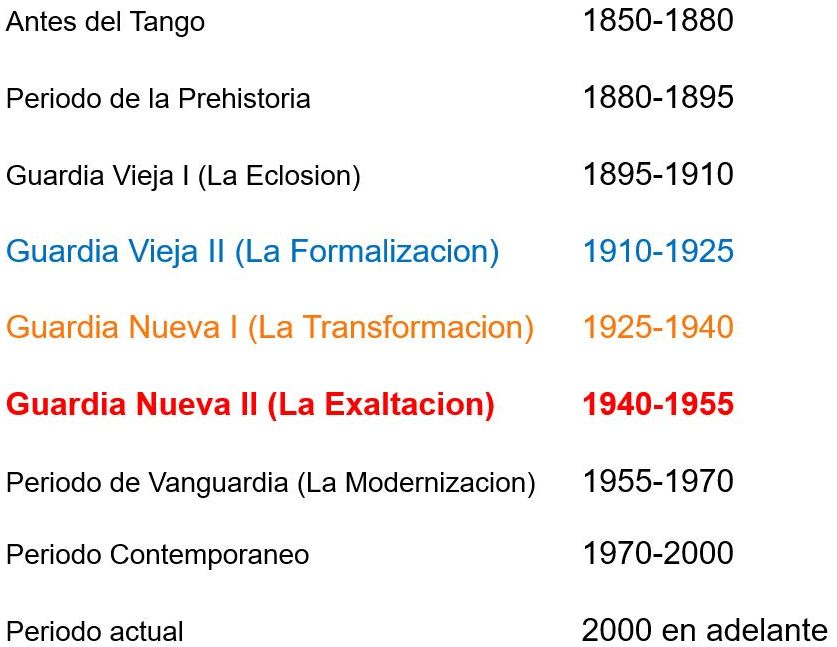
This list, however, does not include an ‘Epoca de Oro’ (Golden Age)! Around 1940, there is only the Guardia Nueva, divided into two phases: ‘La Transformacion’ and ‘La Exaltacion,’ which spans from 1925 to 1955, with 1940 in the middle. Is this the ‘Epoca de Oro’? Certainly not, because historically, tango underwent at least three or four transformations in the interim. The framework is easily understood: in 1925 (actually, as early as 1924), Julio de Caro founded his orchestra, and in 1955, with the end of the tango-friendly Perón government, the era of frequent military coups (‘Revolución Libertadora’) and thus the decline of tango culture began. But what does the year 1940 refer to?
Musicologists are always looking for correlations between musical and social events. 1935 seems like a good year to examine this, as it was the year Carlos Gardel died in an accident. However, this event had little impact on instrumental tango. More interesting is the fact that in 1935 Biagi joined Juan D’Arienzo as a pianist, and the two subsequently developed a completely new, ultra-rhythmic style that many orchestras adopted until the early 1940s. From 1942 onward, there was a clear trend toward more romantic and complex music.
We must therefore also pay attention to the orchestras actively participating during this period.
Typically, the orchestral lineage is divided into three sections: the Julio de Caro section, the Osvaldo Fresedo section, and a traditional section comprised of musicians from the old guard (Guardia Vieja). Paloma Martin’s classification from her 2014 article is somewhat more precise [1], which further specifies this very simple classification:
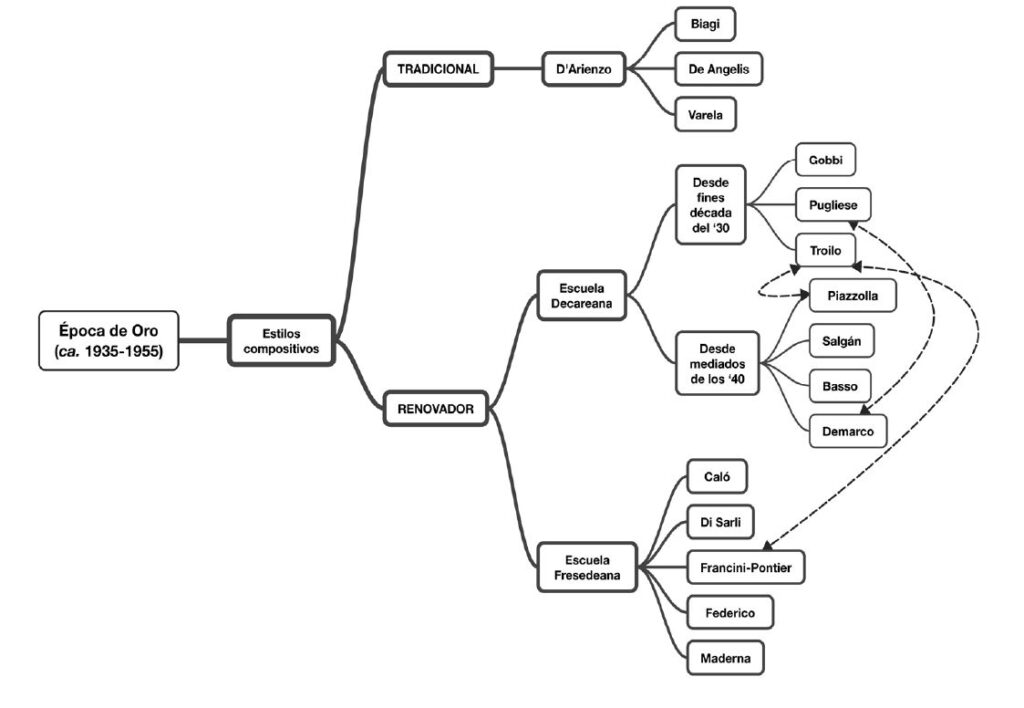
This helps somewhat in better categorizing the orchestras’ styles, but it’s not really helpful for answering the initial question. At least Ms. Martin places the beginning of the EDO (unlike Ferrer) in 1935.
Another online source attempts to approach the problem by examining when the orchestras were active. However, this is not really helpful either, as many orchestras played for a very long time, but some were no longer able to maintain their peak performance.
In summary, I would also argue that the ‘Golden Age’ should begin in 1935. The end came slowly and then abruptly in 1955. However, it can be said that even typical interpretations were hardly danceable by the end of the 1940s.
Abrazos,
-Richard
Sources
1 Paloma Martin: The instrumental Tango of the Río de la Plata:
Approaches to a comparative musical analysis of the innovative
styles in the so-called ‘golden age’. Montevideo, 2014.