It is certain that the Argentinians, and especially the immigrants of the first, more Spanish-influenced wave of immigration and their descendants, the “Criollos”, lived in a harsh environment; the fact that dueling with a knife was part of their everyday life is often recounted in tango lyrics.
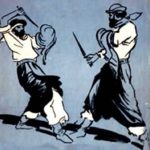
The typical weapon of the adversaries was the utility knife (Facon) typical in Argentina, Brazil and Uruguay [1] in one hand and a cloak wrapped around the other forearm [2]. The fighting style was also known as “escrima criolla” [3].
Below is an image of this fighting style, which likely often resulted in injuries and deaths, but was also simulated for training and entertainment purposes to demonstrate courage. The intention of the duelo criollo among the gauchos was not necessarily to kill the opponent, but rather to mark him with a facial scar [3].

Since the culture of the Gauchos was continued by Compadres and Compadritos during the early years of tango history (end of the 19th century), the Duelo Criollo was also widespread – probably in a less formalized form – apart from the fact that the aforementioned Compadres and Compadritos were quick to resort to knives anyway.
It’s hardly surprising that these urbanized knife duels were often about money or a woman. For a tango dancer, hearing the name Duello Criollo immediately brings to mind the tango of the same name.[4]first interpreted by Carlos Gardel. The music was written in 1928 by Juan Rezzano [5] and the text was written by Lito Bayardo [6]. Here are two cover versions of the piano version:
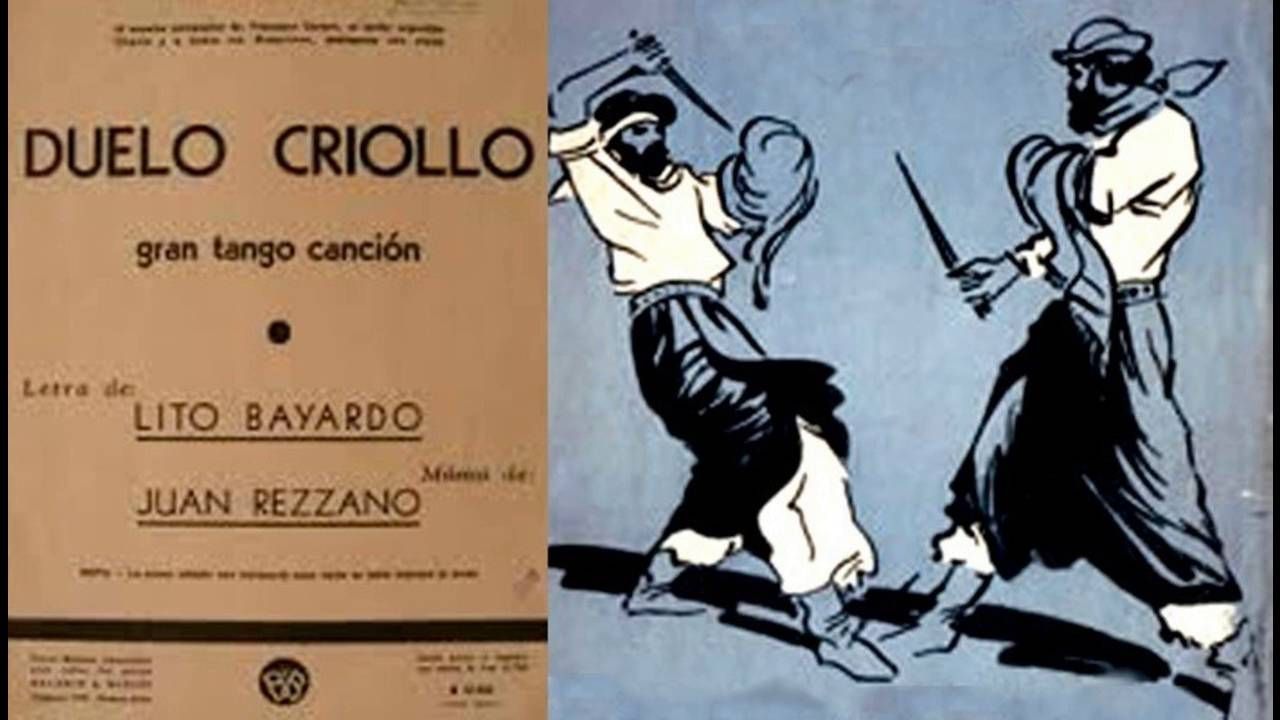
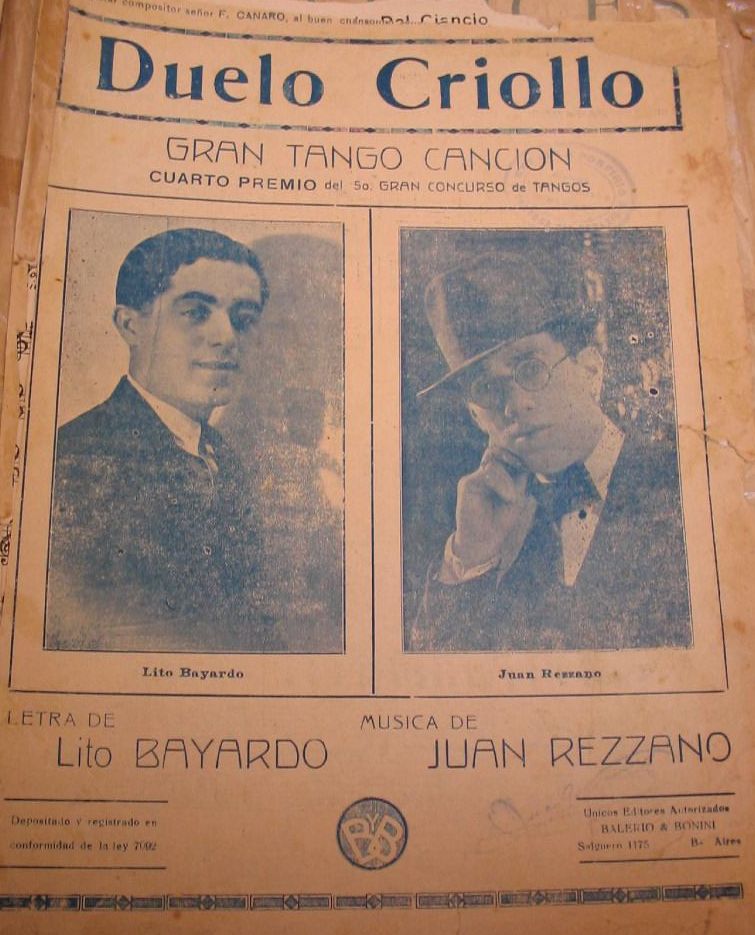
Below is the original version by Carlos Gardel from 1928 and the probably best-known version by Francisco Canaro from 1945 with Guillermo Rico as singer.
Here is the text in Spanish[5]and English:
| Mientras la luna serena baña con su luz de plata como un sollozo de pena se oye cantar su canción; la canción dulce y sentida que todo el barrio escuchaba cuando el silencio reinaba en el viejo caserón. Cuentan que fue la piba de arrabal, la flor del barrio aquel que amaba un payador. Sólo para ella cantó el amor al pie de su ventanal; pero otro amor por aquella mujer, nació en el corazón del taura más mentao que un farol, en duelo criollo vio, bajo su débil luz, morir los dos. Por eso gimen las noches de tan silenciosa calma esa canción que es el broche de aquel amor que pasó… De pena la linda piba abrió bien anchas sus alas y con su virtud y sus galas hasta el cielo se voló. | While the quiet moon sheds its silvery light like a sorrowful sigh, one can hear her song; a song, sweet and soulful, to which the whole barrio listened when silence reigned once more in the old house. They say she was the loveliest of the arrabal, the flower of the barrio, who loved a payador. He sang of love only for her beneath her window; but another love for the same woman was born in the heart of a notorious rogue, so that a streetlamp illuminated a duelo criollo— and in its dim light, both men died. That is why the nights moan with such hushed stillness, echoing that song which is the sign of a love long gone… Because of this sorrow, the beautiful girl spread her wings wide and—clad in her finest raiment, her virtue intact— soared up into the heavens. |
Here, the duel – mentioned only in passing – recedes into the background, while the woman left behind mourns the loss of her beloved, as both rivals fell in the duel.
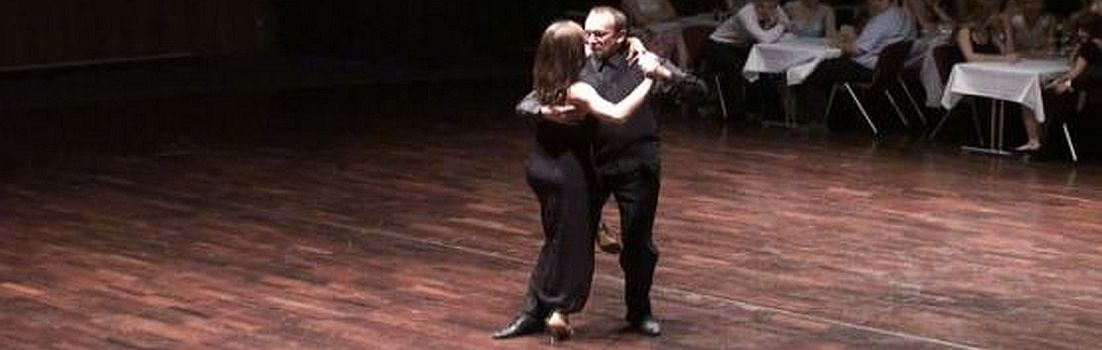
Also of interest is the theory that the tango steps of the Moulinete (step patterns for turns of the couple around a common center of rotation) are derived from the movements of “escrima criolla” [7]. Personally, I think this theory is a bit far-fetched.
Below are other versions of Duelo Criollo, first the version by Angel Vargas from 1952, the version by Alberto Marino from 1949 and the very modern version by Adriana Varela from 2001:
-Richard
Literature
1 https://en.wikipedia.org/wiki/Fac%C3%B3n
2 https://elpiantao.wordpress.com/2014/01/18/duelo-criollo/
3 http://esgrimacriolla.blogspot.com/2013/01/curiosidades-del-duelo-criollo.html
4 http://www.todotango.com/musica/tema/649/Duelo-criollo/
5 http://www.todotango.com/creadores/biografia/532/Juan-Rezzano/
6 http://www.todotango.com/creadores/biografia/938/Lito-Bayardo/
7 Sartori, R: Tango: The Essence – 49 Maxims for Dancing Eros. Dotbooks Publishing, Munich, 2012.