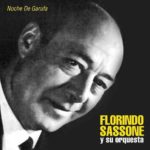
Sassone (born 1912 – died 1982) is rarely heard at milongas. Why? When colleagues are asked about it, they often say that this artist is post-EDO and doesn’t belong at milongas. Is that really true?
The idea for this blog came to me today while listening to laut.fm radio this morning. Laut.fm plays music on their tango channel, featuring tandas and cortinas, and they have exceptionally good taste in music (the link is below). So I was all the more surprised when I came across the following tanda by Sassone, precisely because the pieces aren’t among the “Big 100” that you always hear at milongas. The music has a fresh and, in my opinion, quite danceable sound, so I decided to do a little more research.
The tanda reads as follows:
Carillon de la Merced (1973?)
Re Fa Si (1973)
Felicia (1966)
A la gran muneca (1966)
All of these are titles frequently performed by other artists and thus firmly established in the passive repertoire of the average milonguero. However, a closer look at the recording dates quickly reveals interesting details (I only heard the pieces briefly once, so my comparison from memory with the recordings available to me may not be entirely accurate). What we can definitely see, though, is that the recordings are very late, indeed post-EDO. To understand why, we need to delve into Sassone’s biography.
Pedro Florindo Sassone was born on January 12, 1912, and made his debut in 1930. He then played as a violinist in the orchestras of Roberto Firpo and Osvaldo Fresedo, started with his first orchestra in 1935, and a year later played with Alberto Amor as a vocalist [1]. As an orchestra conductor, he was never in the foreground here, even giving up music entirely in 1940, only to launch a comeback in 1946-1947. His breakthrough with his music came with the discovery of the singer Jorge Casal; later, he signed Roberto Chanel as his understudy [1]. From 1947 onwards, Sassone increasingly recorded titles, with the majority of the titles being recorded in the 1950s and 1960s [2]. Sassone was already a prominent figure in cabarets and media such as radio and later television from his early days, performing as a live orchestra. This is probably one of the reasons why relatively few recordings exist.
Although he had an orchestra in the early years of the EDO, but didn’t yet make any recordings, his music can undoubtedly be placed in the post-EDO era. Stylistically, his violin parts are very strongly reminiscent of Fresedo, and a hint of Di Sarli can be discerned in the piano; nevertheless, Sassone has developed his own distinct style. In the 1960s and 70s, he played with very large ensembles [3]. The composition “Baldosa Floja” should also be mentioned in passing.
Here are the four pieces of the oA Tanda:
Sources
1 http://www.todotango.com/english/artists/biography/736/Florindo-Sassone/
2 https://www.el-recodo.com/music?O=Florindo%20SASSONE&lang=en
3 https://www.milonga.co.uk/tango/sassone.shtml
P.S.: Laut.FM Tangokanal: https://laut.fm/tango