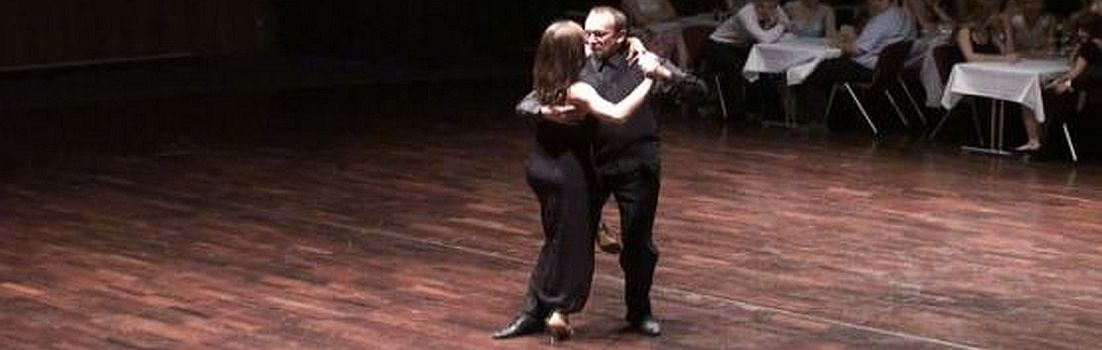
On the one hand, the goal of this blog is to give tangueros a better understanding of music and dance; on the other hand, a blog should also offer subjective and personal information. So, here are my personal impressions. When I learned in the 90s that Argentine tango wasn’t just theoretical, and when I started listening to tango music from South America, Juan D’Arienzo was one of the first names I learned. I began with three CDs: one by Osvaldo Fresedo, another by Trio Hugo Diaz, and a CD with the soundtrack to “The Tango Lesson.” After watching the film several times and playing the CD even more often, it became clear to me that my favorite music would undoubtedly be by Juan D’Arienzo. I hadn’t yet understood Fresedo’s music, and while I found Trio Diaz musically fascinating, I had no idea how one could ever dance to it. The two songs I particularly liked here were the recordings of “El Flete” and “Pensalo bien”. This was mainly because of the way rhythm was handled in this music.
The definition of rhythm is not very simple. Wikipedia describes rhythm as “a continuous structure of individual sound events.” “How exciting a rhythm is perceived to be depends heavily on the mixing ratio and the way in which its accents coincide with or deviate from the basic beat.” Very early on, I defined a distinction for myself between Latin American and European dance music. While orchestras in Europe rely heavily on specific rhythm instruments like the drums, in my opinion, it is a sign of Latin American music that all instrument groups contribute to the rhythm (often equally). This is not to say that melody instruments don’t play rhythmically; rather, it is rare for, for example, a violin section or the piano in European orchestras to have a purely rhythmic function. The classic tango orchestra (sexteto tipico) consists of a string section, a bandoneon section, bass, and piano. In tango, it is quite common to distribute tasks differently within these sections, meaning all instruments can play either rhythm or melody.
Playing the notes and rests with strong accents and independently of each other (musically: staccato) enhances the impression of rhythm. Besides very fast passages, accented playing, and syncopation, the music of Juan D’Arienzo exemplifies this approach.
It all began with a musician of Italian descent, born in December 1900 in Buenos Aires (Balvanera district). Juan D’Arienzo learned to play the violin at the age of 12 and made his debut at the National Theater in 1919, performing alongside Angel D’Agostino as a pianist [2] and Ernesto Bianchi on bandoneon, which led to the formation of a first orchestra. D’Agostino left this orchestra and was replaced by Luis Visca. Even at this early stage, D’Arienzo had stylistically distanced himself from the then-prevailing sound of Julio De Caro (Decarismo). Between 1928 and 1929, D’Arienzo made 44 recordings for Electra. Electra’s owner, Alfredo Amendola, was the brother-in-law of D’Arienzo’s father and wanted to give Juan a chance to launch his career [8]. Among those playing the bandoneon were Ciriaco Ortiz and probably also Pedro Maffia. While D’Arienzo played one of the three violins at that time, this would change in later formations, where he only conducted the orchestra [4]. Carlos Dante and Francisco Fiorentino were among the singers. D’Arienzo made no recordings between 1929 and 1935, after which he switched to RCA Victor. He made some instrumental recordings with, among others, Luis Visca and Lidio Fasoli on piano. Anibal Troilo was one of the guest musicians featured on these recordings [4]. Otherwise, the orchestra played with three bandoneons, three violins, bass and piano at the Cabaret Chantecler.
Everything changed later in 1935 when a new pianist joined the then sextet [2]. The pianist Rodolfo Biagi switched from the Juan Canaro Orchestra to D’Arienzo’s when Visca’s contract expired. Visca, otherwise a decent pianist, was frequently ill, and since Biagi also played with Juan Canaro’s orchestra at the Chantecler, he occasionally filled in for the ailing Visca [9]. Visca left the orchestra at the end of 1935 because of his deceased father [10].
Biagi had previously played in some recordings for Gardel and afterwards in the orchestras of Juan Bautista Guido and Juan Canaro [4]. Horacio Salas describes D’Arienzo in his book as an orchestra leader who, around the year 1935, had “only been moderately successful so far.” [3]. Rodolfo Biagi’s entry made 1935 a pivotal year for his subsequent career [2].
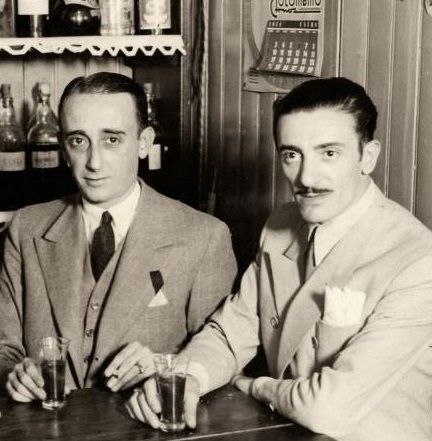
Juan D´Arienzo together with Rodolfo Biagi
Together with Biagi, he contrasted De Caro’s softer, more sentimental style with a more rhythmically accentuated one. Traditional pieces were played faster, with plenty of staccato and a simple yet stringent rhythm. The music was very danceable and brought back the original “dos por quattro” (2/4) time signature [2,3]. Also typical of Biagi are the short piano figures between the musical phrases. This unprecedented style of playing earned Biagi his nickname “Manos brujo” (magic hands). Other elements that D’Arienzo always emphasized were the legato playing of the violins’ contraltos, and, typically as the piece’s conclusion, the trio section (Spanish: “Variación”), in which the bandoneons, in virtuosic passages of 32nd to 64th notes, usually further enhance the rhythmic component.
Biagi left D’Arienzo’s orchestra in 1938 to build his own. He was succeeded by Juan Polito until 1940, then Fulvio Salamanca from 1940 to 1957, and afterwards Juan Polito again took over as pianist. Even Carlos Di Sarli was briefly a pianist in D’Arienzo’s orchestra. Undoubtedly, the pianists were always the backbone of his orchestra. There is much debate about who was ultimately responsible for developing this distinctive style. It is generally accepted that the main aspects originated with Biagi, who also wrote the arrangements and later continued this ultra-rhythmic style in his own orchestra.
The reasons for Biagi’s departure are much debated. One reason was likely his growing popularity as a star of the orchestra, which overshadowed D’Arienzo as conductor. A rumor suggests that the real break occurred one evening in mid-1938 when the orchestra played “Lagrimas y Sonrisas” and the brilliant Biagi received a standing ovation. D’Arienzo is said to have then told Biagi, “I am the only star in my orchestra, and you are fired!” [6]. This end came suddenly, but not unexpectedly. It is also rumored that the tango “Piensalo bien” (“Think about it carefully”), recorded in their last recording session together on June 22, 1938, heralded the approaching end, especially since it was a tango never before performed, with lyrics written by D’Arienzo’s friends [6]. In the first session after Biagi’s departure, just two weeks later with Polito as the new pianist, D’Arienzo performed the song “Nada mas” with the main line “I want nothing more, nothing more than that you don’t leave me.” Ah, here one could see a musical message [6]. Biagi understandably needed a little longer, as he had to assemble a full orchestra. He managed to do this in just two months.
D’Arienzo always played for the dancers, who ultimately made him rich. His music is either appreciated or despised by tango connoisseurs, but it is undeniably captivating because the rhythm immediately gets under the skin of dancers of all skill levels. In his biography, José Gabello writes that D’Arienzo gave tango back to the dancers and (quoting José Luis Macaggi) that he thereby made the Cuarentas possible [2]. Nevertheless, D’Arienzo’s popularity among the dancers declined after Biagi left his orchestra. It was also viewed negatively that, to put it kindly, D’Arienzo was politically very neutral; some even claimed he was always very close to the ruling regime. D’Arienzo himself admitted to having been a personal friend of General Perón [10]. Tango lovers also resented his attempts to create a tango for export [12].
D’Arienzo collaborated with many different singers. Throughout most of his career, he consistently emphasized the primacy of the orchestra, relegating the singers to a subordinate role as estribillistas and cantores de orquesta. Only in his later years did he abandon this approach, recognizing the singers in a more prominent position. Among his most famous singers were Alberto Echagüe, Hector Maure, Mario Bustos, and Jorge Valdez. In many cases, even the singing itself was used for a rhythmic component. A complete list of singers can be found, among other places, on Gregory Diaz’s website [4]. There you can also find a discography of Juan D’Arienzo’s works, where you can even listen to short samples of the pieces (for the first few seconds) [7].
Juan D’Arienzo died in Buenos Aires on January 14, 1976, and is buried in the Chacarita Cemetery. Even before his death, the orchestra continued to operate under the name Los Solistas de Juan D’Arienzo, using his name as a brand [8].
Very conservative DJs (especially in Buenos Aires) mainly play D’Arienzo’s tracks where Biagi is on piano [12]. I personally don’t want to comment on that, nor on the views that D’Arienzo, who neither played in the orchestra nor wrote the arrangements of his pieces, is a completely overrated artist (to put it mildly), whose pieces didn’t reflect the sophistication of the styles of the time. D’Arienzo was undoubtedly a superb conductor, and without his collaboration with Biagi, the Cuarentas would have looked very different, because many of the existing large orchestras had more or less adapted to his rhythmic style and increased tempo.
Juan D’Arienzo left behind a vast body of recordings. Tango.info lists 4540 tangos, 550 milongas, and 454 valses [11], 46 compositions, 3 texts, and an estimated 1119 performances. Estimating the exact number is difficult, as D’Arienzo sometimes conducted up to four orchestras [12]. It is rumored that he sometimes had several sessions in the evening, conducting a few pieces with each orchestra and then quickly rushing to the next one to be seen there.
To give some musical examples, we begin with “Esta noche me emborracho” from the first series of recordings in 1928 with Carlos Dante as singer:
Aside from the shellac artifacts, what we hear here is a tango with a solid basic rhythm, well-structured interplay between bandoneons and violins, and a somewhat colorless Esribillo by Carlos Dante—all in all, a piece in the typical style of the transitional period between Guardia Vieja and the Cuarentas, still bearing a strong Guardia Vieja influence. It is not unusual, by the way, that D’Arienzo recorded precisely this tango with the famous lyrics by Discepolo, after its premiere by Azucena Maizani on March 22, 1928 [5] and was also sung in the same year by Gardel, who shaped the interpretation with his typical style.
If you listen to the same piece from a later phase (after Biagi) with Echagüe as the singer, it sounds completely different:
In particular, one can hear that the piano playing is more dominant and the interpretation tends more towards a staccato-like tone. The short piano passages between phrases and the legato violin playing in between, over the consistently metronome-like rhythm, are clearly audible.
Here is the piece “Pensalo bien,” with which D’Arienzo Biagi presumably wanted to warn against leaving. For me, this song and the short scene from Tango Lesson (masterfully danced by Pablo Veron) were one of the moments that awakened my love for tango.
In this recording we hear Biagi at the piano. “9 de Julio” serves as another example of the interplay between D’Arienzo and Biagi, and this is one of the first recordings in this formation. I have the feeling that Biagi is holding back quite a bit, but you can already sense him pushing to the surface.
D’Arienzo made further recordings of this tango in 1950 and 1966, which can also be found on YouTube. Another example is “Indiferencia,” here in the 1938 recording with Echagüe, a piece composed by Biagi:
This means the piece has been adapted to the new style. Biagi’s typical little piano figures are clearly audible.
After publishing this article, it was suggested that I use the following title to demonstrate that Juan D’Arienzo also recorded in a somewhat softer style. I am happy to comply with this suggestion. Here is the 1944 recording of Amarras with Hector Maure:
As an example of D’Arienzo’s later style, here is the song “Mi Dolor” sung by Osvaldo Ramos, a song with limited danceability, but one that fascinated me musically for a long time. Here it is danced by Frank Obregon and Jenny Gil:
In some old videos from a TV production, you can see D’Arienzo in a live recording. First, here is the instrumental version of Loca; I would like to draw attention to the violin solo of the Contrecanto. D’Arienzo always had this played by a soloist. Typically, he had these passages played by the violin on the 4th string (“cuarta cuerda,” D string), which produced a fuller (cello-like) sound. At times, D’Arienzo played with up to 10 violins in the orchestra. At approximately 1:50, the soloist (probably Bernardo Weber) steps forward and plays the Contrecanto. The pianist is Juan Polito, and the first bandoneon we hear is Carlos Lazzari.
As another example of the integration of vocals into the orchestra, here is the recording of “Nada mas” with Mercedes Serrano as the singer, who sings an unusually long part for D’Arienzo in front of the orchestra:
In the Chronica TV program, here are some more clips with Juan D’Arienzo and Armando Laborde, Alberto Echagüe and Osvaldo Ramos:
Acknowledgement
This article was posted in the forumwww.tanzmitmir.at and discussed. I would like to thank Cassiel, Solotango and Tango-Vifzack for their help.
Literature:
1 https://de.wikipedia.org/wiki/Rhythmus_(Musik)
2 http://www.todotango.com/english/artists/biography/32/Juan-DArienzo/
3 Salas H: Der Tango. Abrazos Books, 2002. p. 292
4 https://www.el-recodo.com/juandarienzo-en?lang=en
5 https://es.wikipedia.org/wiki/Esta_noche_me_emborracho
6 https://elespejero.wordpress.com/2015/06/22/tango-stories-pensalo-bien/
7 https://www.el-recodo.com/music?O=Juan%20D%27ARIENZO&lang=en
8 http://www.todotango.com/english/history/chronicle/522/Orquesta-Tipica-Juan-DArienzo/
9 http://www.todotango.com/english/history/chronicle/286/Biagi-Interview-to-Rodolfo-Biagi-in-1960/
10 http://www.todotango.com/english/history/chronicle/4/DArienzo-Tango-has-three-things/
11 https://tango.info/JuanaDarie
12 http://www.totango.net/DArienzo-Biagi-export.html