
Imagine a tango festival where thousands of fans celebrate tango and compete in dancing and singing to be crowned a new tango king! This isn’t a Bajofondo concert in Buenos Aires (although that can also attract thousands), but one that takes place every year in a small town in Finland.
Following the tango craze in France and Berlin between 1910 and the late 1920s, people in Europe were confronted with tango music, which was both fascinating and unsettling. Almost immediately, local musicians began playing Argentine tangos and European compositions with lyrics in their respective languages. The era of the tango hit was born, but it was abruptly ended by World War II. After the war, Europe was flooded with American rock and roll, and tango almost faded from public consciousness. There was one notable exception in the far north of Europe: Finland.
During and after the war, famous singers performed tangos with Finnish lyrics [1]. One of them was Georg Malmsten, born in Helsinki in 1902, who, however, came from the Swedish population of Finland. He began his career as a naval officer and studied opera singing [2]. He mainly sang popular songs, most of them self-composed and arranged, and recorded more than 800 pieces, mostly in minor keys. His most famous tango is ‘Valkea Sisar’ (‘White Sister’) [3]. His well-defined and refined voice is particularly striking, making this no ordinary pop song, but a serious musical masterpiece. In the instrumental section, the bandoneon has been replaced by an accordion, and the rhythm is primarily driven by raw power (drums), but the main instruments (violin and wind instruments) are beautifully arranged polyphonically, giving the song a familiar sound to tango fans.
Songs in minor keys and in the tango style are a typical characteristic of Finnish tango. Some describe Finnish tangos as ‘tango on the rocks,’ perhaps because Finns have a particular way of expressing their feelings. It seems as if they need the melancholy of their tangos to melt the ice. Others mention the particular Finnish way of perceiving life as miserable and hopeless. The Finnish newspaper ‘Helsingin Sanomat’ even held a competition in 2006 for the most melancholic song of all time. Fortunately, neither of the two winning songs was a tango [4]. In a country where it stays dark for four months and the suicide rate is high, it’s easy to become depressed anyway. Perhaps the Finns dance to get rid of their depression.
The most popular tango singer was Olavi Virta, born in Sysmä in 1915. He was known for nearly 600 recorded songs, as the first true king of tango, and for the tragedy of dying in poverty after years of alcohol abuse. His first records from 1938 include some of the most beautiful songs:
Unohtomaton Koti [unforgettable home]
Vain yhtä pyydän [I only ask one]
Here too, we can hear almost Argentinian arrangements. Finnish tangos of later origin often resemble European ballroom tango more closely. Since there are no free sources for listening to both songs, the intros and vocal parts (tracks 18 and 22) can be found at Tricont [5] and Amazon [6]. You can listen to the recordings in advance or buy the CD that I use for DJing.
One of his later tangos (Punatukkaiselle tytölleni – “my red-haired girl”) can be heard here:
Interestingly, at the beginning of his career he also recorded traditional Argentine songs, such as ‘El Choclo’ (‘Tulisuudelma’) and ‘La Cumparsita’ [7], for which he received a gold medal for both. Interestingly, he recorded the first one as a mambo.
Finally, let’s mention the song that some Finns consider the unofficial national anthem. It’s a tango by Unto Mononen, born in 1930 in Muolaa. He began his career as a singer but switched to composition after his voice was damaged following a botched thyroid operation [8]. His most important tango, ‘Satumaa’ (‘Fairyland’), was composed in 1955 but had a difficult start. It gained widespread recognition when Reijo Taipale performed it in 1962. Since then, it has been performed by numerous musicians, including Olavi Virta, Eino Grön, and even Frank Zappa.[9], who breaks his tongue trying to read the original text (for those who want to try, here are the original vocals: [10]).
I also mentioned the competition for the most melancholic Finnish songs. Satumaa was nominated for first place.
Here are a few more significant examples of “Satumaa”:
Eino Grön’s version dates from 1973. Here, the change in instrumentation from traditional Argentine tango to European ballroom tango is clearly evident.
Finland has produced numerous important tango singers, and I’m very sorry I can’t mention them all. In conclusion, I’d like to mention Taisto Tammi and, as a singer, Laila Kinnunen, who in 1961 was the first singer to represent her country at the Eurovision Song Contest [11].
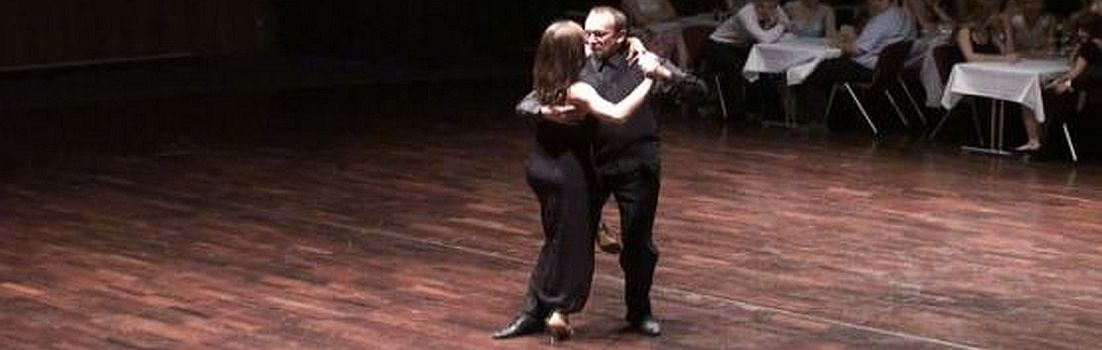
What does tango look like in Finland? It’s not really connected to the Argentine technique and isn’t as refined as the European standard tango. It’s more like a social dance without major or minor intricacies, but made for and by the people. Since the Finnish dance posture is very similar, we can describe Finnish tango as European tango in an Argentine (close) posture.
Here’s a video about it:
Where can you dance Finnish tango? At Finland’s largest tango festival, the ‘Tangomarkkinat,’ in Seinäjoki, a small town 350 km north of Helsinki, of course. The estimated attendance is 120,000, which is quite a feat for a town of only 28,000 inhabitants. The festival was established in 1985 as an annual event. Its highlight is a tango singing competition, usually broadcast by Finnish television stations. The winners of this competition are officially called tango kings or queens and typically win record deals [12]. Many careers have started here. There are also competitions in dancing, or for the best tango composition and the best lyrics [13]. In 2013, Kyösti Mäkimattila and Heidi Pakarinen were crowned Tango Queens [14].
In conclusion, Finland has the second-largest tango scene in the world (after Argentina). The Finns cultivate their own style, which can be both astonishing and truly unique. If you’d like to explore the more unusual side of Finnish tango, please read ‘Tango on intohimoni’ (or ‘Tango is My Passion’) by MA Numminen [15].
So the next time you hear a tango song with non-Spanish vocals, there’s a good chance it’s a Finnish song. And that’s nothing more than basic knowledge that any trained tanguero/tanguera should have!
Abrazos!
-Richard
1 http://en.wikipedia.org/wiki/Finnish_tango
2 http://de.wikipedia.org/wiki/Georg_Malmst%C3%A9n
3 http://translate.google.de/#auto/en/Valkea%20Sisar
4 http://www.finnland-forum.de/viewtopic.php?f=2&t=1805
5 http://trikont.de/shop/all-worlds-alle-welten/finnischer-tango-1-tule-tanssimaan/
6 http://www.amazon.de/Finnischer-Tango-Tule-Tanssimaan-Various/dp/samples/B000023YPB/ref=dp_tracks_all_1#disc_1
7 http://en.wikipedia.org/wiki/Olavi_Virta
8 http://en.wikipedia.org/wiki/Unto_Mononen
9 http://en.wikipedia.org/wiki/Satumaa
10 http://www.justsomelyrics.com/329692/satumaa-lyrics.html
11 http://en.wikipedia.org/wiki/Laila_Kinnunen
12 http://en.wikipedia.org/wiki/Tangomarkkinat
13 http://www.tangomarkkinat.fi/en/program.html
14 http://www.helsinkitimes.fi/lifestyle/7192-a-tango-for-finland-2.html
15 http://en.wikipedia.org/wiki/Tango_on_intohimoni