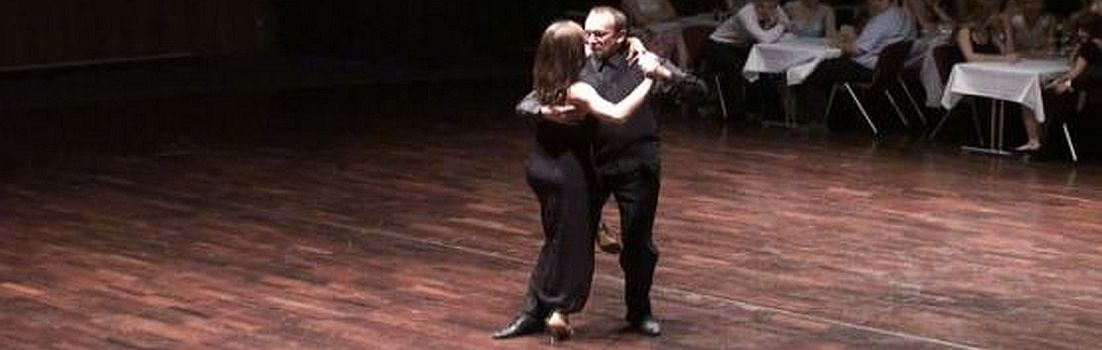
Today’s article is about a rather old tango which, in my opinion, exemplifies the tragedy of fate, but makes it a wonderful declaration of love for tango.
The song ‘De mi Barrio’ was written in 1923 by Roberto Goyheneche [1]. It’s important to note that the name is spelled with an ‘h’ and not to be confused with the famous tango singer Roberto Goyeneche (‘El Polaco’), who was born in 1926. Roberto Emilio Goyheneche lived from 1898 to 1925. Born in Buenos Aires, he studied piano and played in Juan Carlos Bazan’s orchestra, later as pianist for Eduardo Arolas, and until 1922 in Roberto Firpo’s orchestra. He then formed his first orchestra, which included the bandoneon player Pedro Laurenz [2].

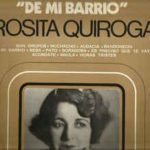
The composition of ‘De mi Barrio’ in 1923 was presumably intended for Rosita Quiroga, who first recorded the song in 1924. Other famous singers such as Susana Rinaldi and Isabel de Grana (together with Canaro) followed, and the song has since become firmly established in the repertoire of modern tango singers (some examples below). The lyrics are told from a woman’s perspective, but this hasn’t stopped male tango singers from interpreting the song (for example, Alberto Castillo and Mario Alonso).
Beyond this purely technical background information, I personally find the text very interesting. I confess that I put my rudimentary Spanish skills to the test with this text, perhaps because I was fascinated by the interpretations of several modern singers. Here is the text [3]:
Yo de mi barrio era la piba más bonita,
en un colegio de monjas me eduqué
y aunque mis viejos no tenían mucha guita
con familias bacanas me traté.
Y por culpa de ese trato abacanado
ser niña bien fue mi única ilusión,
y olvidando por completo mi pasado,
a un magnate entregué mi corazón.
Por su porte y su trato distinguido
por las cosas que me mintió al oído,
no creí, que pudiese ser malvado
un muchacho tan correcto y educado.
Sin embargo, me indujo el mal hombre
con promesa de darme su nombre,
a dejar mi hogar abandonado
para ir a vivir a su lado.
Y es por eso que mi vida se desliza
entre el tango y el champagne del cabaret
mi dolor se confunde en mi sonrisa,
porque a reír mi dolor me acostumbré…
Y si encuentro algún otario que pretenda
por el oro mis amores conseguir,
yo lo dejo sin un cobre pa’ que aprenda
y me paguen lo que aquel me hizo sufrir.
Hoy bailo el tango, soy milonguera
me llaman loca y ¿qué se yo?…
Soy flor de fango, una cualquiera
culpa del hombre que me engañó…
Entre las luces de mil colores
y la alegría del cabaret,
vendo caricias y vendo amores
para olvidar a aquel que se fue…
This is the english translation:
In my neighborhood, I was the most beautiful girl
educated in a nun convent
and although my parents did not have much money
i had dealings with high standing families.
And because of this fine behavior
it was my only illusion to be a good girl
and completely forgetting my background
I gave my heart to a magnate.
Because of his habitus and his noble demeanor,
because of the things he lied to my ear,
I did not believe that such a correct and educated person
could be bad.
However, the bad person seduced me
with the promise to give me his name
to leave my home abandoned
to live by his side.
And that’s why my life slides
between the tango and the champagne of the cabaret,
my pain is confused in my smile
I’ve got used to smiling my pain.
And when I meet someone who believes
to get my love for gold
I leave him without a single piece of copper to learn
and pay me for what made me suffer.
Today I’m dancing Tango, I’m Milonguera
they call me crazy and “what do I know”?
I am a bloom of the swamp, a someone
because of the man who betrayed me.
Among the lights of a thousand colors
and the joys of the cabaret
I sell caresses and love
to forget the one who left.
One can now debate whether the protagonist was broken by lost love and tried to forget her pain in cabaret, or whether this twist of fate created a strong woman who proudly embraced her life as a milonguera and wanted to take revenge on the ‘evil’ men – I personally believe in the latter interpretation – at least I see in the lyrics of the refrain a very touching declaration of love for tango and milonga.
Here are some interpretations of the song:
A very early version of Rosita Quiroga from 1926
A later version of Rosita Quiroga from 1952
This version, starring Isabel de Grana and Canaro, offers much more drama:
A slightly softer version with Fanny Navarro and Julio de Caro
Another version, sung by Susana Rinaldi.
Tango singers have also performed the popular song, although it doesn’t really fit due to the lyrics. Here’s a small selection:
Mario Alonso is singing together with Canaro
Alberto Castillo (with Tanturi) has recorded the song.
While early versions (such as Rosita Quiroga) are still heavily influenced by a Gardel style interpretation, modern recordings use more musical and emotional bandwidth. Since many modern tango singers have the song in their repertoire, here are just a few examples. Lets start with my favorite:
This version of Stella Milano is from 2002.
Another modern version with Lidia Borda from 2005
The version by Serena Wey (with Estufa Caliente) from 1997 is also very beautiful (unfortunately not on YouTube).
Finally, the instrumental versions:
OTV with a very early recording from 1927, a version I like to play on the dance floor.
A recording by Osvaldo Fresedo from 1925 is rarely heard (unfortunately not on YouTube).
Literature
1 http://www.todotango.com/creadores/ficha/61/Roberto-Goyheneche
2 http://www.todotango.com/creadores/biografia/874/Roberto-Goyheneche/
3 http://www.todotango.com/musica/tema/2092/De-mi-barrio/