

As a tango DJ, I started collecting tango music back in the 90s. This was mainly CDs, bought in Germany, Argentina, and Australia. Consequently, my tango music collection is extensive, and I sometimes have trouble keeping track of it all. A lot of money has gone into my collection and equipment, without any chance of ever getting it back, but that’s okay.
Tango beginners and DJs alike often struggle to find any music at all. These days, that’s not as big a problem as it was in the 90s. You can even get music for free and legally. The solution is internet radio.
As a teenager, I was fascinated by shortwave radio and the idea of listening to music from faraway countries and in other languages (I remember Radio Peking sending me a thick envelope full of brochures in response to a reception report for their German program). Later, it was common to make recordings from FM radio and use them to create mixtapes for the car or to impress a lady (who remembers compact cassettes?). These recordings from the radio were, and still are, legal for personal use. The only downside was the rather poor sound quality. Today’s radio stations broadcast their music “streams” worldwide via the internet in far superior quality.
You don’t even need a computer to receive it; modern surround sound receivers and even clock radios already contain chips that can receive internet radio. The point here is that recording these radio stations is also legal and in the public domain in most countries, as long as it’s for personal use.
Recording radio stations is easy; there are programs available for this purpose. These programs save the music as individual MP3 files to your hard drive, and some even tag the files automatically. Such software is available as freeware. I will introduce one such program below.
How does this fit with tango? Traditionally, Argentina has many radio stations specializing in tango music, but these now also exist internationally. Well-known examples include “Radio Malena” and “2×4” from Buenos Aires, “Radio Tango-Velours” from Paris, and “Tangoparabailar” from Germany, the latter even playing in the tanda format. More comprehensive lists can be found via Google or, for example, here:
- http://streema.com/radios/genre/Tango
- http://www.internet-radio.com/stations/tango/
Many of these stations transmit at a bitrate of 128 kbps, which is perfectly adequate for listening; some play at 64 kbps, but that’s already below my personal quality threshold. If you save these songs to your hard drive, you’ll quickly amass a collection of several thousand tracks, and the genre can be tailored to individual preferences by selecting different stations. For the connoisseur, this is a fascinating option, but for the aspiring DJ, it’s only indirectly beneficial, as publicly using music from this source is highly likely (depending on the country) to violate copyright laws, since these copies are only legalized for personal use. I personally also have reservations about the quality. My main reason for listening to internet radio is to stay on top of current trends and discover new music. Furthermore, the radio stations’ playlists are compiled by people who know their stuff and are sometimes experienced tango DJs. Listening to their playlists is like the famous “learning from the best” for me. I now believe that engaging with current tango radio programs provides more efficient information than a tour of CD shops in Buenos Aires.
Here’s a short tutorial: The software I’m using is Streamwriter, a program offered for download here by the German author (Alexander Nottelmann):
- https://streamwriter.org/en/
There are a few other programs available, but I chose Streamwriter because it can be easily adapted to different needs. Therefore, I won’t be discussing “RarmaRadio,” “Screamer Radio,” or “StationRipper” here, and I also can’t comment on the situation with Apple devices, as I have no experience with them.
Streamwriter as software for recording tango music
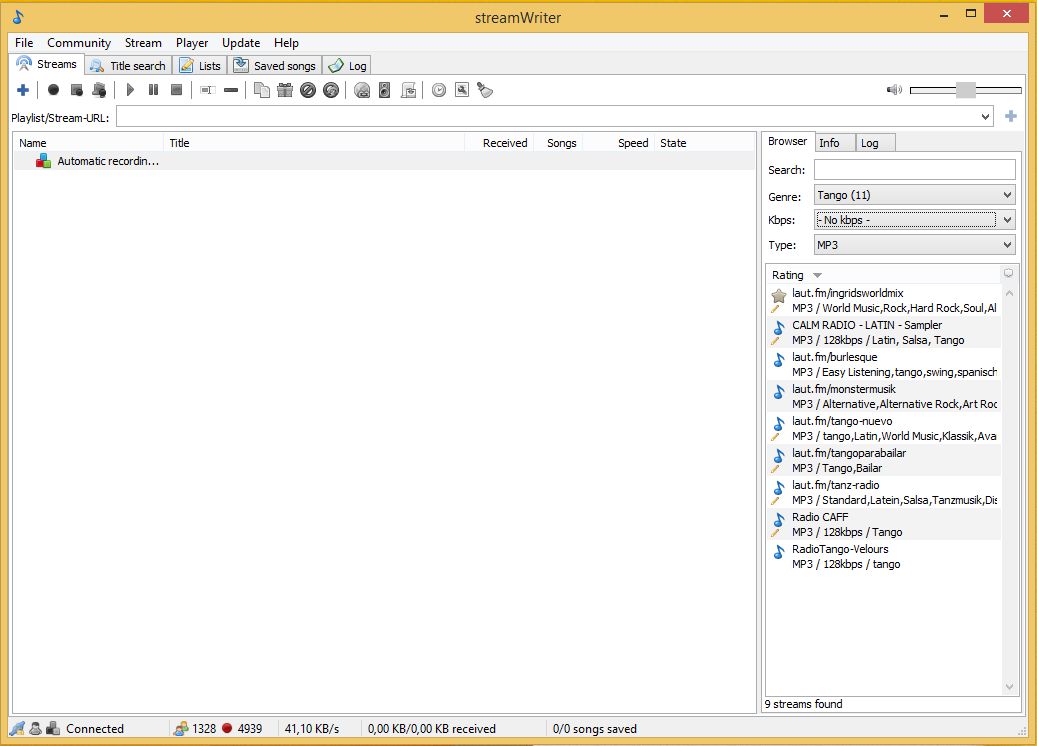
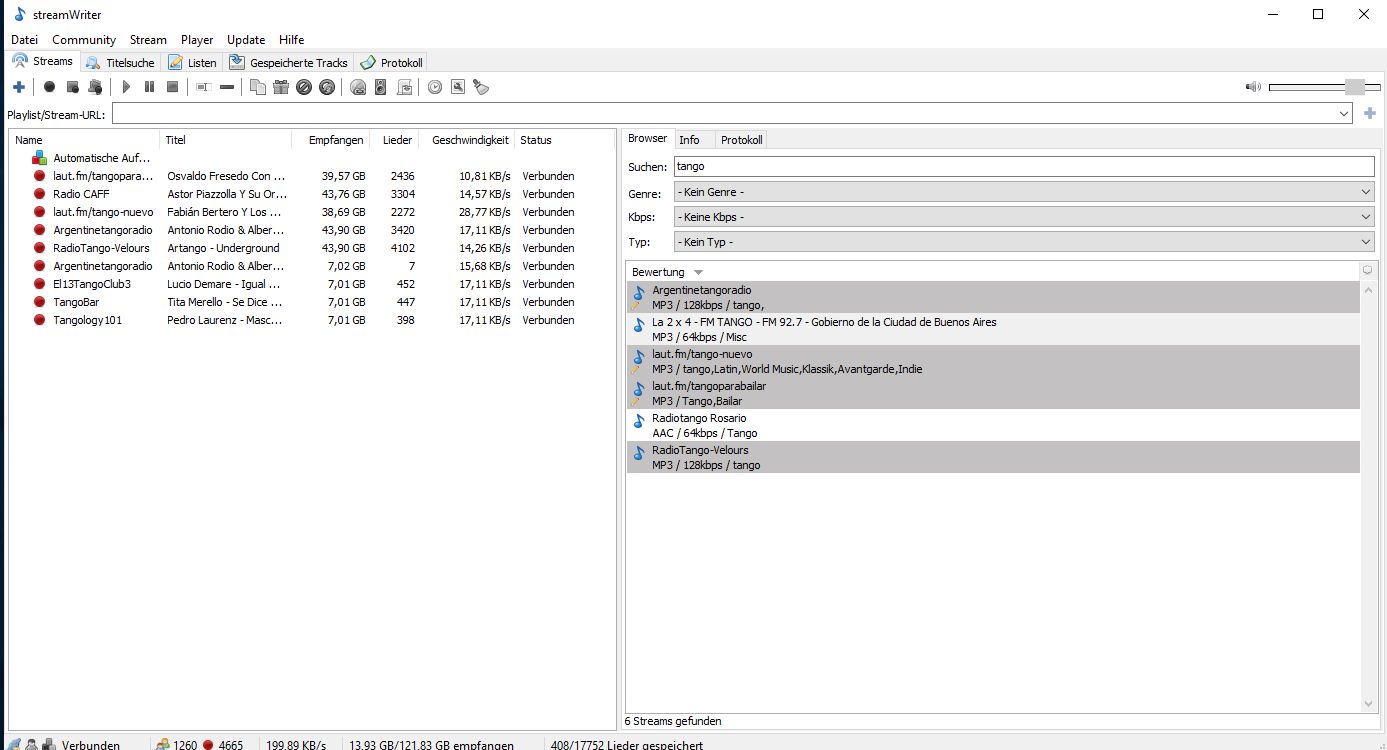
Streamwriter can be easily installed on a PC. You’ll initially see a screen with two sections. On the left is the (currently empty) list of selected streams, and on the right is a list of currently playing stations. In the genre field, we now select “Tango”.
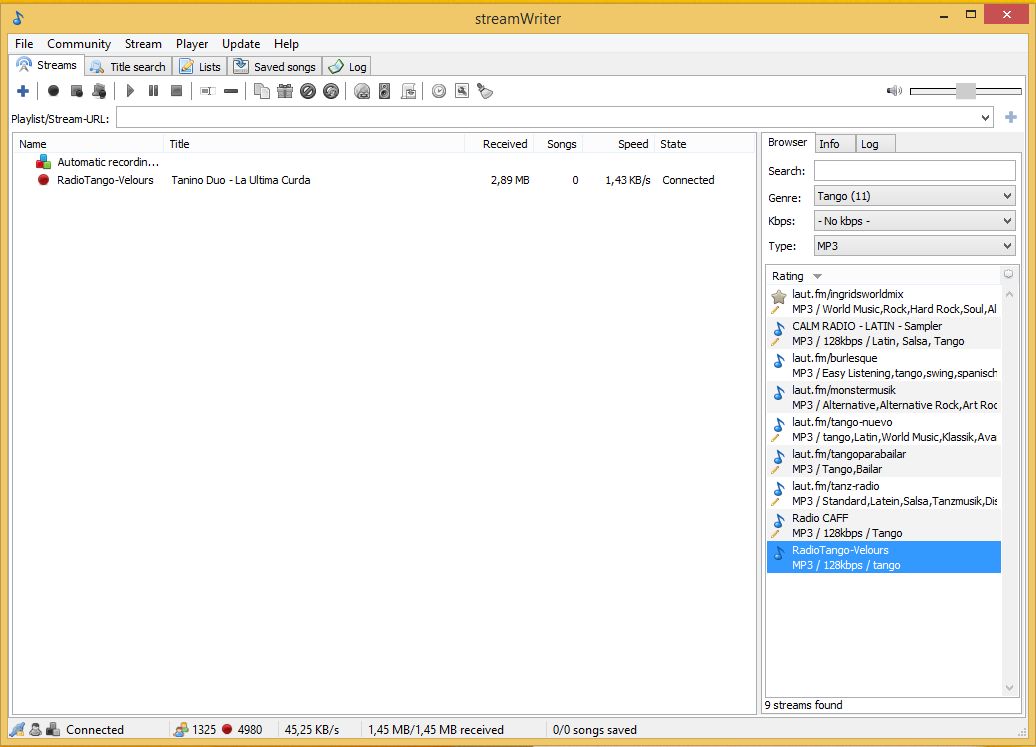
When you select a station, it’s copied to the left and the program immediately starts recording (red dot!). I’ve set this up here for the French station “Radio-Velours”. The current song is displayed in the title bar; in this case, it was “La ultima curda”.
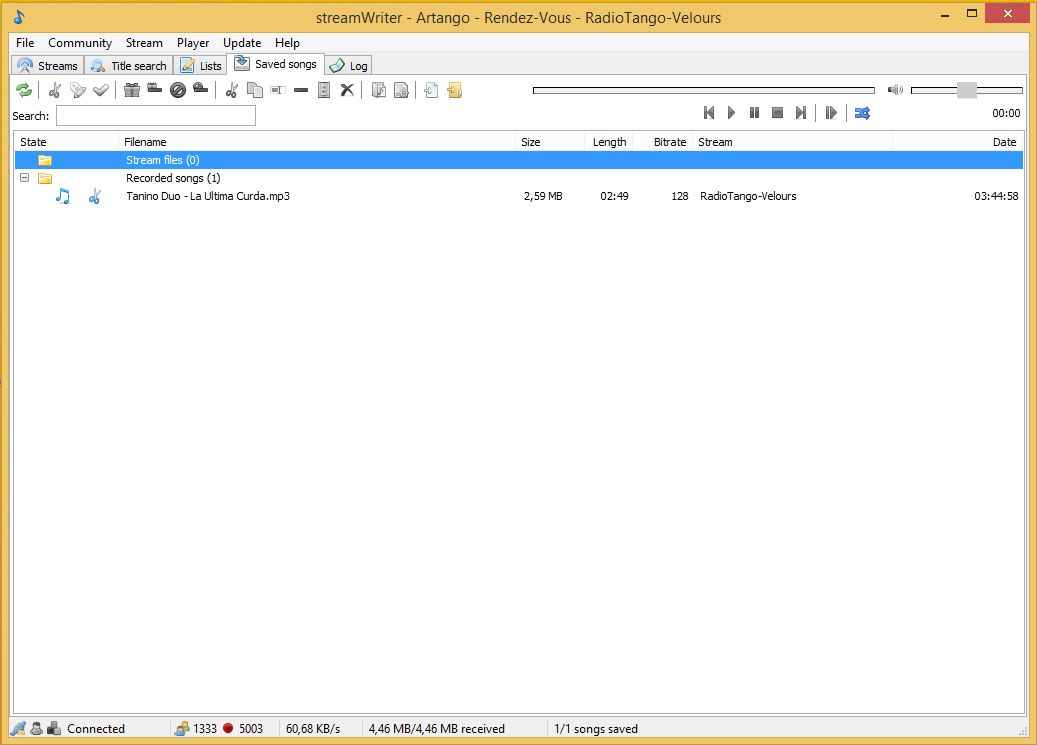
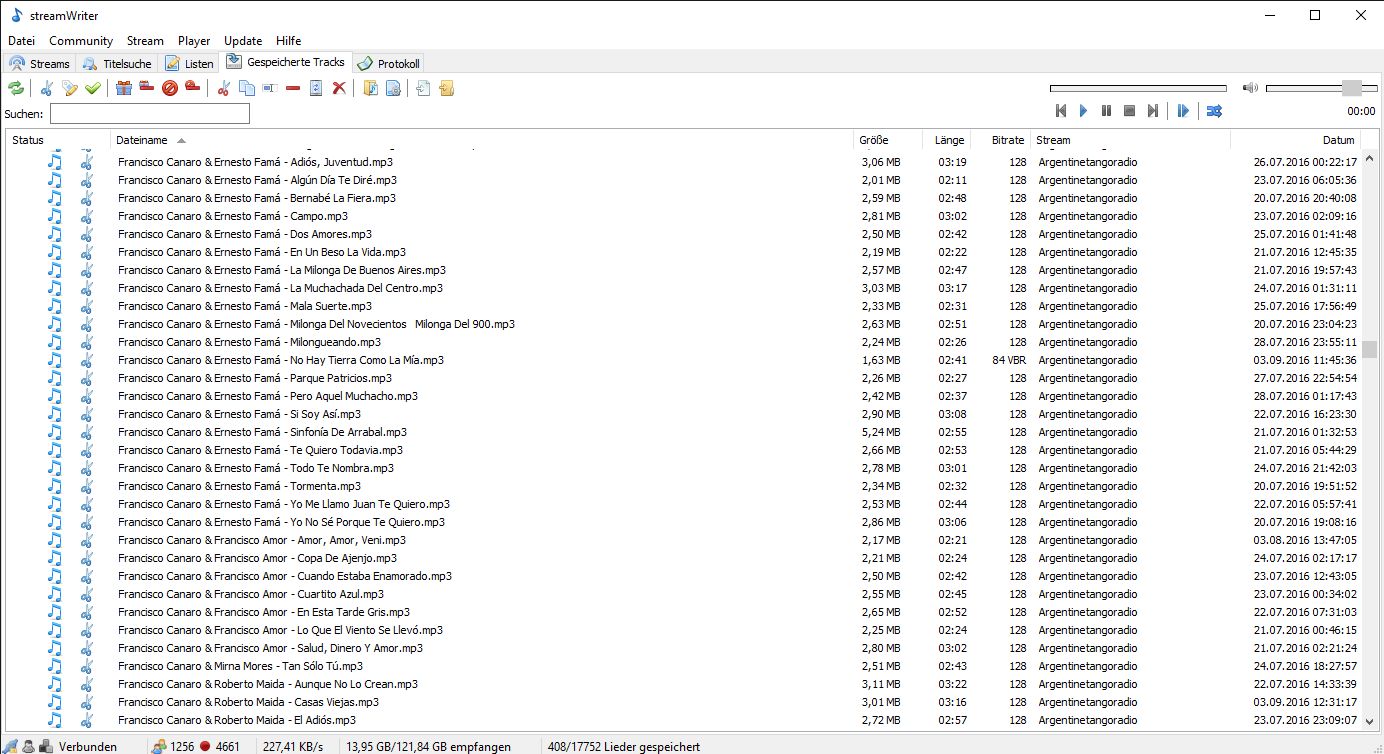
After a while, the recording is complete and the song appears in the list of saved songs. The bitrate of 128 kbps is also noted here.
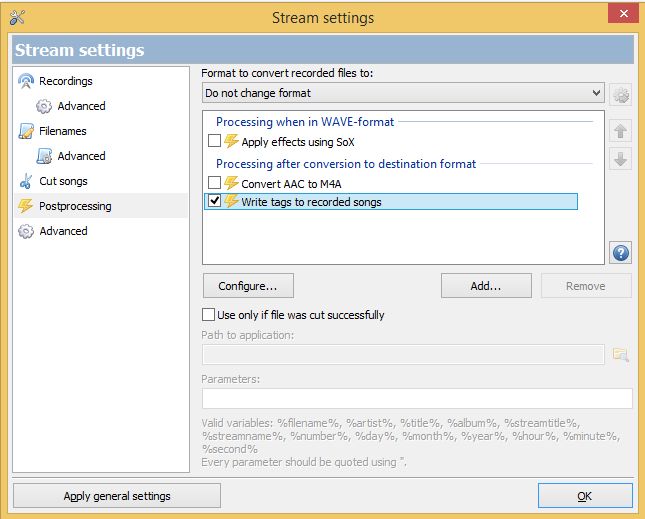
The MP3 file doesn’t have any tags yet. These would have to be added manually. It’s easier to configure Streamwriter to do this automatically in the “post-processing” settings.
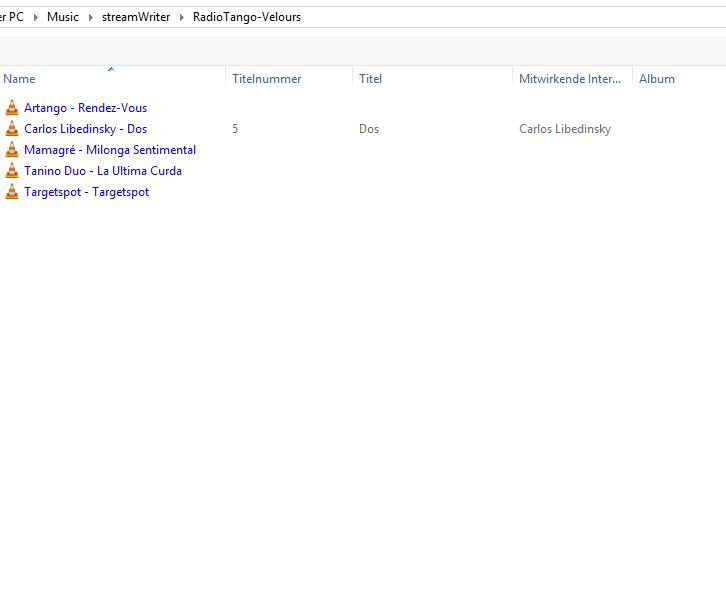
The music files are now stored in the Music/streamwriter directory under the station name. The song “Dos” has also been saved with tags for title and artist.
What I found particularly fascinating was that Streamwriter allows you to record from multiple stations simultaneously. Below is a list of my current stations. I’ve been recording for several weeks now and have already recorded more than 10,000 songs.
With a little practice, you’ll quickly find out how to add additional stations to the list or how to instruct Streamwriter not to create duplicates.
The list of recorded songs is very easy to search, browse, and play with a single click.
It has never been easier to legally obtain many tangos in good listening quality. I wish you much fun and enjoyment with this, and I hope you will also succumb to the fascination of not only saving the songs but also listening to the commentary by Argentinian radio presenters.
Greetings,
-DJ Ricardo