Let’s take a trip back to the early days of tango. The musicians of the so-called ‘Old Guard’ (‘Guardia Vieja’) were generally not formally trained instrumentalists with conservatory education. Consequently, their compositions tended to be rather simple, or the musicians had to overcome long and arduous career paths. Until the 1940s, it was therefore common practice for orchestras to employ professional musicians who arranged the scores for the ever-growing ensembles. Today, we see an example of an orchestra in which classically trained musicians played tango and emancipated themselves from the Old Guard. Accordingly, they were considered part of a newly emerging ‘New Guard’ (‘Guardia Nueva’). It is 1924, the era of the famous sextets, and it was precisely during this time that Julio De Caro founded his renowned sextet, which significantly influenced the development of tango for the following decade.
Julio De Caro was born on December 11, 1899 (exactly on Carlos Gardel’s birthday), practically into a conservatory; his father, José De Caro, the former director of the conservatory at the Teatro della Scala in Milan, ran a shop for instruments and sheet music as well as music lessons in Buenos Aires [1, 2]. Julio was born the second of 12 children into a wealthy family and received a thorough musical education there, just like his brothers Francisco and Emilio [3]. Julio began studying piano but soon switched to the violin, simply swapping instruments with his brother Francisco. From the outset, his strict father envisioned a career for Julio as a soloist in a symphony orchestra, but the youngsters were strictly forbidden from engaging with the then-flourishing tango. Nevertheless, the boys frequented the city’s tango salons and befriended local tango luminaries (Eduardo Arolas, Juan Carlos Cobian, and Roberto Firpo). Vicente Greco, another influential orchestra leader, was a frequent guest at the family home [2]. In 1917, Julio played a piece for Firpo’s orchestra at the Palais de Glace on a borrowed instrument and received a standing ovation and an invitation to join Eduardo Arolas’s orchestra (‘El Tigre de Bandoneon’). Arolas also provided him with accommodation after he was thrown out of the family home by his father, who saw his hopes for a classical future for his son dashed, following Julio’s acceptance of a position in the Brignolo orchestra at the age of just 18 [2]. Francisco went with him, and so Julio and Francisco played in Arola’s orchestra until 1919. Then Julio formed a quartet with the bandoneonist Pedro Maffia, played for a time for Osvaldo Fresedo from 1920, and from 1922 for Minotto Di Chicco and later for Juan Carlos Cobian [1, 3].
This shows that a young musician in Argentina and Uruguay at that time didn’t immediately start with their own orchestra, but first gained playing and interpretive experience in existing orchestras. Along the way, they also forged networks for the future (e.g., the friendship between Julio and Pedro Maffia).
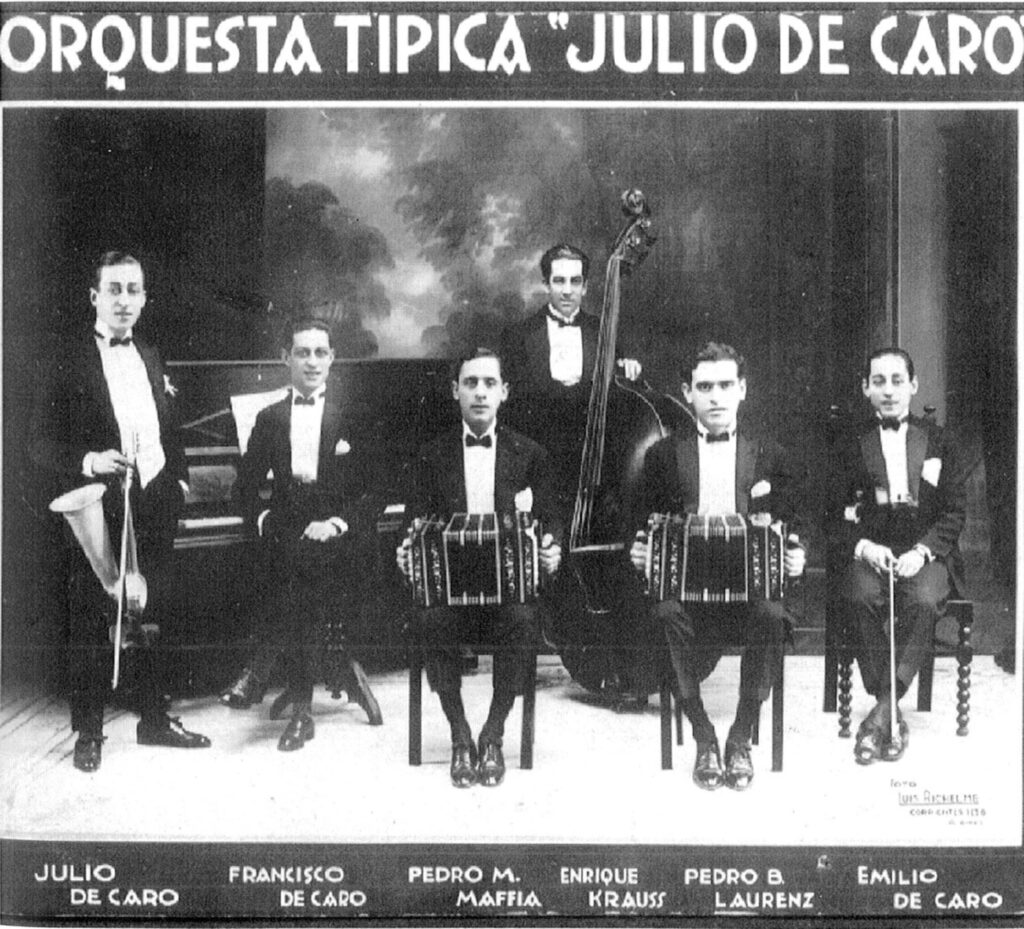
At the end of 1924, a separate orchestra was founded, originally at the instigation of Francisco De Caro [2], which consisted of the three De Caro brothers (piano and two violins), Maffia and Luis Petrucelli on the bandoneons and Leopoldo Thompson on bass [2]. Petrucelli left the orchestra shortly afterwards and was replaced by Pedro Laurenz, a gain for the orchestra; it should also be noted that both Maffia and Laurenz later led their own orchestras.
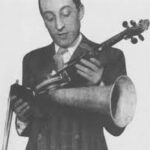
A unique feature of Julio De Caro’s music was his instrument. The violin with an attached horn is known as the Stroh violin (or cornet violin) after its inventor. The jazz violinist Paul Whiteman was so fascinated by De Caro’s music that he sent one of his Stroh violins to De Caro [2]. The advantage of this instrument was that it allowed him to produce more volume, especially for record recordings; however, the disadvantage was its somewhat harsher sound.
The group was based on a contract at Café Colon and Vogue Club [2]. A recording contract with RCA Victor followed, as did appearances on the new medium of radio. From 1929 the orchestra switched to Brunswick and from 1949 to Odeon.
The orchestra’s style was very different from the prevailing musical style of more traditional orchestras and could certainly be considered avant-garde for its time. This was particularly evident in the harmonic richness of all the instruments, the virtuosity of its bandoneon players, and the outstanding piano playing of Francisco [2]. Martin describes the development of tango orchestras in three phases. The first phase involves composing the songs, the second phase involves interpretation, and the third phase involves arrangements [5]. De Caro is placed in the second phase here. His interpretations were so popular at the time that this phase has gone down in tango history simply as ‘Decarismo’ [3].
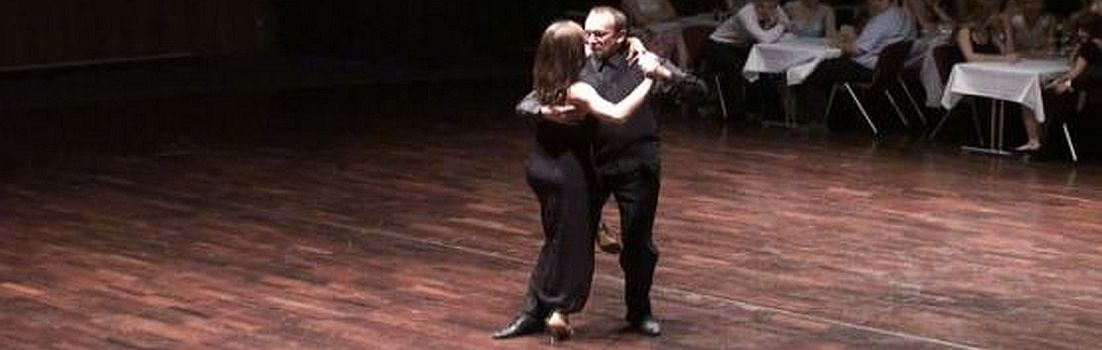
De Caro was never particularly focused on dancers. His real aim was to show that ‘El Tango tambien es musica,’ that is, that tango is music in its purest sense.
Unfortunately, as a representative of purely instrumental music, De Caro could not keep pace with the developments of the ‘Edad de Oro’ when the integration of vocal parts into the orchestra became increasingly important [2]. The story goes that Julio De Caro was confronted with the music of Juan D’Arienzo and remarked that this orchestra would soon be forgotten. How wrong he was.
You’ll rarely hear De Caro tracks at a milonga, mainly due to the sound quality of their early years, but also because of their often poor danceability. I agree with Lavocah, who wrote: ‘You’ll hear many tracks that sound interesting, but you won’t want to hear any of them twice.’
Here we hear the title “Flores Negras” from 1927, where the sound of the Stroh violin can be clearly heard.
and the title “El Taita” from 1928:
Sources
1 https://www.todotango.com/english/artists/biography/34/Julio-De-Caro</p>
2 Lavocah, Michael: Tango Masters, Tango Stories, Musical Secrets.
Milonga Press, Norwich, 2012.
3 https://en.wikipedia.org/wiki/Julio_de_Caro
4 Gobello, Jose: A Brief Critical History of Tango.
Corregidor Editions, Buenos Aires, 1999.
5 Martin, Paloma: The instrumental Tango of the Río de la Plata:
Approaches to a comparative musical analysis
of the innovative styles in the so-called ‘golden age’.
Montevideo, 2014.