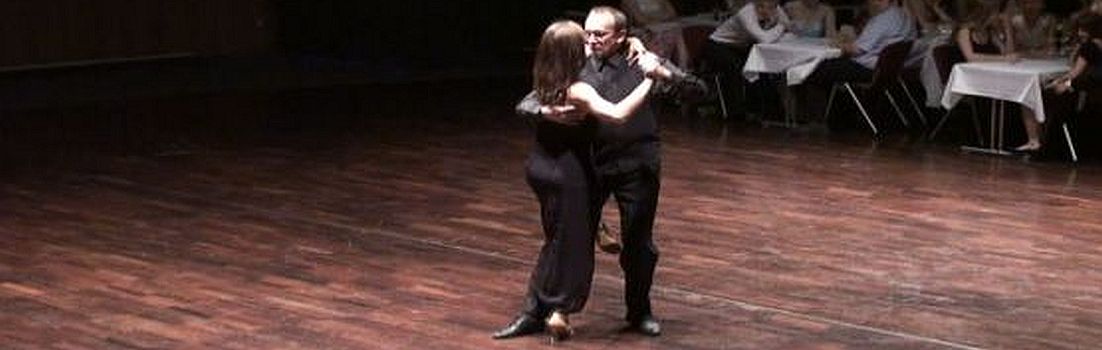

Did I ever mention that my heart beats for the tango, but my love belongs to the vals? As someone once described it: ‘The vals is one of the most beautiful pieces of music ever written.’
As a DJ, I find pure joy in the vals, as almost every orchestra offers beautiful valses, and with the vals, you can disregard all the rules and freely compose tandas to your liking. Many international (non-tango) musical genres lend themselves particularly well to this, and today I’d like to present one of my tandas (here for three tracks):
The Golden Pave (2001) – Klezmatics & Chava Alberstein
Di Krenitze (2001) – Klezmatics & Chava Alberstein
Ershter Vals (1989) – Klezmatics
As you can see, we are entering the realm of Klezmer, the music of Eastern European Jews, a music that is a synthesis of traditional folk music, jazz, and world music [1]. References to tango also occur, especially from the period between 1920 and 1940.
The first two titles from Klezmatics [2], a band from New York, are firmly established in the repertoire of tango DJs because they were released on the popular CD ‘Tango con Corazon 4’, which is a staple in the collections of many veteran tango DJs. Let’s start with the first song:
The one is performed by Chava Alberstein [3]. The song sounds familiar to German ears, but not always understandable. The lyrics are in Yiddish, an Eastern European language with many connections to German, Slavic languages, and even Hebrew words. Klezmer music is generally sung in Yiddish, and many of the lyrics are traditional and refer to Jewish culture. In this particular song, it is ‘Di goldene Pave’, which translates as ‘The Golden Peacock,’ a poetic symbol in Jewish culture [4]. Among other things, it is considered a poetic symbolic bird that delivers greetings and messages from a loved one [5].
The text is written as a lullaby; I only want to reproduce the first verse here, further verses at [5]:
Iz di goldene pave gefloygn, gefloygn.
Un di nakht hot geefnet di goldene oygn,
likhtiker mayner, shlof ayn.
The golden peacock has flown, flown
And the night has opened its golden eyes.
My light, go to sleep!
This song is popular as a vals; here we see a dance performance by Linnea Andersson and Daniel Carlsson:
The second song by the same musicians is called ‘Di Krenitze’, ‘The Fountain’
The text tells of a well where girls come in the evening with their buckets to draw water. The first verse is here; more for interested readers in…[6].
Dort, vu grozn zaynen naser,
Shteyt a krenetse fartrakht,
Kumen meydlekh tsien vaser
Mit di emer ale nakht.
Where the grasses are wet
There stands a lost well,
The girls are coming to fetch water.
with the buckets every evening.
This song is also well-known, and combining it with the previous one to form a tanda makes sense, especially since both are very danceable. For many years I struggled to find a third song to add to the mix, until I finally discovered it during a period of heavy Klezmer listening. It’s also performed by the Klezmatics, this time without Chava Alberstein. I’ve also occasionally played a version by Klezroym.
Here is Klezroym’s version:
The song “Ershter Vals”, meaning “First Waltz”, is about a woman’s memory of her first ball and her first dance; if the song is sung by a male singer, it is the memory of the first dance with his wife.
Here is the second verse:
Din gevebt elegants,
vi geshvebt in dem tants
Tsu mayn harts hostu zikh gedrikt,
mikh mit grester freyd baglikt.
Your elegant dress,
as if floating in the dance,
You pressed yourself to my heart,
It filled me with the greatest joy.
Beautiful music that’s also extremely danceable – a highlight at every milonga..
Greetings,
-Richard
literature
1 https://de.wikipedia.org/wiki/Klezmer
2 https://de.wikipedia.org/wiki/The_Klezmatics
3 https://de.wikipedia.org/wiki/Chava_Alberstein
4 https://en.wikipedia.org/wiki/Di_Goldene_Pave
5 https://www.tangoyim.de/blog/lieder/di-goldene-pave/
6 https://yiddishsongs.org/di-krenetse/
7 https://www.polinashepherd.co.uk/wp-content/uploads/Ershter-Vals-shorter-version.pdf