In the 1920s and up until the mid-1930s, tango was still interpreted in a more traditional rhythmic style by smaller ensembles (sextetos). Many orchestras successfully performed with singers (mostly in the role of estribilista) and were able to establish themselves musically and commercially. At the same time, two movements emerged that aimed to revolutionize and modernize the traditional concept of tango music. On the one hand, there were the orchestras of Cobián and De Caro, with the goal of musical and interpretive refinement. Parallel to this, however, we also see a new trend towards softer, more romantic tangos, not least due to the collaboration between Canaro and Maida as singers. In addition, another musician established himself, whose distinctive sound shaped and ultimately dominated the field of romantic tangos.
Osvaldo Nicolás Fresedo was born on May 5, 1897, in Buenos Aires, in the neighborhood of La Paternal, which earned him the nickname ‘El pibe de la Paternal’ (The Piper of La Paternal). After initial music lessons from his mother, he furthered his musical training with the violinist Pedro Desrets [2]. Unlike his brother Emilio, who learned the violin and later focused more on composition and writing tango lyrics, Osvaldo studied the bandoneon with Juan Manuel Firpo [2]. As early as 1913, he played with his brother and two guitarists, including at the Café Paulín. In 1916, he played in Francisco Canaro’s orchestra, and in 1917 with Roberto Firpo [2]. His first recordings were made in 1917 for the Telé-Phone label with an instrumental trio consisting of himself on the bandoneon, Tito Roccatagliata (violin), and Juan Carlos Cobián (piano), which performed at the Armenonville. In 1919, he founded his first orchestra (including Julio DeCaro as first violinist and pianist José María Rizzuti) and played at the Casino Pigall [3] where his orchestra rose to become a fashionable orchestra. This marked the beginning of one of the longest continuous careers as an orchestra leader, spanning 63 years [3]. Having previously made recordings for Victor, he travelled to the USA in 1920 to sign a recording contract for Victor together with Tito Roccatagliata and Enrique Delfino as Trio Select [2]. This trio later became the Orquesta Típica Select. After his return, he restructured his sextet and placed Cobián at the piano [3, 4]. Between 1922 and 1925 he recorded for Victor and later switched to Odeon [3]. He also became famous when he was allowed to accompany Gardel for two recordings (‘Perdón, viejita’ and ‘Fea’) [3]. By 1927, Fresedo was so well-known that he sometimes entertained up to five orchestras simultaneously and had to rush from one performance to the next in the evening to be seen at least once everywhere. Carlos DiSarli also played as a pianist in one of these ensembles for a time, clearly inspired and influenced by Fresedo [2]. So much so that he later dedicated a song to him (‘Milongero viejo’). In 1929, Fresedo accompanied Gardel to performances in Paris.
Early on, he developed his own style, musically nuanced, refined, melodic, and smooth, which set him apart from the traditionalists and placed him among the innovators of the Guardia Nueva. His excelled style, combining elegance and rhythm, made him particularly popular with Argentina’s upper class, and his enormous financial success in later years allowed him to maintain large orchestras and experiment with highly innovative concepts, such as the integration of saxophone, harp, and vibraphone. In 1956, after switching from Victor to Odeon, he made recordings with Dizzy Gillespie (trumpet) as a guest musician [1]. During and after the ‘Edad de Oro’, Fresedo suffered the same fate as many orchestras of the Guardia Vieja and Guardia Nueva: Fresedo, too, clung to his traditional style and could not adapt to the new era, even though he was still well-known and famous..
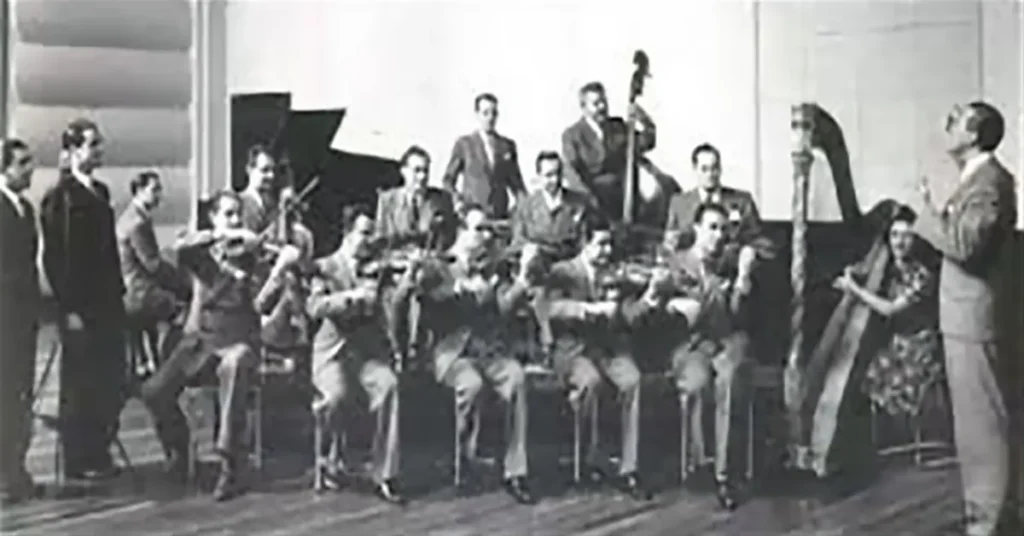
Matching his incomparably elegant style, he always had a keen eye for selecting his singers, such as Ernesto Famá, Edmundo Rivero, Roberto Ray, Oscar Serpa, Ricardo Ruiz, and Hector Pacheco, who invariably harmonized perfectly with his current orchestrations. This brought him great popularity, along with financial success; between 1925 and 1928 alone, he recorded approximately 600 tracks for Odeon [1]. The total number of his recordings amounts to 1252, placing him third among the great tango orchestras [5]. Osvaldo Fresedo died on November 18, 1984 [1].
Fresedo is particularly popular with DJs for his romantic recordings, with Roberto Ray in the 1930s (e.g. ‘Vida mia’, 1933) and Oscar Serpa in the 1940s (e.g. ‘Buscandote’, 1941), which are still frequently played in milongas today and have inspired numerous other orchestras to create their own interpretations.
In music history, Fresedo is regarded as the founder of a distinct school of orchestral musicians (‘Escuela Fresedeana’), whose most famous representatives include the orchestras of Miguel Caló, Carlos DiSarli, Francini-Pontier, Domingo Federico and Osmar Maderna [6].
Here is an example of early Osvaldo Fresedo, ‘El Espiante’, here in a restored original recording from 1917, which still sounds very traditional:
Just 10 years later, it already sounds completely different; here we hear Fresedo with Ernesto Famá with the title ‘El Carrerito’ from 1928..
And now we come to the decidedly romantic titles, here the title ‘Vida mia’ written by Fresedo, here from 1933 with Roberto Ray as the singer..
Another 10 years later, now already in the middle of the golden age, here is the title ‘Te llama mi violin’ from 1942, sung by Oscar Serpa, the title is by Elvino Vardaro:
Here is a later recording, ‘Nostalgias’ from 1952 with Hector Pacheco as the singer:
For those still interested in the recording with Dizzy Gillespie, here is ‘Vida mia’ with trumpet from 1956:
literature
1 https://es.wikipedia.org/wiki/Osvaldo_Fresedo
2 Ludwig, Egon: Tango Lexikon. Lexikon Verlag, 2002, pp. 220-222.
3 https://www.todotango.com/creadores/biografia/41/Osvaldo-Fresedo/
4 https://www.fresedo.de/2021/05/fresedos-famous-time-1923-1928.html
5 Lavocah, Michael: Tango Stories-Musical Secrets. Milonga Press, 2012, p. 150
6 Martin Paloma: The instrumental Tango of the Río de la Plata: Approaches to an analysis
comparative musical of the innovative styles in the so-called
“Golden Age.” Montevideo, 2014.