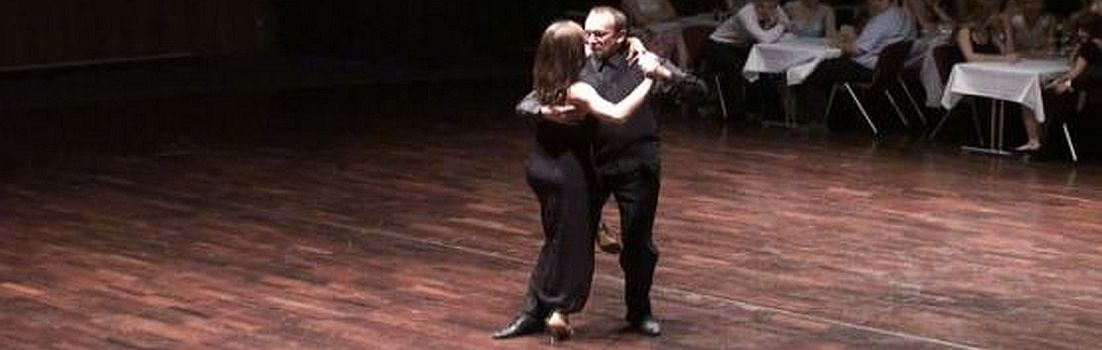

So there’s tango and tango and…?
When we begin learning tango (and especially when we believe we’ve progressed to advanced levels), we often like to observe various advanced dancers on the dance floor. We’ll likely notice that some dance in different postures, while others use the floor space more flexibly. I’m not referring here to the usual distinction between ‘Argentine Tango’ and ‘European Ballroom Tango,’ as the latter is a completely different dance (both musically and stylistically).
Even at a glance at a milonga, we see couples in elegant postures, mainly with stepping movements; other couples dance in an open embrace and concentrate more on embellishments and energetic leg movements.
Experts might tell us that these are different styles of tango, and that we are now entering a difficult moment where we may be confronted with ideology, stubbornness, and extremism (albeit not necessarily). Let us therefore turn our attention to this issue.
1. Development of dance
Dancing is an expression of our inner reality, a way of moving or displaying our bodies to real or inner music. In this context, both cultural and social norms are very important, both in terms of musical background and in how the human body is presented and dressed [1]. Tango has its roots in Candombe as a group dance and is danced by couples either in a social context or performed as a show. For most of its history, tango has been a social dance with a focus on social interaction. As both dance and music, tango was heavily influenced by other dance styles (and music) in the melting pot of Argentina and Uruguay, where immigrants, primarily from European nations, formed a multicultural society. Thus, early forms of tango evolved from rural forms of the milonga, spiced with habanera and European partner dances such as the waltz and two-step. From here, tango adopted the walking, turning, and especially the ballroom hold, from which the abrazo later developed.
A very early style of tango is called Canyengue [2, 4] and is considered the most traditional. The posture and rhythm, in particular, make this style unique. The posture is very low, and the dancers’ bodies and steps usually reflect the strong habanera rhythm of the songs.
Tango de Canyengue later evolved into Tango Orillero, the tango style from the poorer suburbs (Orillas) of Buenos Aires and Monte Video.[3]The Tango Orillero is wild and explosive, with fast, syncopated steps and can even include small jumps. This development was possible because the dance halls in the outer districts were not as crowded.[4].
As tango developed, it became more popular, and from the 1920s onwards, ballrooms in Europe and milongas in Buenos Aires were extremely crowded. This forced dancers to adapt to overcrowded dance floors.
2. Tango styles in close embrace
Since the Golden Age of Tango in the 1940s, dancers have had to adapt to crowded dance floors. This limited the dance style to small step patterns and a compact posture. The advantage of this development was the abrazo (the close embrace where the dancers’ heads and chests are more or less in contact), which creates a special feeling and intimacy between the dance partners and is, for most of us, a very important part of tango.
Because of this style, most couples automatically danced in the salons of the BsAs; the style was called ‘Tango de Salon’ or ´Baile de salon´ [2,3]. This was not an intended development, but a natural adaptation to the reality of the dance floor.
Dancers want to be courteous on the dance floor, so they usually avoid sweeping steps in crowded spaces to prevent collisions (some call this floorcraft). Salon Tango has evolved over a long period. Because dancers in Buenos Aires weren’t very mobile (they actually attended the milongas in their own neighborhoods), subtle stylistic variations soon developed. Especially after the tango renaissance of the 1990s, these local variations were named, refined, and sometimes even named after the suburb of origin, such as the Villa Urquiza style (more freedom for embellishment) [3, 10] or the Confeteria style of the central part of BsA. Some modern styles have been developed by teachers, such as the Apilado style or the Milongero style (developed by Susana Miller and Pedro “Tete” Rusconi) [5,6].
3. Dancing with imagination
Since the 1940s, some dancers have attempted to enrich the traditional dance with embellishments and poses. This style is based on the Villa Urquiza style and aims to give dancers more freedom to play (fantasy), hence it was called Tango Fantasia [2,3]. Tango Fantasia actually described all tango forms that differed from the mainstream. Additional elements that created a new degree of freedom included high boleos, ganchos, and dramatic poses [2]. Tango Fantasia was also a way of life; therefore, suits with white-trimmed collars were called ‘traje de fantasia’ and were a sign of a new, revolutionary, and nonconformist approach to tango.
Because this dance style requires more space, it was usually used for performances during the breaks of milongas and later developed into show or stage tango (Tango Escenario) [2]. Stage tango isn’t for everyone and generally aims to attract attention with athletic and dramatic movements. Typical moves like jumps and lifts are therefore definitely not suitable for a social tango dance floor.
Expanding the traditional movement repertoire is a challenge for dancers, and many have attempted it over the past 20 years. In conjunction with new musical styles, young dancers in Buenos Aires have developed a free tango movement with figures in open positions or altered postures (soltadas, extended volcadas, cadenas, backward sacadas, and colgadas) danced to modern tango music. This modern tango music gave this style its name: NeoTango or Tango Nuevo (not to be confused with the tango works of Astor Piazzolla) [3, 12]. The music for this new style is played either by contemporary modern tango orchestras or by electronic orchestras such as Gotan Project, Bajofondo or Otros Aires.
Gustavo Naveira and Fabian Salas founded the Tango Investigation Group in the early 1990s and developed a new system of tango movements based on the analytical principles of dance kinesiology [7, 12]. Leading dancers of this style include Gustavo Naveira & Giselle Anne, Fabian Salas & Carolina del Rivero, Mariano Frumboli & Eugenia Parrilla, and Norberto Esbres & Lucia Paes.[12].
4. Conclusion
The style of tango dancing is diverse and allows for personal preferences. In an open-minded world, the author argues, dancers should be free to choose their personal style—be it a traditional, closed embrace or a more open one incorporating modern nuevo techniques. Many tango dancers adapt their style to the situation on the dance floor and feel free to make more energetic movements when the space allows. The transition from a close to an open embrace is also a matter of energy, as a very close embrace doesn’t permit energetic steps or modern colgadas. Some dancers today refer to this flexible approach as Tango Liquido.[2,3], as the traditional close embrace can fluidly transform into an open Nuevo posture. This is especially true for modern tango music with a high dynamic range, such as Pugliese music.
Others seek movements that can arise naturally from the body’s core. This approach is called Tango Organico [3, 8] and is considered purely technical or political [11]. Development is generally not tied to a specific dance style. Homer and Christina Ladas are among the main figures responsible for this:
http://www.youtube.com/watch?v=UTAqfREEspA
It’s worth noting that all these different tango styles originated in Buenos Aires and are therefore all very authentic. Tango is an evolving culture, both in music and dance, and has undergone tremendous change since its golden age 75 years ago.
Dancers must adapt to the situation on the dance floor. Causing collisions through energetic steps on a crowded dance floor or disrupting the flow of dances is considered impolite; therefore, all dancers should adhere to the code of conduct [9]. Teachers have the freedom to teach their personal style, which ensures that tango remains a diverse culture. Students should follow the teachers of their choice and develop to the point where they can make their own decisions about their preferred dance style. Milongas organizers must be open-minded to provide an environment for dancers of all styles. The worst thing about tango is forcing or coercing dancers into a particular style (the author has experienced milongas where the dance floor was deliberately reduced in size to force couples into close embrace dancing). Some even claim that tango nuevo is not danced in Buenos Aires milongas and should therefore be banned from all milongas. This is definitely false. Tango nuevo is danced at least at Club Villa Malcolm (Palermo), Practica X (Caballito), and Tango Brujo (San Nicholas) [13].
While the classification of tango into different styles is useful for the training and description of dancers, ‘it also contributes to discord within and between tango communities’ [15]. More recent theories suggest that different tango styles are adaptations to different ‘environmental niches’ [14]. Therefore, the philosophy ‘There is only one tango’ is often used to reconnect different tango worlds. Supported by prominent tango dancers such as Eduardo Arquimbau and Pablo Veron, the essence of this ‘one tango philosophy’ is the idea that each dancer dances their own style. The principles of this philosophy are [15]:
1. All forms of tango are related through a common origin.
2. The classification of tango variations into different stylistic elements is artificial.
3. Every dancer has their own tango style.
4. Tango is constantly evolving and adapting to changing environments.
5. All forms of tango should be of equal value and deserve the respect of tango dancers.
6. Experimental trends in tango, such as fusion with other dance forms, should be presented openly and transparently.
7. All forms of tango should be allowed to coexist at the milonga.
8. People who do not allow the free expression of tango variations have a negative impact on the tango community. [Direct Quote from: 15].
Tango should be an open culture without borders. That’s what we love and what makes tango so special.
-Richard
Appreciate and learn from the past, dance in the present and let the future unfold (H.Ladas)
Literature
1 http://en.wikipedia.org/wiki/Dance
2 http://tejasTango.com/Tango_styles.html
3 http://de.wikipedia.org/wiki/Tango_Argentino#T.C3.A4nze
4 http://en.wikipedia.org/wiki/Argentine_Tango
5 http://www.veryTangostore.com/apilado-style.html
6 http://www.Tangoencanto.com/content/Tango-topics/what-is-milonguero-style/
7 http://de.wikipedia.org/wiki/Tango_Nuevo
8 http://organicTango.info/gravitas.htm
9 http://www.theorganicTangoschool.org/Resources/Documents/Dance%20Flow%20in%20Tango.pdf
10 http://Tangovoice.wordpress.com/2010/02/25/Tango-estilo-villa-urquiza/
11 http://Tangovoice.wordpress.com/2010/07/18/organic-Tango/
12 http://Tangovoice.wordpress.com/2010/05/12/Tango-nuevo-definition-of-the-dance/
15 http://Tangovoice.wordpress.com/2013/04/15/the-one-Tango-philosophy-truths-and-consequences/