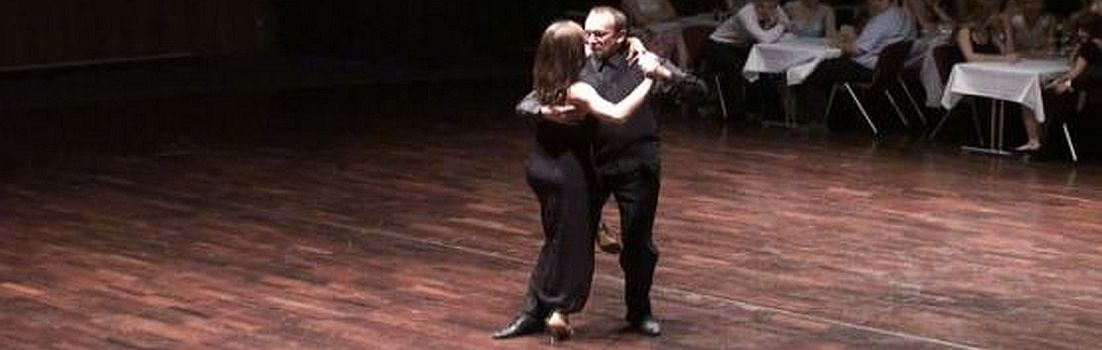
Following the tango craze between 1910 and 1930 in Germany, England, and France, other countries joined in, and tango music became popular. One of these countries was Poland, where tangos were played in Polish.
The whole story begins back in 1913 [1], but the golden age of Polish tango was in the late 1920s. In 1929, the famous tango ‘Tango Milonga’ (lyrics and sheet music) was published [2]. Composed by Jerzy Petersburski, it became an immediate international hit with adaptations in German (‘Oh Donna Clara’) and English (‘Oh Donna Clara’). The lyrics were written by Andrzej Włast [3]. The German lyrics were written by Fritz Löhner-Beda and the English texts by Irving Caesar and Jimmy Kennedy [4] translated. The tango was originally written for Stanisława Nowicka.
Oh, Donna Clara,
Ive seen you dancing tonight,
Oh, Donna Clara,
Im in love with you!
Here is the original song in an old instrumental version by Henryk Gold and a more recent version by Mieczysław Fogg from 1960.
In the 1930s, the most important tango singers were Tadeusz Faliszewski, Stefan Witas, Mieczysław Fogg, Albert Harris and Janusz Popławski [5].
Here is Mieczysław Fogg with his song “Ostatnia niedziela” (“Last Sunday”, composed by Jerzy Petersburski) from 1936.
Just as a curiosity, here’s the Hebrew translation of ‘Ostatnia niedziela’ by the Polish pop singer Adam Aston. The new title is ‘To ostatni Szabas.’ We all know that contemporary tango had a brief affair with Hebrew klezmer music. Even though this song isn’t klezmer, perhaps this romance began here.
http://www.youtube.com/watch?v=5ha92yBAB-c
Here are two more songs, one by Mieczysław Fogg: “Serce Matki” (“Mother’s Heart”) and “Juz Nigdy” (“Never Again”), sung by Sława Przybylska. This is another composition by Jerzy Petersburski.
For today’s listeners, this tango by Janusz Popławski from 1939 might be more suitable. Its title is ‘Złociste chryzantemy,’ which means ‘Golden Chrysanthemums.’ This was one of the last songs written before World War II and a masterpiece that brought the great era of Polish tango to a close [1].
Serdeczne pozdrowienia,
-Richard
References
1 http://www.todotango.com/english/biblioteca/cronicas/tango_en_polonia.asp
2 http://a-pesni.org/popular-in/polska/milonga.htm
3 http://en.wikipedia.org/wiki/Andrzej_W%C5%82ast