Originating from the well-known tango DJ Stephen Brown from Texas [1]. The orchestras of the EDO can be divided into five style categories (not taken into account here are the categories proposed there for music before and after the EDO):
- Hard Rhythm (hard rhythm): D’Arienzo, Biagi, Rodriguez
- Soft Rhythm (soft rhythm): Tanturi, Caló, Laurenz, D’ Agostino, Troilo, Di Sarli
- Smooth (weich): Di Sarli, Canaro, Fresedo, Troilo
- Lyric (lyrics): Caló, Troilo, Di Sarli, Canaro, Fresedo, Tanturi, Demare, De Angelis
- Dramatic (dramatic): De Angelis, Pugliese
This is clearly a functioning classification scheme because the orchestras of the 1940s fit into it more or less well. Hundreds of tango DJs use this scheme to structure their milongas. A classification with only five distinct groups seems sufficient for the typical milonga, but it doesn’t account for the fact that orchestras changed their style or recorded pieces of different styles during their development. Brown partially incorporated this by listing orchestras multiple times (e.g., Carlos Di Sarli is listed in three categories; one could easily place him in the dramatic category as well, given his later recordings).
For the rapid classification of tango orchestras, a visual classification system that also allows for a more refined differentiation would be very helpful. One could proceed as follows.[2]:
We observe that Brown’s classes are sometimes located at opposite ends of a spectrum with respect to a common characteristic. For example, the classes “hard rhythm” and “soft rhythm” represent the extremes of a common characteristic (rhythm). If we group the classes “soft” and “lyrical,” for example, under the term “romantic/lyrical,” we could consider this the opposite of the dramatic. Our new, modified classification would thus have two characteristics: rhythm and emotionality, with their respective extremes.
- Hard rhythm
- Soft rhythm
- Romantic/Lyrical
- Dramatic
To allow for a visual classification, one could consider these characteristics as axes of a Cartesian coordinate system and thus assign a position on this coordinate system to musical pieces or orchestras. This results in a point in the coordinate system for a specific piece of music, while an orchestra would occupy a point cloud or an area within this system.
As an example, I will take two orchestras here.. Juan D´Arienzo He did indeed play almost exclusively rhythmic tangos, to a greater or lesser degree. These mostly lie in neutral territory with regard to emotionality, although some later recordings do exhibit a certain degree of drama, and a few romantically tinged recordings can also be found. His music would therefore be best described as primarily characterized by strong rhythms, with extensions in both directions of the emotional spectrum.
Francisco Canaro The music here would be characterized more in the area of gentler rhythms and the romantic side, although one can occasionally find pieces with more dramatic emotionality.
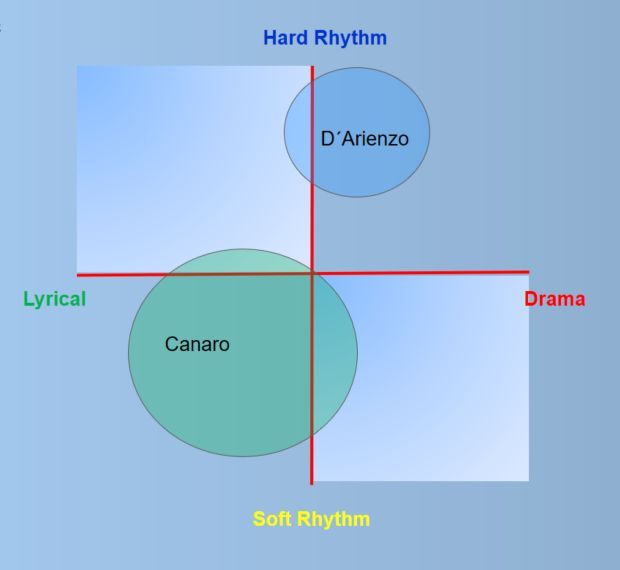
Representation of two Orchestras of the EDO as an area in the coordinate system
I’ve included both orchestras in the diagram. The quadrants for Drama/Soft Rhythm and Lyric/Hard Rhythm are highlighted in a slightly lighter shade. These quadrants are likely to be less common. While a dramatic piece with a softer rhythm is easy to imagine, a romantic piece with a hard rhythm would probably be quite rare.
For my own use, I have additionally assigned (color-psychologically appropriate) colors to the classes to enable even faster classification in the modified scheme according to Brown.
Abrazos,
-Richard
Literature:
1 http://www.tejastango.com/tandas.html
2. Stoll, R: 15 Big Orchestras of the EDO. Lecture at the TABOE Tango Festival 2015/2016.