All these previously discussed details are now to be combined into a milonga. This is the fundamental question every DJ must ask themselves when planning a milonga. There’s no hard and fast rule here, except that tanda cycles are the norm to balance the frequency of tangos, valses, and milongas. Tango is generally a popular choice, vals is also highly popular, but couples tire more quickly at milongas, so the milonga tandas are usually shorter. A tanda cycle of TTVTTM is recommended, meaning a vals tanda follows two tango tandas, and then the same for the final milonga tanda. Such a tanda cycle lasts between 75 and 90 minutes with typical tandas. Personally, I find that a vals tanda is better suited as a bridge between different styles, so I usually play my cycles TTMTTV, which isn’t usually noticeable. In my experience, there are two basic strategies for a tango evening:
1. Continuous increase in energy.
A typical tango evening begins with beginners, who may have just come from a preparatory course (organizers usually make good use of the rented hall). Beginners prefer uncomplicated music with a clear rhythm, rather slow, instrumental, and without complex syncopation, which falls well into the “soft rhythm” category. More advanced dancers arrive later in the evening (oddly enough, this is the case everywhere in the world) and love more complex music with singers and colorful, syncopated rhythms, offering room for interpretive dancing. Later, more romantic pieces are expected, and much later, the dramatic genre comes into play. For the DJ, it’s therefore easy to play in precisely this order. From simple to faster, harder rhythms, through romantic music to drama, corresponds to a continuous increase in energy leading to a climax. Afterward, the energy is usually allowed to dissipate with calmer music. Normally, the music remains EDO until the climax. After that, there is room for experimentation (such as Nuevo, NonTangos or even the occasional Tanda Salsa or Bachata, depending on the audience).
In my experience, this strategy works very well for shorter milongas (up to about 3 hours), as the program can be played continuously without becoming boring. The DJ’s skill lies in finding a smooth transition between the different styles and adapting this to the needs and desires of the dancers.
2. Contrasting Characters
For very long milongas, the aforementioned plan isn’t ideal, as boredom can quickly set in during an 8-hour milonga if you’re playing the same character for an extended period. One idea could be to create contrasts between the tandas to constantly surprise the dance couples and present a diverse range of styles. A tanda cycle could look something like this:
T: D´Arienzo-Maure quick Rhythm
T: Troilo-Ruiz melodic
M:Canaro-instrumental simple & straight
T:Calo-Beron soft Rhythm
T:Di Sarli (50ies)-instrument. lyrical, soft drama
V:D´Agostino-Vargas playful, happy
Contrasts can be constructed in many ways: pace, energy, character, time, etc.
The real advantage of this method is the ability to manage very long milongas (6-8 hours) without boredom setting in. Since the tandas are not coordinated, it’s also much easier to create a playlist “on the fly” and to respond to guest requests and any problems that may arise on the dance floor.
3. Mixed approach
What I understand by this is a synthesis of the two aforementioned strategies, namely the use of contrasting tandas, but with the aim of creating a development with one (or more) climaxes. The goal is a slow build-up of energy, which then rises in a tanda cycle with predominantly dramatic music and can subsequently subside, perhaps with the aim of another climax later. I personally like this approach for the few longer gigs I DJ.
However you choose to organize your milongas, it’s always a good idea to have a strategy, at least until you realize it’s not working and you need a plan B. This leads me to reiterate my call for flexible DJing, something I can’t do without extremely good organization of my collection and the ability to preview tracks.
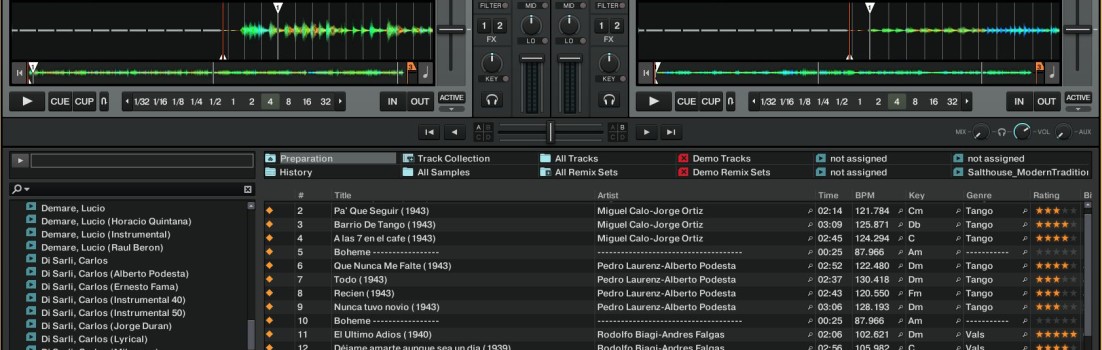
Many DJs plan a playlist at home. This is primarily a good approach, as you can prepare perfectly designed tandas and combine them into a wonderful strategy. I did this myself for many years, but then often found myself in the situation where, during the milonga, the playlist was simply playing. This often works more or less well, but it doesn’t mean you’re a good DJ (just because the playlist was so good). On the contrary, you’re not a DJ, because a DJ plays according to reality (on the dance floor). I admit that I also always arrive at a gig with a prepared playlist, but it’s rarely played exactly as planned, because I like to change the order of my tandas, or add completely different tandas. Sometimes the whole plan is scrapped, and I assemble a completely new playlist on the spot. Not because I’m bored or because the beautiful “bedroom DJ” plan within me was bad, but simply because it doesn’t fit the moment, and I have to react to my dancers. I very rarely use auto cruise; I always start my decks manually. That’s what makes a DJ and gives us the feeling and confidence of being in complete control.
Abrazos,
-Richard (DJ Ricardo)