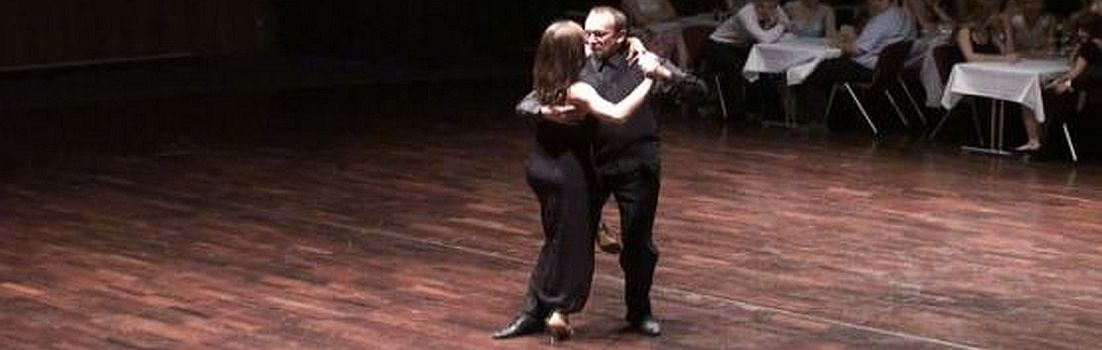
ABRAZO: Embrace (dance hold)
APERTURA: Open Side Step (#2 Basic Step)
ARREPENTIDA: Repeatable step construction to change direction. Usually a combination of rebotes with turns, also cadenas in different variations.
AXIS (axis): Vertical axis of rotation or balance line, usually running through the body’s center of gravity. Normally, both partners have their own axis, but depending on the dance posture, a shared axis can also be created.
El BALANCEO: Weight shift in closed foot position
La BALDOZA (Carré): Another name for the 6-step Basico. Often used in such a way that the last step is danced on the outside. This creates a left turn with outside positions. The name comes from the black and white floor tiles in Argentina.
La BARRIDA (Arrastre): The (usually linear) movement of one partner’s foot is accompanied by the other partner’s foot (while maintaining contact). This creates the illusion that the foot is being actively moved.[barrer = to sweep]
La BASE: Abbreviation for ‘Paso Basico’)
El BASICO 8-step basic step (salida) beginning with RF backward (Man). Some teachers divide this into 1. INTRODUCCION (steps 1-2), 2. SALIDA (steps 3-5), and RESOLUCION (steps 6-8). Some teachers call all basic steps SALIDA, others just steps 1-5.
El BOLEO (Voleo): A change in the direction of rotation (or movement) of the body or the swing leg during an ocho, or an ocho-like movement or step. With higher kinetic energy, a whip-like movement with elevation of the swing leg is created (‘High Boleo’). Boleos can be danced forwards or backwards, circularly or linearly, or in combinations thereof. Boleos can also be cut short (‘Frozen Boleo’). It is important for the dancer to keep the swing leg relaxed to allow for an uninterrupted flow.[bolear = to throw]
Forward BOLEO: Boleo in forward circular swing (see Boleo).
Linear BOLEO: Boleo danced linearly without rotation.
La CADENA: Multi-step rotation [Cadena = Chain] Typically 4 steps in the parallel system. Can be repeated (see Arrepentida).
La CALESITA: One partner is on a stable axis, the other partner moves circularly around this axis of rotation. [Calesita = Marry go Round]
CAMBIO DE FRENTE: Step combination to change direction
El CAMINADA: Walking step. ‘Caminada por el medio’ in the normal position of the partners towards each other.[caminar = laufen]
La CAPILLADA: Embellishment (see Firulete)
CARPA: Position in which the axes of both partners are inclined towards each other. For Volcada or Calesitas.
El CENTRO: Body center
CIERRE: Closing (e.g., step 8 of the Basico)
La COLGADA: A position in which the axes of both partners lean backward. The center of rotation is usually the supporting leg of the following partner.[colgar = to hang]
El COMPAS: beat
CONTRAGIRO: Right turn (also CONTRAMOLINETE)
CONTRAPASO: see TRASPIE
CONTRATIEMPO: Doubling of strokes (see TRASPIE)
La CORRIDA: Several quick steps taken
El CORTE: Incomplete step (‘cut off’) as a change of direction.
CORTADO: ‘Cut-off’ step
COSTADO: ‘caminada por el costado’ Step left outside.
COSTADO DERECHO: Step to the right outer side.
El CRUZE: crossed position (e.g. lady in step 5 of the Basico)
CRUZADO: crossed
El CRUZE ATRAS: Back Cross
El CRUZE ADELANTE: Before the Cross
El CRUZE DE LA MUJER: Follower’s Cross (e.g., step 5 of the base)
EL CUATRO: High form of crossing (queen) without pressure. The image of the number 4 is created.
EN CONTRA: A common technique where an action (ocho or voleo) is accompanied by the leader in the opposite direction (example: lady dances ocho to the left, gentleman dances step to the left). This creates a turn. It is typically used for turns, as the beginning of a turn, or to prepare for other techniques (e.g., sacada).
La CUNITA: Rocking step with complete weight transfer.
El ENGANCHE: Passive Gancho from an open position into a turn. Usually danced after a deep Sacada.
El ENROSQUE: ‘Screwing in’ the feet during a turn. The free leg comes into a crossed position.
El ESPACIO INFERIOR: Lower area, legroom
El ESPACIO SUPERIOR: Upper area, upper body
El FIRULETE: Decoration (Lady)
El GANCHO: An active linear or circular step is stopped by the partner’s leg (thigh) and buckles at the knee joint. Followed by a forward step.
Forw. GANCHO: Gancho moves forward in a circular ‘wrapping’ of the partner leg.
El GIRO: A turn consisting of either one complete molinete construction or several constructions by one or both partners. Usually with a direction indicated (a la derecha, a la izquierda).
El GIRO PEQUENO: A small turn with less than a complete molinete. Usually danced from a backward ocho to a forward ocho.
El GIRITO: Small turn, typically not following the Molinete pattern. Often also used instead of Giro pequeno.
El HABANICO: Fan-like step sequence for the lady.
HAMACA: See Cunita.
La MEDIALUNA: The lady’s crescent-shaped step sequence.
El MOLINETE: Typical step pattern for turns: back, side, forward, side for left turns; for right turns, one also speaks of ‘contra molinete’.
El OCHO: A combination of a step and a pivot on the new axis. Forward ocho with a forward step, backward ocho with a backward step.
OCHO ADELANTE: Forward Ocho
OCHO ATRAS: Ocho (backwards)
OCHO CORTADO: A combination of a Rebote into a Paso Ocho (QQS), a rebote to the side into a forward cross for the follower (QQS). The most well-known step for dancing in a close embrace, with countless variations in terms of step pattern and rhythm.
OCHO ACOMPAGNADO: The following person dances an Ocho while the leader accompanies this with a step pattern (e.g. also an Ocho).
La PARADA: The follower stops in an open stride position. Their weight is evenly distributed on both feet, with the axis between them. The leader can then make foot contact with one of the follower’s feet.
La PASADA: A step over the partner’s leg, usually to dance an ocho, a barrida, or a simple step. A popular combination is a gancho, with or without lifting the forward step of the pasada.
El PASO BASICO: 8-step Base
El PASO BASICO CRUZADO: Basic step in the crossed system (steps 3 and 4 of the base) with traspie for the man and a hesitant step on 5.
El PLANEO: Circular movement of the foot on the ground.
El PIVOT: Rotation on the axis (ball of the foot)
La POSTURA: The hold.
El REBOTE: Rebotes are a rocking step without full weight transfer. A popular step for close-contact dancing. Rebotes can be danced forward, sideways, backward, in a crossed position, or doubled.
La SACADA: Step into the partner’s open foot space. This creates the illusion (!) that the partner’s leg is being swept away. Sacadas are executed as forward or backward steps, or are essentially invited by the partner to perform them.[sacar = wegnehmen]
El SALTO/SALTITO: Jump
SANDWICH (El sanguichito): One of the partner’s feet is fixed between both feet.
La SENTADA: Seated position of the lady.
La SOLTADA: Breaking down the posture to dance steps in an open dance position.
El TACONEO: Stepping with the heel
El TRASPIE: Syncopated step. Danced together in the milonga, but usually only by one partner in tango to change the system.
La VOLCADA: Swing of the free leg into Carpa position. Usually resolved with a cross.[volcar = umfallen]
El VOLEO: See Boleo
(Not extensive, but may be helpful for the next Tango Lesson in Spanish)