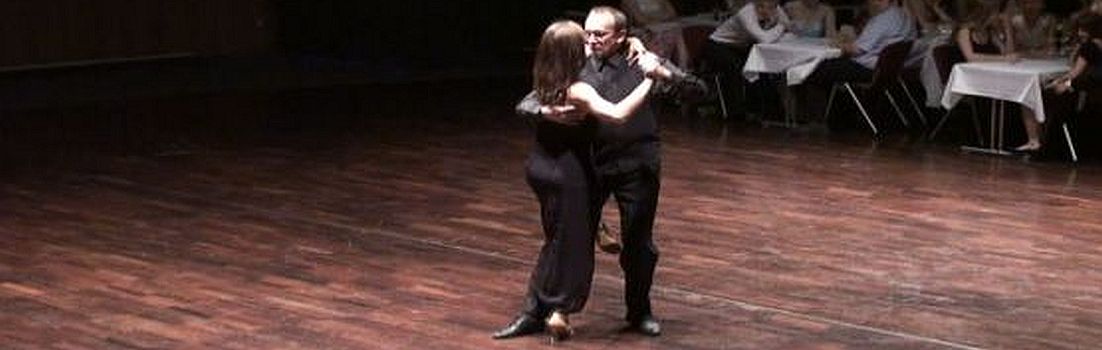

As a DJ, one naturally views the orchestral diversity in tango with different eyes than when considering this issue from a music historical perspective. Nevertheless, I often listen to tango music without any specific requirement of milonga suitability, and I personally enjoy many of these pieces, even though I would rarely, if ever, play them in a milonga. I’ve noticed that my preferences evolve over time. With music from the EDO era, these have recently tended to be recordings by Troilo and De Angelis, but I’ve also developed a new fondness for orchestras from the 1930s, whose clear musical lines appeal to me—less so the avant-garde sounds of De Caro, but rather the traditional style, which, despite the often challenging sound quality, still has its place in the milonga today. Here, I adhere to the old rule of playing classic tandas primarily in the early stages of a milonga playlist. So today, we’re talking about one of the oldest milonga-suitable orchestras, aside from Francisco Canaro. It is Francisco Lomuto who not only shares a first name with Canaro, but was also a contemporary and friend.
Francisco Lomuto was born on November 24, 1893, in Buenos Aires. Like Julio de Caro, he came from a musical family with a total of ten children. His father was a violinist, his mother a pianist who gave him his first piano lessons. Later, he studied music for a time at the Santa Cecilia Conservatory. His first job was as a radiotelegraph operator for the Pacific Railway, but he then began performing as a soloist and as a duo with his brother Enrique, writing several tangos that were also played by his friend Francisco Canaro and Roberto Firpo. He founded his first orchestra in 1923, as was common at the time, as a sextet. Like Canaro, he no longer played himself, but instead had his brother Enrique play the piano. Later, other well-known musicians joined the orchestra, such as the bandoneonist Ricardo Luis Brignolo (the composer of ‘Chice’), Eduardo Armani, and Minotto di Chicco. The orchestra performed at the Teatro Empire. It should be mentioned that, as was common at the time, Lomuto also had jazz pieces in their repertoire and sometimes even integrated musicians with jazz-typical instruments for this purpose [2].
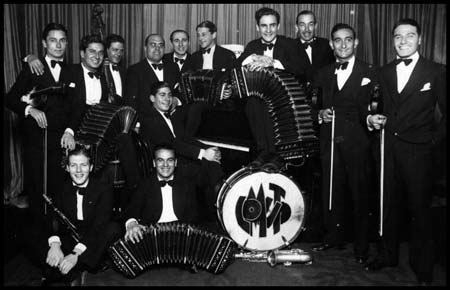
In 1926, bandoneonist Daniel Alvarez replaced Brignolo. Other musicians included Leopoldo Schiffrin (the father of the renowned composer) on violin, and singers Antonio Lesende and Carlos Pérez, the latter better known as ‘Charlo.’ Alvarez altered the orchestra’s rhythm and replaced Carmelo Napolitano as arranger. Initially recording for the Nacional label, he switched to RCA-Victor in 1931, a turning point for the quality of his music [1, 4].
Daniel Alvarez founded his own orchestra in 1933 and was replaced by Martín Darré on both the bandoneon and as arranger. By then, the orchestra had grown to 25 musicians and was playing in the most prominent venues in Buenos Aires and Mar del Plata [2].
Another turning point in his music was the inclusion of Fernando Díaz as a singer in 1934, around the same time that Canaro reached one of the high points of his career with Roberto Maida [4].
In 1936, Lomuto was elected president of the Society of Authors and Composers (SADAIC), founded by Canaro.
Lomuto died on December 23, 1950, in the town of Tortuguitas, north of Buenos Aires. His life’s work comprises more than 950 recordings between 1922 and 1950 [2]. A significant attribute of his music was the use of a diminished seventh as the final note of his pieces [1, 3].
His musical style is conservative, and he can undoubtedly be placed among the old guard of traditional tango. It’s likely that he initially followed the lead of his friend and mentor Francisco Canaro, and although he played until the end of the EDO (European Dance Organization), he lacked the flexibility to adapt to the changing musical trends and developments within the EDO. Nevertheless, many of his later works are quite suitable for milonga and will likely be on the playlist of more traditional DJs..
The appendix contains some examples from the 1920s and from the peak of his career in his mid-thirties. Also noteworthy are some very danceable milongas and lively and pleasing waltzes.
Literature:
- https://www.todotango.com/creadores/biografia/101/Francisco-Lomuto/
- https://es.wikipedia.org/wiki/Francisco_Lomuto
- Lavocah, Michael: Tango Stories: Musical Secrets. Milonga Press, 2012.
- Benedetti, Hector: New History of Tango. Siglo Veintiuno Editores Argentina SA, 2015.
Let’s start with ‘Ojos Negros’ from 1927:
‘Never Again’ from 1931:
‘Nostalgias’ from 1936
‘No hay tierra como la mia’ from 1939, danced here by Valentina Garnier and Juan Amaya
and another waltz: ‘Amor y Celos’ from 1930