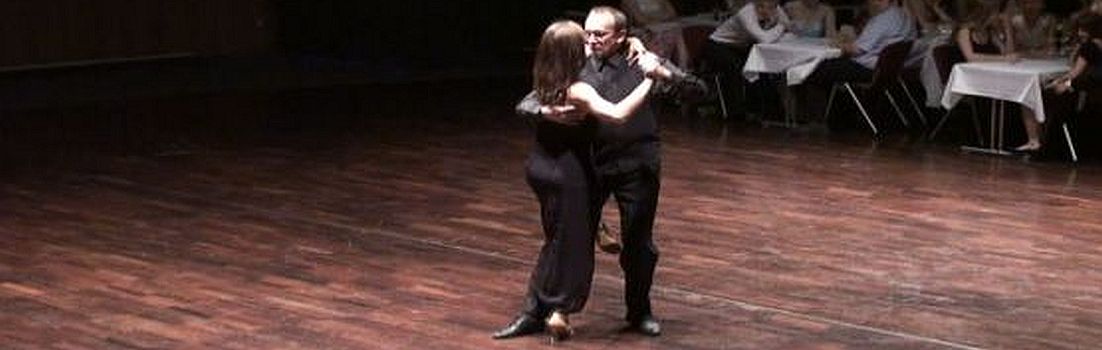

Imagine a football association overseeing 20 teams with varying degrees of talent, including players and coaches, and then being invited to an international championship. What do they do? They assemble a team from their best players and have them coached by a gifted trainer. This isn’t just a football thing; it’s also a tango game.
By the early 1920s, most of the better tango orchestras were already signed to one of the major record labels. The labels Nacional and Odeon, in particular, made a name for themselves in this regard [1] and RCA-Victor [2]. They were in competition with each other. Around 1925, almost simultaneously with the introduction of the electrical recording process by RCA-Victor, they came up with the idea of forming their own orchestra from the best musicians of their contracted orchestras [3]. Luis Petrucelli was originally slated to conduct this orchestra, but when he cancelled due to an engagement in the USA, the pianist Adolfo Carabelli was engaged as his replacement. Carabelli was more at home in the realm of classical music and less familiar with tango, but he had a good eye for selecting his instrumentalists [4]. The orchestra was primarily used for studio recordings and never performed in front of an audience. Hence the name “la orquesta invisible”.

While the recordings in the 1920s were very diverse (jazz, foxtrots, polkas, rancheras, paso dobles), the Orquesta Típica Victor (or simply OTV) dedicated itself specifically to tango in the 1930s. A list of the musicians reads like a list of the most famous virtuosos (e.g., Ciriaco Ortiz, Pedro Laurenz, Luis Petrucelli, or the violinist Elvino Vardaro); for further details, I refer you to the sources available online [3, 4].
Things get somewhat confusing because Carabelli founded his own orchestra, which also existed in secret, initially focusing on jazz. Besides the original OTV lineup, many recordings were also released under other subgroups, such as Orquesta Tipica Select, Orquesta Victor Popular, or (very well-known) Orquesta Tipica Los Provincianos (conducted by Ciriaco Ortiz), or even simply under Adolfo Carabelli, sometimes without specifying whether this referred to OTV or OT Carabelli. For further information on other groups, see [3].
Carabelli was replaced in 1936 by the bandoneon player Federico Scorticati, and in 1943 the leadership finally changed to Mario Maurano.
Among the most important singers were Carlos Lafuente, Roberto Diaz and Alberto Gomez.
From 1925 to 1944, 445 tracks were recorded by OTV or its subgroups, most of them in the 1930s. The musical style is essentially traditional; stylistically, OTV never truly arrived in the EDO, especially since by the early 1940s the need for a house orchestra had disappeared, as the band’s growing popularity meant that enough high-quality orchestras were available.
Interestingly, other labels also established their own house orchestras, such as OT Brunswick or OT Columbia [5]. However, these were of secondary importance. Only the Brunswick original is still played at milongas today..
literature
- https://en.wikipedia.org/wiki/Odeon_Records
- https://es.wikipedia.org/wiki/RCA_Records
- https://es.wikipedia.org/wiki/Adolfo_Carabelli
- https://es.wikipedia.org/wiki/Orquesta_T%C3%ADpica_Victor
- Lavocah, Michael: Tango Stories: Musical Secrets. Milonga Press, 2012.
Here are some examples. We’ll start with one of my favorites: Vieja Calesita from 1929, starring Luis Diaz as estribilist.
Ten years later it sounds like this (Adios Buenos Aires, 1938 with Angel Vargas), danced here by Juan Carlos Martinez and Nora Witanowsky:
And here’s another Vals (Sin Rumbo Fijo, 1938 with Angel Vargas) danced here by Joachim and Michelle:
And here, for comparison, is the sound of OT Los Provincianos (A tu memoria madrecita from 1934):