Today I want to talk about a tango dance figure that puzzles many students and tango enthusiasts. On the one hand, because it seems so easy to teach, and on the other hand, because it’s so difficult to learn.
If you ask an experienced milonguero what the basic step in Argentine tango is, you will often hear that there isn’t one, or that it’s simply the walking step: the caminar. Tango consists of techniques that can be combined like words to form sentences, which is essentially controlled by the leading partner.
That’s the general concept, but it’s difficult to implement in dance teaching. Since the 1940s [1] and 1950s [2]. A basic step has evolved that is easy to teach and universally applicable, even on very small dance floors, primarily for show dance. This combination (El Basico) was developed by Juan Carlos Copes and Marie Nieves to create their own choreography and to teach it [2]. His students and stage dancers became the great teachers and multipliers for tango in the later years of the 20th century [2]. This made the Basico virtually the standard for tango ‘para export’. The 8-step Basico is a further development of the somewhat simpler basic step (the 6-step Basico, also called Baldosa) with the addition of the cross in position 5 for the lady.
The steps involved are:
Start in closed position with weight on LF (lady RF), ladies’ steps in the opposite direction unless otherwise specified.
- RF reverse
- LF sideways
- RF forward (external partner)
- LF forward
- RF closes (lady crosses LF in front of RF)
- LF forward
- RF sideways
- RF closes
This combination has several advantages: firstly, pivots can be incorporated, especially in steps 1 and 6, allowing beginners to dance through corners and show couples to better adapt their choreography to the audience. Furthermore, the lady’s cross-step position offers a multitude of movement possibilities, ‘endless combinations, almost permutations,’ as my esteemed teacher Nicole Nau points out [1, p112].
For beginners, these step options initially provide a secure structure and recognizable positions, numbered from step 1 to 8 [1]. Steps 6-8 are referred to as ‘Resolución’, the initial steps commonly as ‘Salida’ [1], although there is no consistent nomenclature among different teachers (e.g., one of my teachers referred to steps 1 and 2 as ‘Entrada’ and steps 3-5 as ‘Salida’).
Unfortunately, this sequence of steps contains some complex problems that a tango beginner can only resolve with the help of a teacher. These include the outside step 3, which can only be danced correctly with a shoulder lead ‘al costado’ from step 2 onwards, and the leading of the lady into the crossed position, which in turn can only be achieved through the gentleman’s opposing shoulder turn.
Looking at the steps of the basico in relation to the music, it’s noticeable that the eight steps danced in time (compass), meaning all steps on S (slow), correspond exactly to four bars. However, a more rhythmic version is often taught, using the following three-bar rhythm: SSQQS QQS (Q here means quick). In this version, the closed positions fall on the end of a bar, and the following steps fall on beat 1, which corresponds better with the music.
Let’s return to the original use of the basico as a foundation for show dance. Here, the space plays only a minor role, since the dancer has many options for adapting their choreography to the spatial conditions. The basico also offers advantages as a framework for the musical phrasing of the choreography, which for stage dancers is (or should be) already coordinated with the phrasing of the music, as figure elements can be reliably incorporated into the new setup position in ‘position zero’ (feet together) [2]. A start like this is no problem. However, problems arise when applying this concept to a milonga. Since milongas in Buenos Aires are usually overcrowded and danced in a relentless ronda with no space, step 1 in particular poses a problem, as there is often no room behind. The solution is to dance step 1 in place, which the more advanced dancers will (hopefully) do automatically. The experienced milongueros no longer dance the basico, but instead orient the majority of their steps forward. For a thorough discussion of the problem and the necessity of “unlearning” the basico, see Turner, 2006 [3].
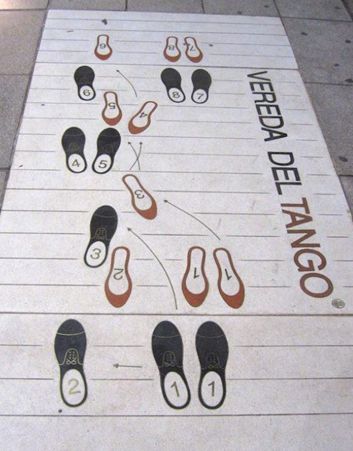
Many advanced tango dancers and teachers, as well as those in competitive dancing, often begin the dance with step number 2, referred to here as the ‘Apertura.’ This has the advantage that this strongly accentuated step occurs on beat 1. However, it is difficult to consistently follow this concept, and it is not practical for a milonga anyway. In this approach, the Apertura is often danced over two slows (SS) to adjust for the phrasing of music.
The realization remains that the engagement with the base for milongueros will continue for many years to come, and that emancipation from this concept is neither quick nor easy.
Literature
1 Nau-Klapwijk, Nicole: Tango Dimensionen. Kastell Verlag, 1999 (pp. 223-225).
2 Badion, Michelle: History of the 8-count basic in Argentine Tango:
https://michellebadion.com/blog/f/history-of-the-8-count-basic-in-argentine-tango
3 Turner, David: A Passion for Tango. Dingley Press, 2006 (2nd edtn., Chapter 2)