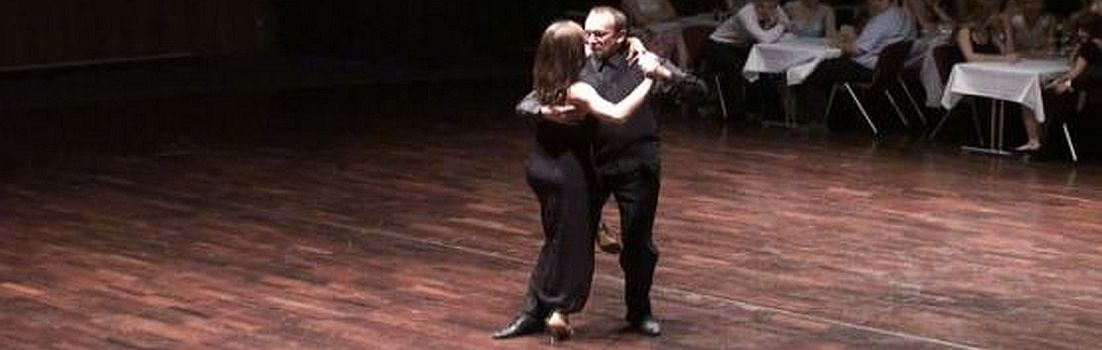
Of all the tango steps, the ocho is the most prominent and iconic, possibly even one of the oldest movement elements in danced tango [1]. The name comes from the fact that the movement pattern of the feet when several ochos are danced in place resembles the number 8 (Ocho = eight).
Technically, the ‘Ocho’ movement consists of a step and a pivot turn on one foot in the direction of the previous stepping leg. In its simplest form (Ocho forward = Ocho adelante), this is a forward step with a 180-degree turn (half turn). After the basic step, this movement is arguably one of the first more complex step combinations that beginners must learn. Just as with the basic step, the complexity of this movement increases as soon as the dance posture and the resulting internal body movements are taken into account.
The other alternative to the forward ocho is the backward ocho (ocho atras), which consists of a backward step and a backward pivot towards the previous stepping leg. The two movement elements of the ocho must be performed separately to allow for variations. I am referring here to the ocho as this combination, but I should mention that some authors define the ocho as two such combinations, presumably to fully encompass the figure eight [2], this way, we would talk of a half ocho, which is a bit confusing in my opinion.
- An Ocho forward in basic form without a partner
To discuss the Ocho, we will first consider the basic form, in which the movement is danced independently of a partner in place. For practice purposes, a wall is often used as a reference.
The forward step is therefore always taken parallel to the wall with the leg positioned towards the wall. The Pivot occurs after the step, as soon as the weight has been transferred to the foot of the stepping leg and the initial supporting leg (now the stepping leg) begins its movement towards the new supporting leg. The leg turns towards the wall by exactly half a turn, so that the next step can again be taken parallel to the wall.
A common mistake among beginners is initiating the turn too early, while still in the forward step, initiated by the muscles of the old supporting leg. This leads to a poorly controlled wobble during the full execution. A better approach is to begin the turn while transferring weight, with the new stepping leg beginning its path close to the new supporting leg. The turn then occurs on the new supporting leg, driven by the leg muscles (lower leg, thigh) and core muscles (abdominal and back muscles), so that the upper body initiates the rotation first. The counter-anchor is the friction between the supporting foot and the ground. This creates a twisting motion within the body, similar to a wound-up spring, which is released towards the end of the turn when the lower body follows the already completed upper body by slightly reducing the ground contact of the supporting foot. This utilizes the initial momentum and the inertia of the torso.
It should be noted that the entire execution of the Ocho is performed by the dancer and no assistance (rotational impulse) is expected from the partner.
Regarding the turn, the dancer gets the feeling that the turn begins in the upper body and is completed last by the legs and feet. One of my teachers in Buenos Aires even went so far as to say that the turn feels like it begins with the weight of the head and then moves down through the body.
- Ocho forward with partner
Let’s now consider the Ocho in relation to a partner who, initially, is not to perform any further movement. For the sake of simplicity, I will assume here that the Ocho is performed by the lady as the follower and the gentleman as the leading partner. It should be noted, however, that gentlemen must also be able to dance the Ocho movement and understand the technique.
Here, the man’s front (the wall in the exercise) serves as the reference point, while the woman dances the ocho parallel to him. It’s important to note that the distance between the dancers must be sufficient to allow enough space for the forward step of the ocho. More precisely, this means that the pivot should be slightly over-turned so that the next forward step is taken just a little further away from the partner, ensuring this distance for the next ocho.
However, the biggest problem in executing the ocho is the Dance posture. In tango, both dancers (with a few exceptions, such as Soltadas, promenade positions and paradas) are in a close hug. The posture can be very wide (Tango Nuevo, Tango Fantasia) or very narrow (Baile de Salon, Tango Epilado), depending on the dance style. The expectation is that the dancers’ fronts are always parallel and facing each other. The front is defined here as the chest and shoulder area of the dancers. This creates a systematic problem. In a conventional posture, a 180-degree turn of the partner (i.e., 90 degrees on each side) is not possible. The posture would have to be broken, which, even if the man turned along with her, would be neither practical nor aesthetically pleasing. The solution is simple yet very complex. The woman performing the Ocho dissociates her center (front) from the lower part of her body (legs and pelvis). To achieve this, the lower body rotates the full 180 degrees, while the front, along with the dance posture, rotates significantly less. The balance is achieved in the lower spine, which takes over the additional rotation. This concept is called dissociation. This works well with a less closed posture (Baile de Salon and Tango Fantasia), where the tightness of the hold can be further adapted to the figures (Tango Liquido). The wall exercise can again be used to learn this dissociation, but it’s important to ensure that the upper body rotation is significantly less pronounced than the already practiced leg and pelvic rotation..
As part of the nonverbal communication within the couple, the leading role here falls to the man. The lead should never be conveyed solely through the arms; rather, the rotation of the leader’s upper body serves to communicate the type of movement and, in the case of a pivot, the range of motion to the following partner. Here, the axis is less important for signaling than the rotation of the leader’s shoulder away from the body, creating space for the follower’s movement and presenting an invitation to move [1]. It should be noted once again that the leader only determines the timing and limits of the rotation in the pivot, but does not support the movement by projecting force into the followers system.
An interesting variation is the possibility of dancing the Ocho completely without (or with extremely limited) upper body rotation. This variation leads to a series of forward cross steps with very little rotation, a technique that is called Ocho Milonguero. Here, the normal stepping pattern is replaced by a rotational movement of the walking leg around the supporting leg (from one crossed position to the next).
Possibilities for further development relate in particular to the free leg during the pivot. Traditional technique here requires keeping the knees and feet close together, meaning the stepping leg must be moved very close to the supporting leg. Lowering the leader’s center of gravity allows the follower to move their free leg in a wider circle around the supporting leg. This allows for a greater range of motion, which can be particularly desirable in more modern styles (Tango Fantasia, Tango Nuevo, Tango Escenario). However, these techniques are frowned upon in a traditional milonga, as they can disrupt or even injure neighboring couples. This is especially true for lifting the free leg off the ground and extending the movement to a boleo, specifically a ‘high boleo.’
The complexity of the technical execution makes it difficult for beginners to dance good ochos. It should be noted that this learning process usually requires the assistance of an experienced teacher and practice of the technique. The earlier such a teacher is consulted, the easier the learning process, because there is no need to unlearn faulty movement patterns.
- Ocho accompagnado
As the gentleman, one can wait during the ochos, for example after step 5 of the base, or accompany the lady’s ochos with side steps. This variation is called ‘Ocho acompagnado´. This is significantly simplified by switching to the alternative system as the gentleman; in this case, the gentleman moves in the same direction as the lady’s forward step. Side steps in the opposite direction are called ‘Ocho en contra´. These movements result in a turn of the couple and are frequently used in giro turns (turns around a common center of rotation using the technique element molinete). It is also common for the man to dance an ocho himself, often a backward ocho.
In the video below, Fabian Salas demonstrates forward ochos accompanied by side steps in the parallel system, slightly under-rotated to make it easier for beginners.
- Backward Ochos
The reverse ocho is similar to the forward ocho in that the forward step in the ocho is replaced by a backward step and includes a backward pivot [2]. The lady’s backward mobility is significantly restricted here, and she requires the gentleman’s assistance with weight shifting [2]. Because the movement into the backward-started pivot is significantly more difficult here, this requires dedicated training and control by a tango teacher for the lady.
The explanations above regarding the pivot and dissociation techniques apply equally here. It is also helpful that for the backward ochos, the lady must over-turn to maintain the distance from the gentleman; however, if this should fail, the consequences are less severe because the lady will then move away from the gentleman, which he can easily compensate for (see the following video).
The gentleman also likes to accompany the reverse ochos with side steps in the parallel system. The following sequence is often taught to beginners:
1 RF rückw.
2 LF seitw.
& RF closes to Traspie (move lady into a left pivot)
3 LF seitw. (Dame LF vorw.)
Continuing with accompanied backw.-Ochos for the lady
This sequence can also be used as an entrance to a forward ocho. Here’s the demonstration for the backward ocho, also by Fabian Salas, again slightly underturned with an exit into the alternative base:
The lady’s special training for the reverse ocho is particularly important for the correct execution of the Molinete, a movement that incorporates a backward ocho as a technical element. Without high-quality technique in the backward pivot, two problems arise: First, the overall rotation of the molinete becomes too small, and second, the lady moves away from the gentleman, throwing him off balance.
- Embellishments
Embellishments during the ochos are possible for the lady, provided there is a time window of opportunity. Simple options for the forward ocho include crossing the free leg after the forward step (a back cross without weight) and crossing it out after the pivot. For the backward ocho, an alternative would be a forward cross (again without weight) followed by uncrossing after the pivot. A forward voleo is another possibility (I will not elaborate on this further here).
Here is a complete video by Vanessa Gauch solely about decoration options for forward ochos:
- Alternatives and extensions
It should be mentioned here without further discussion that an Ocho can always be replaced by a Rebote (Rebound); this will then become the technical element of the Ocho Cortado. Developments of the Ochos towards other technical elements such as Boleos, Ganchos or Volcadas will also be discussed in further discussions at the appropriate point.
Abrazos,
-Richard
Literature
1 Turner, David: A Passion for Tango. Dingley Press, 2006 (2nd edtn., Kapitel 7)
2 Nau-Klapwijk, Nicole: Tango Dimensionen. Kastell Verlag, 1999 (p. 228).