As a DJ, you play music; as a tango DJ, you play tango music. You play music of diverse origins and varying qualities, and the structure of a mix will differ depending on the event. The good news is that there are no rules, and if there are, they practically beg to be broken. So, what kind of music do we play at our events?
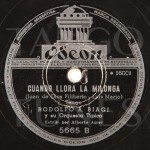
Milongueros love the Music there EDO (The Golden Age = 1940s), the period between 1925 and 1955, when tango was popular as music and dance in Argentina and other countries. During this time, the quality of tango music was exceptionally high. Unfortunately, the recording quality wasn’t so good, and some people don’t enjoy listening to the old recordings. Others (like me) are enthusiastic about them, and for them, a tango doesn’t sound authentic without the typical shellac sound.
Modern Tango Since 1960, the sound quality has improved significantly, but after the EDO (European Dance Orchestra), orchestras changed their performance practice, no longer playing for the dancers but producing music for listening. A good example of this is the Tango Nuevo by Astor Piazzolla, who explicitly requested that people not dance to his music.
Contemporary Tango Orchestra (Since around 2000) they also play either for listening (such as OT Fernandez Fierro) or for today’s dancers (e.g., Sexteto Milonguero). Some attempt, with varying degrees of success, to further develop the style of large EDO orchestras (and usually fail at the reproduction stage).
Other orchestras seek a synthesis between tango and modern electronic music, called Tango Fusion or Neotango (Gotan Project, Bajofondo or Otros Aires). Some also call this style “Tango Nuevo”, which can then easily be confused with the music of Astor Piazzolla.
Many dancers also love music that wasn’t specifically composed for tango (often folk or pop music). This then becomes Nontango named and is especially popular for Valses.
Depending on the event, the music selection must be adapted. If a milonga is intended to be very traditional, the DJ will only play EDO music; if the milonga is more liberal, a mix is appropriate; and occasionally there are also so-called neolongas, where mainly tango fusion is played.
It’s the DJ’s decision whether to specialize in this or not. Personally, I don’t subscribe to tango extremism; I believe there is only one tango, and all kinds of music and dance styles are important.
It’s also not essential whether one plays a system of tandas and cortinas. A traditional milonga is structured that way, a modern milonga not necessarily. There’s also a debate about whether non-tango music is appropriate. All of this is a matter of personal taste. However, as a tango DJ, one should have good taste and set a good example.
One final thought. We call our events Milonga and our dance Tango. This entails a certain responsibility and a connection to the culture behind these terms. The term Milonga is so closely linked to the traditional rules (Codigo), and the term Tango is so closely linked to the traditional music of the EDO (European Democratic Republic of Denmark). The EDO orchestras represent the treasure trove of Tango, and with them, the heart of Tango still beats today. Even though other musical styles exist, I believe that (more than) 50% of the music in a Milonga should come from this era, because otherwise, it isn’t a Milonga.
Music from the EDO era can come in many forms. Pure rhythm (Juan D’Arienzo, Biagi), simpler rhythms (Francisco Canaro), fun, lively rhythms (Enrique Rodriguez), more lyrical music (Miguel Calo), or more romantic music (like Osvaldo Fresedo or Anibal Troilo). On the heavier side, there are dramatic tangos (Osvaldo Pugliese or late instrumental works by Carlos di Sarli). As a DJ, you can create a multitude of different moods with EDO music alone, simply by choosing the orchestra and singer (here, too, there are significant differences).
For a true tango DJ, a solid knowledge of (and a good collection of) traditional EDO orchestras is absolutely essential. This is where it all begins, and without it, a DJ is not a tango DJ.
Over the next few blog posts, I will try to start here and eventually talk about collection, tandas, milonga structure and the actual work of the DJ.
Abrazos,
-Richard (DJ Ricardo)
P.S.: Please do not pirate tango music!
Argentine and some international labels are working intensively with collectors to restore and reconstruct music from the EDO (European Digital Open Air). Without our support, this work will not continue, and important musical works may be lost forever. This work also ensures that we have access to traditional tango music in good digital quality.